A search for UV printing in Encino is usually one of two questions wearing the same words. Either someone has a sign, a lobby panel or a suite number in mind and wants to know what it gets printed on, or someone has seen a business card with raised, glossy lettering and wants that. Both are UV work, and they run on the same principle, but almost nothing else about them is the same.
We do UV printing at the shop in Sun Valley, about ten minutes up Balboa from Ventura Boulevard, and a good share of it goes out to Encino — Ventura Blvd storefronts, medical and dental suites, law and wealth-management offices, real estate teams, gyms and med spas. This is the conversation we have with people before anything gets scheduled on the flatbed.
The ink dries before the head moves on
Conventional printing puts down a liquid that has to evaporate or soak into paper. UV printing puts down a resin that does not dry at all — it cures. Ultraviolet lamps ride alongside the print head and harden the ink the moment it lands, in a fraction of a second, so it never has time to spread, soak or wick.
Two consequences follow, and they are the whole reason the process exists. First, the material underneath does not need to absorb anything, so you can print on acrylic, aluminum, foam, PVC, wood, glass and metal — things paper ink has no way to stick to. Second, the cured ink sits slightly on top of the surface rather than in it, which means you can stack it: a layer of white, then color on top, then a clear varnish over that. That stacking is where most of the interesting work lives.
There is no drying rack and no offgassing period, so a panel comes off the bed ready to be trimmed, drilled or mounted. That matters less than people think for a single lobby sign and quite a lot for a set of twenty suite plaques that all have to be cut the same way.
White ink is the decision nobody knows they are making
On paper, white is just the paper. On a clear, brushed, black or wood-grain substrate, white is ink, and whether we lay it down changes the piece completely.
No white. Color goes straight onto the material and the material shows through. On brushed aluminum, a red becomes a metallic red. On clear acrylic, everything is translucent. Sometimes this is exactly the effect you want, and sometimes it is a logo that has quietly gone the wrong color.
White underneath. We print an opaque white layer first, in the shape of your artwork, then the color on top of it. Your brand blue stays your brand blue no matter what it is sitting on. This is the default for anything with a logo that has to match something else.
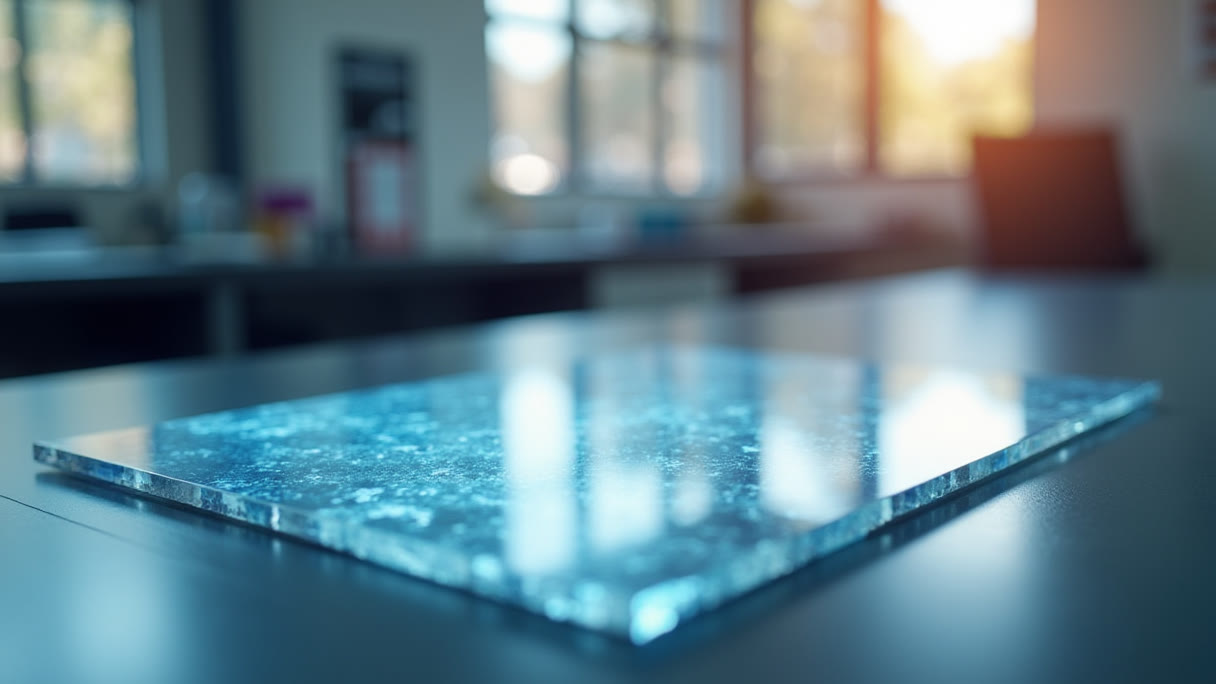
White on top, printed second-surface. For clear acrylic we can print the artwork mirrored on the back of the sheet, white last, so you view the graphic through the acrylic face. The thickness gives the image depth, the gloss is glass-like, and the ink layer is protected by the panel itself instead of being exposed to fingers and cleaning spray. For a lobby panel that people walk past every day, this is usually the better build.
Tell us which one you are after, or send a photo of a reference piece. It is far easier to settle in the file than to argue about after a sheet is cut.
Picking the panel
Three materials cover most of what Encino orders, and the choice is mainly about where the piece lives and how long it needs to hold up.
[Acrylic printing](/products/acrylic-sign-printing-510), from $90. This is the interior piece with presence — reception walls, conference rooms, menu and price boards, the panel behind the counter, framed graphics in a hallway. Acrylic holds saturation and gloss that a matte outdoor panel is not trying to compete with, and standing it off the wall on barrels throws a shadow that reads as permanent. It is not the material for full sun on Ventura; it is the material for the wall people stand in front of.
[Dibond aluminum](/products/dibond-aluminum-196), from $37.42. Aluminum composite: two thin aluminum skins bonded to a solid core. It is dead flat, it stays flat, and it does not swell, curl or delaminate in weather the way a laminated board will. This is the exterior panel — building and storefront signage, parking and directional signs, wayfinding, monument faces, anything screwed to a wall outdoors. It is also the right answer indoors when a panel is large enough that anything lighter would ripple.
[Foam board](/products/foam-board-194), from $28.30. Foam core between two paper liners: light, cheap, easy to cut to shape, and strictly indoor and short-term. Open-house boards, event signage, presentation and pitch boards, trade-show graphics, a listing display on an easel. It dents if you lean a chair against it and the corners go soft if it lives in a car. Buy it for the month you need it, not for the year.
If you are weighing these against each other for a specific address, the UV printing page for Encino lays out what we run locally.
Raised spot UV is the same cure doing a different job
The other thing people mean by UV printing is the tactile finish on a business card. Here the UV-cured resin is not carrying color at all — it is clear varnish, built up in layers only where you want it, so the shape stands up off the card and you feel it before you read it.
Raised spot UV business cards start at $64.67, and the default run of 50 works out to $1.29 each. That is the run realtors and attorneys around Encino usually start with, because 50 cards handed to the right people beats 500 in a drawer.
The finish works by contrast. Gloss raised against a matte or uncoated field is dramatic; gloss raised against an already-glossy card is invisible. So apply it to the logo, a rule, the name — not to the whole face. Thin serifs and type under about 8 pt do not gain much from being raised and can fill in, while a solid mark, a monogram or a heavy sans headline gains a lot. And because the varnish is a separate pass, keep it away from folds and from the extreme edge of the card.
What to send us
Vector artwork, built at final size, fonts converted to outlines, bleed all round. Build color in CMYK, not RGB — a screen green that does not exist in ink will come back as the nearest thing that does, and it is better to choose that yourself.
If your job needs white ink, put the white on its own layer, filled with a spot color swatch actually named White, set to overprint. If the piece is being cut to a shape, put the cut line on its own layer as a single closed path — no double lines, no stray anchor points.
Resolution depends on viewing distance, and the difference is larger than people expect. A card in someone's hand wants 300 ppi at final size. A building sign read from across a parking lot is fine at 100 to 150 ppi at full size, because nobody is inspecting it from a foot away. For raised spot UV, send a second file with the varnish areas as 100 percent solid black on white, same dimensions, same position.
If you are matching an existing sign, a paint color or a brand standard, say so up front and give us the reference. Device CMYK on acrylic and device CMYK on brushed aluminum are not the same-looking blue, and that is a thing to settle before the press, not after.
Sun, cleaning and how long it lasts
UV-cured ink is hard and scratch-resistant, which is why it survives being mounted, wiped and bumped. It is not immune to the Valley sun. Direct west-facing exposure will fade reds and magentas first, then yellows, while blacks, deep blues and greens hold on longest. We will not put a month count on a specific panel in a specific spot — a north-facing courtyard sign and a west-facing wall on Ventura are not the same job. Design with that in mind, keep the file on hand, and a replacement becomes a reorder rather than a redesign.
For cleaning, mild soap and water on a soft cloth. Solvent cleaners and paper towels are what actually wear down a printed acrylic panel, not time.
Angels Print prints acrylic, Dibond, foam board and raised spot UV work at 8511 Lankershim Blvd in Sun Valley, for Encino and the rest of the San Fernando Valley. If your file is ready, pick your material and size and order online. If you are still deciding whether a lobby panel should be acrylic or aluminum, whether your logo needs a white layer, or how much of a card the raised varnish should cover, call us at (818) 806-9006 or bring the artwork by the shop and we will work through it with you first.