

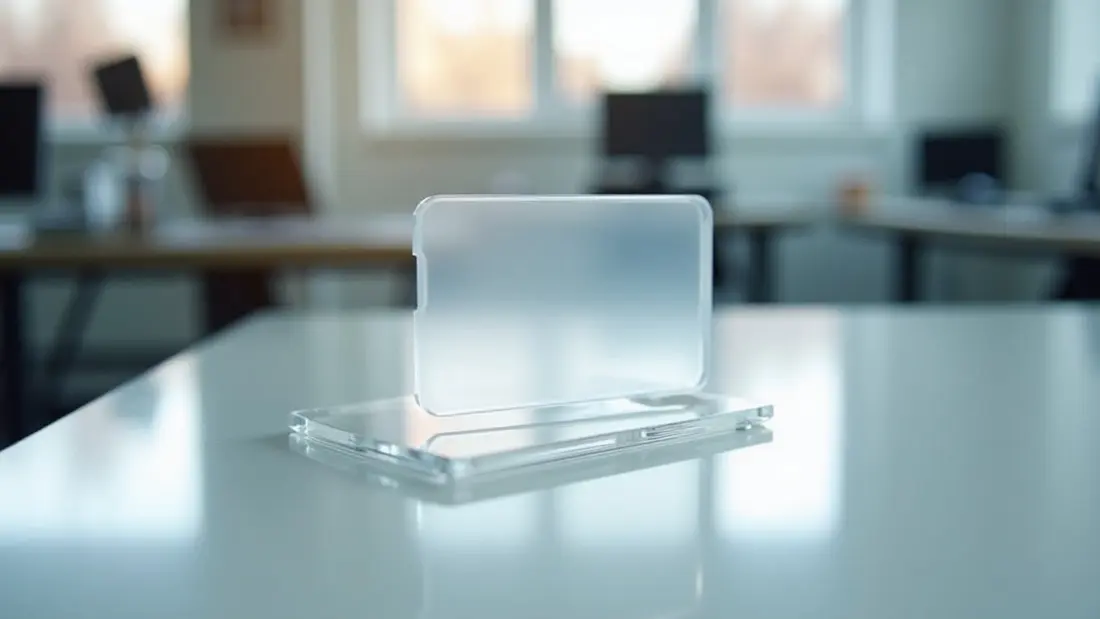
People searching for clear business cards are usually picturing one specific thing: a card you can hold up to the window and see through, with a logo floating in the middle of it. That card exists and we print it. What most people have not thought about yet is the part that decides whether it works — a transparent card has no background. Every design decision that paper makes for you, transparency hands back. Contrast depends on whatever is behind the card, which is a desk, a wallet, a palm, a dark jacket, a bar top. Ink that reads perfectly on your monitor can disappear against a black countertop. So the useful conversation is not "clear or not clear," it is which parts of the card stay transparent, which parts get backed with white, and what happens to the small text. This is how we work through it.
Clear, frosted and solid — three different cards, one material family
All three are plastic, and they behave the same way in a wallet: they do not soften, dog-ear, absorb coffee or come apart at the corner the way a coated paper card does. What separates them is how light passes through. Clear plastic business cards are fully transparent — window glass. Anything you leave unprinted shows the world behind it, which is the whole appeal and also the whole design problem. Frosted plastic business cards are translucent instead: a soft, milky surface that still passes light but diffuses it, so the card reads as its own object rather than a window. Frosted is the forgiving one. Type sits on it legibly without any special handling, edges catch light, and it photographs beautifully. If someone shows us a reference image they love and it has that ghosted, etched-glass look, they almost always mean frosted, not clear.
The third option is plastic business cards with a solid white base — same durable PVC stock, no transparency at all. People skip past it while shopping for something exotic, and then end up back at it once they see how much copy their card actually has to carry. A white plastic card prints exactly like a paper card, with full-color coverage and no contrast anxiety, and it still survives a year in a wallet. If the appeal of plastic for you is the material rather than the see-through effect, this is the honest pick, and it is the cheapest of the three at $84.10 for the default run of 50, or $1.68 a card.
White ink is what makes a clear card readable
On transparent stock, white is a printed color, not the absence of one. That single fact explains most of the surprises. Leave a white logo on a clear card without specifying white ink and it prints as nothing — you get a hole. Print dark text directly on clear plastic and it is legible on a light desk and invisible on a dark one. The fix is an underbase: a layer of white laid down under the artwork wherever you need it to hold its own color regardless of background. Full white underbase across the whole card gives you a card that looks essentially like the white plastic version, which defeats the purpose. Spot white — under the logo, under the type block, under a bar of color — is what actually produces the effect people want. Transparent negative space around a solidly backed logo, so the mark floats.
Practical version of that rule: decide what has to be readable on any background, back it with white, and let everything else be the window. Contact details, phone numbers and email addresses belong in the backed area. Ornament, pattern, an oversized outline of your mark, a die-line graphic — those can live in the clear.
Design rules that survive transparency
A few things go wrong often enough that we check for them on every clear job before it runs. Fine type is the first. Text under about 7pt on a transparent card is a gamble even with a white backing, because the eye has no field to rest against and the edges of the letters compete with whatever is behind the card. Go a point or two larger than you would on paper and add letterspacing. Hairline rules are the same story — anything under about half a point tends to visually break up.
Second, two-sided artwork shows through itself. On paper, the back of the card is a separate surface. On clear plastic it is not: a dense block of color on the back sits directly behind the front, so front and back have to be composed as one image. That is either a headache or the best thing about the format, depending on whether you planned for it. Offsetting the two sides deliberately — a logo on the front, a color field on the back positioned to sit behind it — is the single most effective trick this material offers, and it costs nothing.
Third, gradients that fade to nothing. A fade to white on clear stock is a fade to transparent, which changes the meaning of your artwork completely. If you want a fade to white, that fade has to be built in the white ink layer, not implied by leaving the artwork empty.
Fourth, writing on the card. Plastic is not paper — a ballpoint will bead up and smear. If people are going to write appointment times, table numbers or a name on these, either that area needs a receptive coating or the job wants a different stock. Sales teams that hand-write a direct line on the back of a card are the group most likely to be caught out by this.
What a run costs, and when the math makes sense
Both transparent options run $92.60 for 50 cards — $1.85 each — for either clear or frosted. That is a different order of magnitude from a paper card, and pretending otherwise helps nobody. What it buys is a card that does not get thrown away. The realistic way to use plastic is not as a replacement for your everyday stock but as a second tier: a box of 50 or 100 for the people you actually want to remember you — the architect at the site walk, the buyer at the trade show booth, the client signing the contract — while a paper run covers the counter dish and the community board.
That split is also a design decision. A card people keep can carry less information, because it is not doing the work of a flyer. Some of the strongest plastic cards we print have a name, one number and a logo, and use the remaining space as transparency.
Who these actually work for
Certain businesses get an outsized return here. Anything selling clarity, precision or a premium finish — glass and glazing, windows and doors, optometry, dental, detailing, photography, custom fabrication — gets a card that argues its own case before a word is read. Nightlife and hospitality use plastic because it survives a pocket at 2 a.m. Real estate agents and contractors use it because the card lives in a truck console for eight months. Frosted tends to suit design-led and professional services; full clear suits anyone whose logo is a strong single shape.
It works less well when the card has to carry a lot: a service list, five certifications, two addresses, a QR code and a map. That card wants a background. If you are looking at your current card and it is dense, the honest recommendation is white plastic for the durability, or a paper stock with a finish that does the heavy lifting. We would rather talk you into the right one than print a beautiful card nobody can read.
Before you send the file
Build the art at final size with bleed, keep anything critical well inside the trim, and supply the white layer as a clearly named spot channel rather than as a white-looking element in your color artwork — a white rectangle in CMYK is not white ink, it is nothing. Corners: plastic cards are commonly finished with a small radius, which suits the material and stops the corners from digging into a wallet. And check your card against a black surface, a wood desk and your own hand before approving it, because those are the three backgrounds it will actually be seen on. Print a paper mockup, cut it out, hold it up. It takes two minutes and catches the problems a proof on a bright screen hides.
Angels Print produces clear, frosted and solid plastic cards along with the rest of our business card printing from our shop at 8511 Lankershim Blvd in Sun Valley, for clients across the San Fernando Valley and greater Los Angeles. If you are unsure which of the three fits your artwork, send it over and we will tell you what the transparency is going to do to it.
Configure and order your cards online — clear, frosted or solid white plastic — call us at (818) 806-9006, or stop by the Lankershim shop and handle the stock in person before you commit a run to it.