

September 15, 2026
Digital Printing in Burbank: Short Runs, Variable Data and When Offset Still Wins
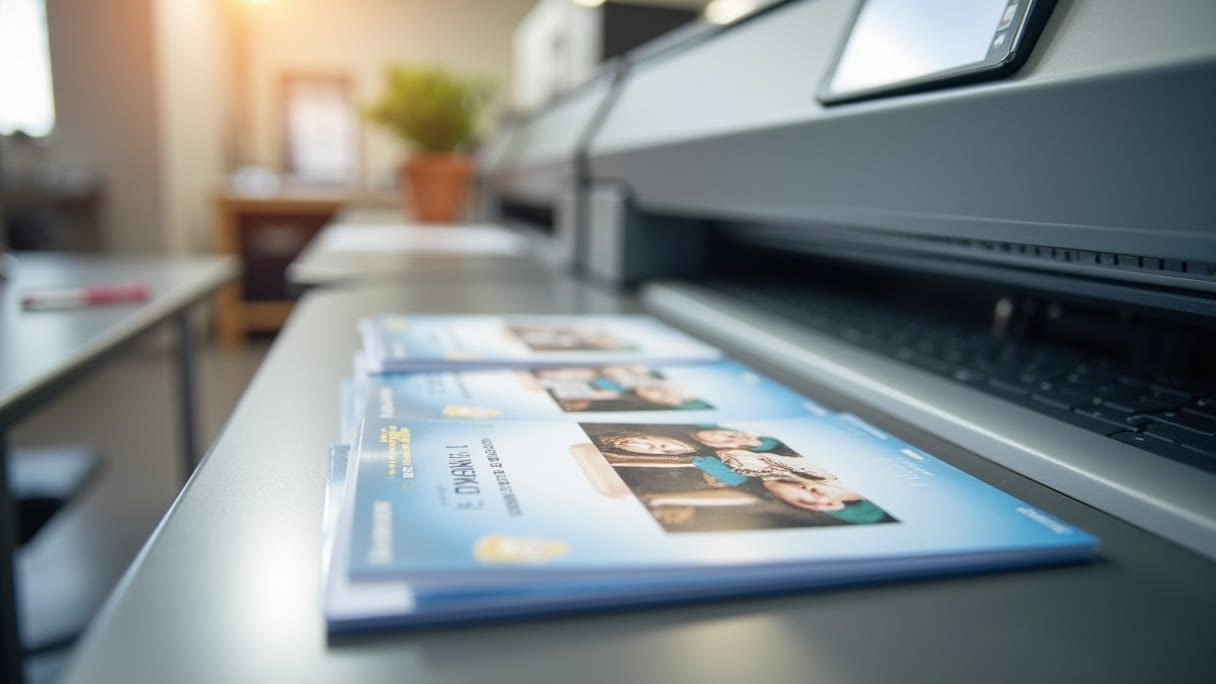
A lot of the printing Burbank actually buys is small. Two hundred postcards for an open house on Kenneth Road. Fifty business cards because someone joined the team on Monday. Twenty-five booklets for a pitch on Thursday. Those are not offset jobs, and the moment you ask for an offset quote on them the number stops making sense — you end up paying for setup you will never amortize, or buying five thousand of something you needed fifty of.
That shape of job is what digital printing exists for, and it is most of what moves through our shop on an ordinary day. We are at 8511 Lankershim Blvd in Sun Valley, on the other side of the 5 from Burbank. Below is how the economics work, where digital stops being the right answer, and what to send us so the first proof is the right one.
No plates, and that is the whole difference
Offset printing makes a physical plate for every ink — four for standard process color, more if you add a spot. Those plates get mounted, the press gets brought up to color, and a few hundred sheets of makeready go in the recycling before the first good one comes off. All of that happens before sheet number one of your actual order. It is a real cost and it does not care whether you ordered five hundred pieces or fifty thousand.
A digital press skips the plate entirely. The file goes to the machine and every sheet is imaged individually. Nothing has to be made first, so there is no setup cost to spread across the run — which means the price per piece is close to flat whether you order fifty or five hundred, and there is no penalty for a small order beyond the fact that small orders are small.
The flip side is that digital never gets dramatically cheaper as the run grows. Offset's per-piece cost falls the whole way up, because that fixed setup keeps dividing into a bigger number. Somewhere in the low thousands the two lines cross. Below the crossing, digital wins on price and wins by a lot. Above it, offset pulls ahead and keeps pulling. If you are ordering ten thousand of anything, ask about offset and mean it.
The reprint is worth more than the discount
The other thing plate-free printing buys you is permission to change your mind. Because there is no setup to redo, a corrected reprint next month costs about the same per piece as this month's run. That reframes the whole "should I order more to get the better price" question.
The classic Burbank version of this: a new business orders two thousand business cards to hit a price break, then moves suites, changes a phone number, adds a title, or rebrands eight months later. The cheap cards become expensive cards, because most of them go in a drawer and then in the trash. Classic business cards start at $25.70, and the default run of 50 works out to $0.51 each. Ordering a small stack, using it up, and reprinting when something changes is usually cheaper over two years than buying in bulk once.
Same logic applies to anything with a date, a price list, a staff roster, or a seasonal offer on it. Print what you will use before the information rots.
Variable data is the thing offset genuinely cannot do
Since every sheet is imaged from the file, every sheet can be different. That is not a gimmick — it is the one capability that has no offset equivalent at any run length.
Mailing. Names and addresses printed directly on the piece rather than on labels stuck over your design. Useful for a small, targeted list — past clients, a specific block, a single ZIP.
Numbering. Event tickets, raffle stubs, gift certificates, warranty cards and inventory tags that need sequential numbers, each one unique, no hand stamping.
Personalization. Name badges for a crew, appointment cards with the patient's next date, table cards where each one is a different table.
If your job has anything unique per piece, say so before we start rather than after, because it changes how the file needs to be built — you send the artwork plus a clean data file, not fifty separate PDFs.
What Burbank orders most
The city has a particular mix of businesses and it shows in the work. Media and production companies need short, precise runs — decks, boards, badges, signage for a stage door — and they need them in quantities that match a crew, not a mailing list. Magnolia Park boutiques order small, frequent, seasonal pieces. Real estate agents work a market where a single listing justifies its own printed run. And there is a whole layer of medical, dental and professional offices near Buena Vista and along Olive that runs on forms, cards and appointment reminders.
Postcards start at $35.61, with 50 pieces coming to $0.71 each. They do more work per dollar than almost anything else we print because they get read without being opened. Open houses, a new location, a grand reopening, a service reminder, a lapsed-customer nudge. If you are mailing, build the address side around the postal clear zone and check size and thickness requirements with USPS before you commit to a shape — a postcard that misses the standard rate costs more to mail than to print.
Rack cards start at $51.71, 50 pieces at $1.03 each. These earn their keep in Burbank specifically because of the hotel corridor near the airport and the visitor traffic through Downtown. They sit in a display where only the top few inches are visible, so put the name and the offer up there and treat the rest of the card as detail for someone who has already picked it up.
Saddle stitch booklets start at $68.85, with 25 copies at $2.75 each. Line sheets, program books, capability decks, small catalogs, menus with real page counts. Two rules before you design one: the total page count has to be a multiple of four, because each folded sheet makes four pages, and on thicker booklets the inner pages creep outward toward the trim edge as the fold thickens — so keep page numbers and anything critical well away from the outside margin.
Color: what to expect, and what not to
Digital color is very good and very consistent, but it is not offset and it is not your monitor. Two honest expectations.
Your screen is lit, paper is not. A backlit display shows saturated blues, greens and oranges that no CMYK process can reproduce on a sheet. Bright royal blue and vivid orange are the two that surprise people most often. If a brand color has to match exactly across everything you print, tell us and we will talk about it up front rather than after a proof.
Large flat solids are the hard case. Big areas of one heavy color are where any digital press is most likely to show slight variation across a sheet or between sheets. It is usually invisible on a business card and very visible on a full-bleed solid background across a booklet cover. Designs that break up large solids, or use them at lighter coverage, come back cleaner.
Coated stock gives you the punchiest color and the sharpest detail. Uncoated is softer and absorbs more, so ink looks a shade duller — which is often exactly the look people want, but decide it deliberately instead of being surprised.
Files
Build in CMYK, not RGB. Convert before you export rather than letting the conversion happen somewhere in the pipeline where you cannot see it. Keep total ink coverage at or below 260% — that is the four percentages added together — and build rich black as a mix rather than four channels at 100%, which is too much ink for the sheet to hold and will offset onto the back of the next piece.
Export a press-ready PDF with fonts embedded or outlined. Include 0.125 inch of bleed on any edge where color runs off, and keep text and logos at least 0.125 inch inside the trim. Raster images at 300 ppi at final size. Give us dimensions in inches, flat and folded, and tell us which side is the front.
One last thing worth checking before you send: heavy coated stock can crack along a fold if it is not scored first. If your piece folds, say so, and we will handle it as a folded piece rather than a flat one.
Angels Print runs digital printing for business cards, postcards, rack cards and booklets at 8511 Lankershim Blvd in Sun Valley, for businesses across Burbank and the San Fernando Valley. If your file is ready, pick your size and quantity and order online — our digital printing in Burbank page has the options in one place. If you are still deciding between digital and offset, working out a page count, or unsure whether your artwork will hold up at final size, call us at (818) 806-9006 or bring the file into the shop and we will look at it with you first.