

September 10, 2026
Uncoated Business Cards in Los Angeles: What Happens When Ink Meets Paper Instead of Plastic
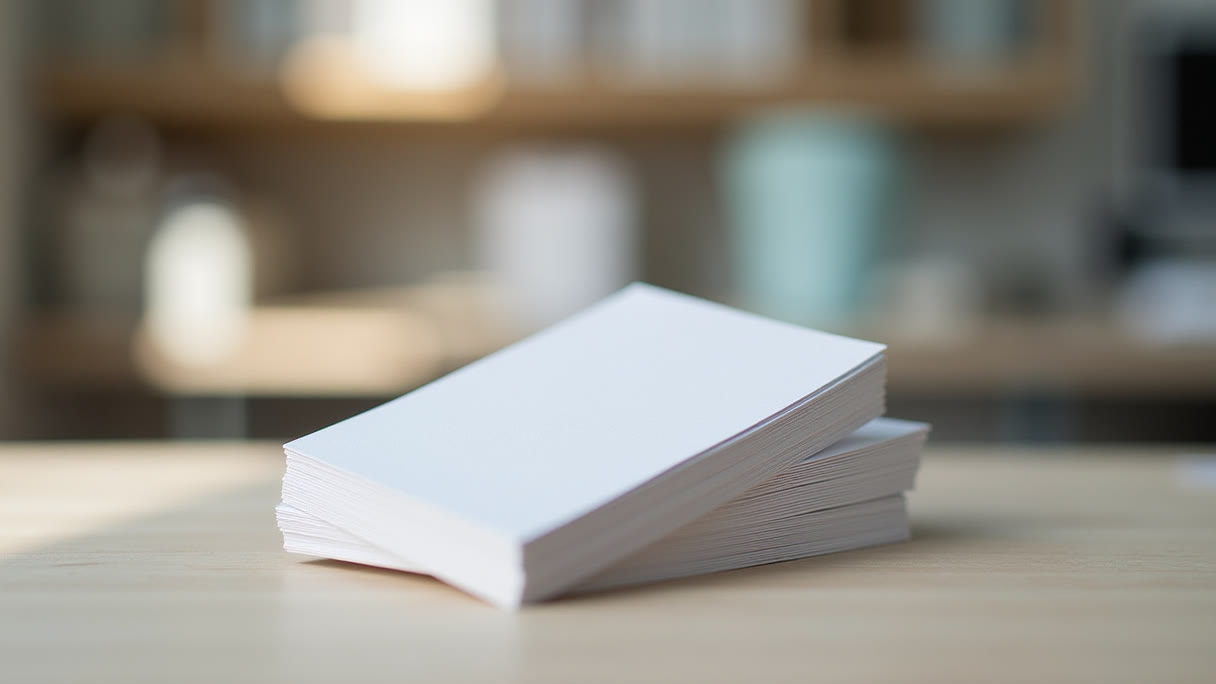
There is a moment at almost every meeting where somebody takes a card, turns it over and tries to write a name or a date on the back. On a glossy card the pen skates, the ink beads up, and the note smears onto the next card in the stack. On an uncoated card the pen just works. That single difference is why a lot of people come to us asking specifically for uncoated business cards, and it is worth understanding what else changes when you make that choice.
We print uncoated business cards at the shop on Lankershim in Sun Valley for people all over the San Fernando Valley and greater LA. They start at $24.35, and the default run in the configurator is 50 pieces at $0.49 each, so you can order a small batch before committing to a box of a thousand. Here is what we go over with people before the job goes on press.
What uncoated actually means
Coated paper has a mineral layer sitting on top of the fibers. That layer is the point: it stops the ink from sinking in, so the ink dries on the surface, sits in a thin bright film and reflects light back at you. It is why a coated card looks sharp and saturated, and why a fingerprint shows up on a gloss finish like a signature.
Uncoated paper has no such layer. The ink lands on bare fiber and part of it wicks down into the sheet before it dries. Everything you notice about an uncoated card comes out of that one mechanical fact — the way it feels, the way it takes a pen, the way the colors read, and the way fine detail behaves.
So this is not a coating you add or leave off at the end. It is a different sheet of paper, chosen at the start, and the artwork should be built with it in mind.
Your colors will come out quieter
This is the part that surprises people, and it is the reason we would rather have this conversation before the run than after.
Saturation drops. Ink that has partly soaked into the fiber cannot reflect as much light as ink sitting on a slick surface. A red that looked electric on your monitor and on the coated sample in your other hand will read as a calmer, deeper red on uncoated. Not wrong — just quieter. If your brand lives on one very loud color, know that going in.
Contrast softens. Blacks read closer to a very dark charcoal than to piano-lacquer black. On an uncoated sheet that usually looks intentional and expensive. On a design that depends on stark black-and-white punch, it can look like the press was tired.
Heavy coverage is the risk area. A card that is one solid dark field edge to edge is asking a lot of an uncoated sheet — it soaks up a great deal of ink over a large area, and that is where you are most likely to see a difference between the screen and the object in your hand. We build in device CMYK and keep total ink coverage in check for exactly this reason. If your design is a full-bleed dark background with reversed white type, tell us and we will look at the file before we commit a full run.
The practical move: design one step more saturated than you want the result to be, keep type in weights that survive a slight softening, and if color accuracy is critical, order the 50-piece run first and look at it in daylight.
Fine detail and hairlines
Because ink spreads slightly into the fiber, very fine elements gain a hair of weight. Hairline rules, six-point type, a logo with delicate serifs, thin white lines reversed out of a dark block — all of these are less forgiving on uncoated than on coated stock.
Reversed type is the specific one to watch. White text sitting inside a heavy dark field is being defined by ink creeping in from all four sides of every letter, so a delicate light-weight font can lose its counters and start to fill in. Bump the weight, bump the size, or put the type on a light background instead. Dark type on a light background is where uncoated is at its best.
The writing test, and who it matters for
If people are going to write on your card, uncoated is not a preference, it is a requirement. Ballpoint, gel pen, fountain pen and rubber stamp all behave properly on an uncoated surface because the ink has somewhere to go.
That covers more businesses than you would think. Anybody who writes an appointment on the back. Anybody who notes a quote or a price. Contractors writing a measurement at a job site. Stylists writing the next booking. Anyone who signs a card as a personal gesture. Coffee shops and barbers running a punch card or a stamp loyalty scheme need it too — a rubber stamp on a gloss card sits wet on the surface and transfers to whatever it touches next.
There is also a texture argument. Uncoated has grain you can feel with your thumb, and people register that as substantial. Coated is smooth and slick and reads as commercial. Neither is better; they say different things about the business handing them over.
Where uncoated is the wrong call
Photography. If the front of your card is a photograph — a property, a plate of food, a portrait — you are giving up real punch by going uncoated. Photos want the surface a coated sheet gives them.
Dirty environments. No coating means no barrier. A card that lives loose in a toolbag, a glovebox or an apron pocket picks up grime, and it stays picked up. A wallet-and-desk card is fine; a job-site card is not.
Rain. Uncoated absorbs water as readily as it absorbs ink. If the card is going to be handed over outdoors in February, plan for that.
If any of those apply, the coated version is classic business cards, starting at $25.70 with 50 pieces at $0.51 each — a dollar more than the uncoated run, and a completely different surface. Plenty of people order both: uncoated for meetings and networking, coated for the counter display and the mailer.
When the card should not be paper at all
Two other options come up in the same conversation, and they solve different problems.
[Clear plastic business cards](/products/clear-plastic-business-cards-835) start at $92.60, 50 pieces at $1.85 each. This is the opposite end of the material spectrum from uncoated — non-absorbent, waterproof, see-through, and impossible to write on with a normal pen. They get kept because they are unusual, and they survive things paper does not. Design for them with restraint: whatever is not printed is a window.
[Die cut business cards](/products/die-cut-business-cards-419) start at $129.14, with a default run of 100 pieces at $1.29 each. Here you are buying shape rather than surface — a rounded corner, a cut silhouette, a card that does not sit flush in a stack of rectangles. If the goal is for your card not to disappear in someone's desk drawer, shape does more work than finish does.
What to send us
Vector artwork with the fonts outlined, built at final trim size, with bleed all round on any element that runs off the edge, and critical content — type, logo, phone number — pulled well inside the trim. Cards are cut in stacks, and a small amount of movement through the cut is normal, so anything sitting tight to the edge is gambling.
Build in CMYK rather than RGB. A color picked in RGB on a backlit screen has no equivalent on paper, and on uncoated stock the gap is wider than usual. If you have a specific brand color you need to land, say so and bring a printed reference rather than a screenshot.
Uncoated cards are ordinary digital printing work for us, and if you want to see the range of stocks and finishes side by side before deciding, that is what the business card printing page lays out.
Angels Print prints uncoated, coated, plastic and die cut business cards at 8511 Lankershim Blvd in Sun Valley. If your file is ready, set your options and order online — the 50-piece run exists precisely so you can hold the result before you buy a thousand. If you are not sure whether your design survives an uncoated sheet, or you want to feel the stocks against each other before choosing, call us at (818) 806-9006 or bring the file into the shop and we will go through it with you.