

September 9, 2026
Tear Off Rip Cards in Los Angeles: Where to Put the Perforation and Why It Decides Everything
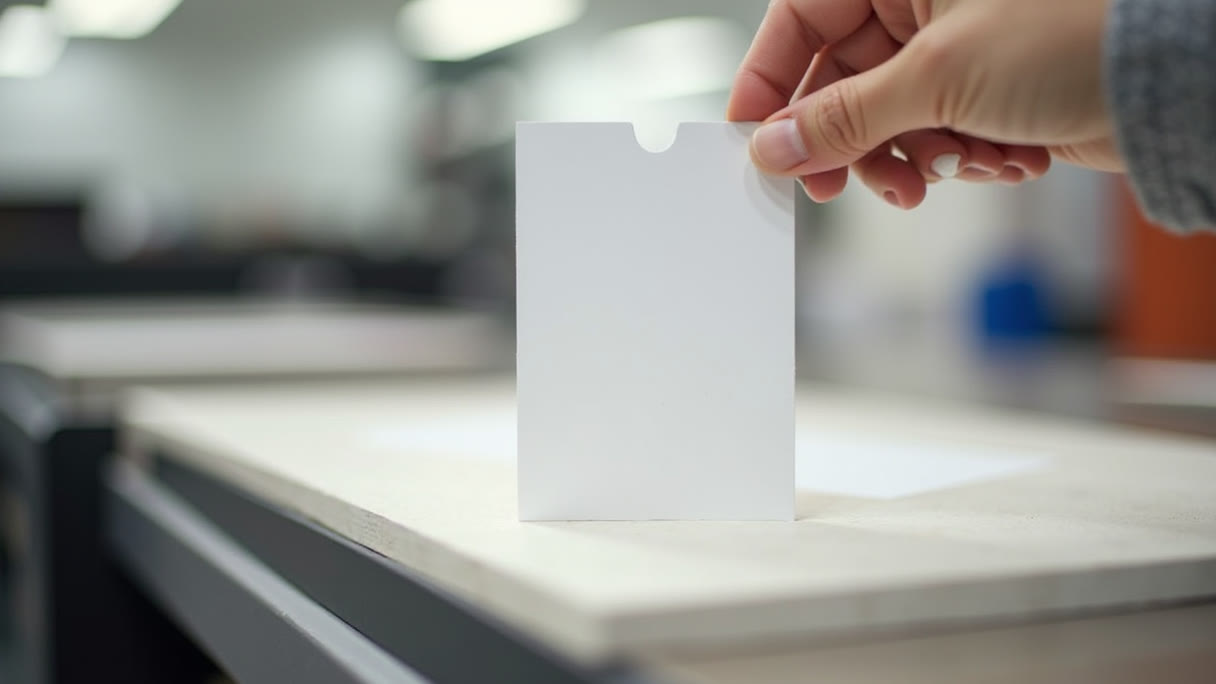
Walk into a laundromat on Sherman Way and look at the corkboard. Half the sheets pinned there have a fringe of tabs at the bottom, and you can read the whole story from across the room: the ones with tabs missing are working, the ones with a full untouched fringe are not. That fringe is the entire product. A tear off rip card is a piece of print whose success is measured by how much of it gets destroyed.
We print rip cards at the shop on Lankershim for gyms, tutors, movers, detailers, dog walkers, leasing offices and restaurants across the San Fernando Valley and greater Los Angeles. The format is cheap and it is unusually easy to get wrong, because almost everything that matters is decided by one line you cannot see in the mockup — where the perforation goes.
What you are actually ordering
Our tear off rip cards start at $37.30, with the default run at 50 pieces — $0.75 each. You pick size, stock and quantity in the configurator, and you tell us where the perforation sits.
Two different things get called rip cards and it is worth knowing which one you want before you open a design file.
The tab flyer. A larger sheet with a row of narrow tabs perforated along the bottom edge, each tab carrying your name and phone number. This is the corkboard and pole version. The parent sheet stays up and does the selling; the tab is the takeaway.
The two-part card. One card, one perforation across it, usually splitting a larger portion from a business-card-sized or coupon-sized piece. You hand the whole thing over; the recipient tears off the part they keep and drops the rest. This is what goes in a bag with an order, gets handed out at a Valley street fair, or sits on a restaurant counter.
The tab flyer is a distribution tool. The two-part card is a handoff tool. They fail for different reasons and they get designed differently, so decide first.
The torn-off piece has to work alone
This is the rule almost everybody breaks. Once the perforation does its job, the small piece is on its own in a pocket, a wallet or a car door bin, and it has no memory of the sheet it came from.
So the tab or the coupon needs, by itself: who you are, what you do in three or four words, and one way to reach you. If your tabs say only a phone number, somebody finds them a week later and has no idea whose number it is. If your coupon says 20% OFF and nothing else, it is a scrap of paper.
And the parent piece has to work after it has been eaten. On a tab flyer, once six tabs are gone the bottom edge is ragged and uneven — that is fine and expected, but do not run any part of your headline, your logo or a border into that zone, because it will be missing at exactly the moment the flyer is proving it works.
Where the perforation goes, and what it costs you
Perforation is a mechanical pass and it drifts a little, the same way cutting does. On any press anywhere, a fraction of a millimetre of movement across a stack is normal. Design as though the perf line has a tolerance and you will never notice it; design as though it lands on a specific pixel and you will.
Keep type an eighth of an inch clear of the perf on both sides. Text that runs right up to the tear line comes back looking like it was chewed, even when the perf landed perfectly.
Never run a QR code or a barcode across a perforation. It sounds obvious written down. It is the single most common file we send back. If the takeaway piece needs a scannable code, the code lives entirely inside the takeaway piece with its quiet margin intact.
Watch the grain. Paper tears cleanly along the grain and raggedly across it. That is physics, not preference — tell us the perf orientation you want and we will lay it out with the grain rather than fighting it.
Do not perforate too close to the edge. A tab narrower than about half an inch is fiddly to grab and tends to tear diagonally in the hand. Wide enough to pinch is the whole test.
Stock: heavier is not better here
On most jobs we push people toward more weight in the hand. Rip cards are the exception, and it is the only product where we regularly talk somebody down a stock.
Too heavy and the tear resists; people pull, the sheet comes off the board, and the tab tears crooked or takes a chunk of the parent with it. Too light and it tears too eagerly — it dog-ears in a bag, and a tab flyer starts shedding tabs on its own before anyone has touched it. Something in the middle, in the card range rather than the poster range, is the right answer for nearly every rip card we run.
Finish matters for one specific reason: uncoated stock takes a pen. If a receptionist writes an appointment time on the takeaway, or a trainer writes a class slot, or you write a quote figure on the coupon before you hand it over, a glossy coat makes that a smeared mess. Uncoated is also slightly friendlier to tear. Coated looks richer and survives a rainy week outdoors better. Pick for the job, not for the mockup.
Why the coupon usually fails
Rip cards are mostly used to carry an offer, and the offer is where the money leaks.
No expiry means no urgency. A tab with no date on it is a bookmark, not a reason to call this week. Put a real date on it, and be willing to honour it.
One offer, not three. The takeaway piece is roughly business-card sized. It holds one idea. A tiered menu of discounts turns into unreadable six-point type and gets thrown away at the register.
Make redemption physical. The reason to use a rip card instead of a text message is that the paper comes back. If the customer has to hand over the torn piece to get the discount, you can count them, and you finally know whether the corkboard at the gym on Vineland is worth the drive.
When a rip card is the wrong tool
Sometimes the request behind "rip cards" is really something else.
If the thing you are giving away has value on its face — a gift amount, a course completion, an award, a prepaid service — print a certificate instead. From $74, 50 pieces at $1.48 each. A certificate is designed to be kept whole and displayed or presented; tearing it in half destroys the point of it.
If the goal is purely keep my number where you will see it, the honest competitor to a rip card is the fridge. Circle and oval magnets start at $130.63, with 100 pieces as the default run — $1.31 each. That is more per piece, but a magnet stays visible for years, while a torn tab goes into a pocket and through the wash. Plumbers, HVAC techs and locksmiths who tried both usually end up on magnets.
If you are mailing rather than posting, die cut postcards — from $178.94, 50 pieces at $3.58 each — do the interruption job better. A shaped card survives a mail pile; a perforated one arrives looking like it was damaged in transit.
And if the story you need to tell is longer than one panel, you do not want a card at all — that is brochure printing, and it holds the detail a tab never will.
What to send us
Vector artwork with the fonts outlined, built at final size, an eighth of an inch of bleed all round, CMYK rather than RGB, and any photographs at 300 ppi at print size. Mark the perforation as a clearly labelled line on its own layer, or just tell us in plain words — perf three quarters of an inch from the bottom, tabs every inch — and we will set it. Short runs go through the same digital printing presses we run everything else on, which is why fifty is a sensible quantity to start with.
One last practical note on distribution: check with whoever owns the wall. Cafés, gyms, laundromats and libraries across the Valley have boards that are genuinely open to local businesses, but a flyer taped where it is not wanted comes down the same afternoon and takes your fifty tabs with it. Ask, and it stays up for a month.
Angels Print prints tear off rip cards, certificates, magnets and postcards at 8511 Lankershim Blvd in Sun Valley, for businesses across the San Fernando Valley and greater Los Angeles. If your file is ready, pick your size, stock and quantity and order online. If you are not sure where the perforation should land, or you want to hold the stock and try tearing it before you commit to five hundred, call us at (818) 806-9006 or bring the artwork into the shop and we will work it out at the counter.