

September 12, 2026
UV Printing in Reseda: What the Process Actually Does, and When to Use It
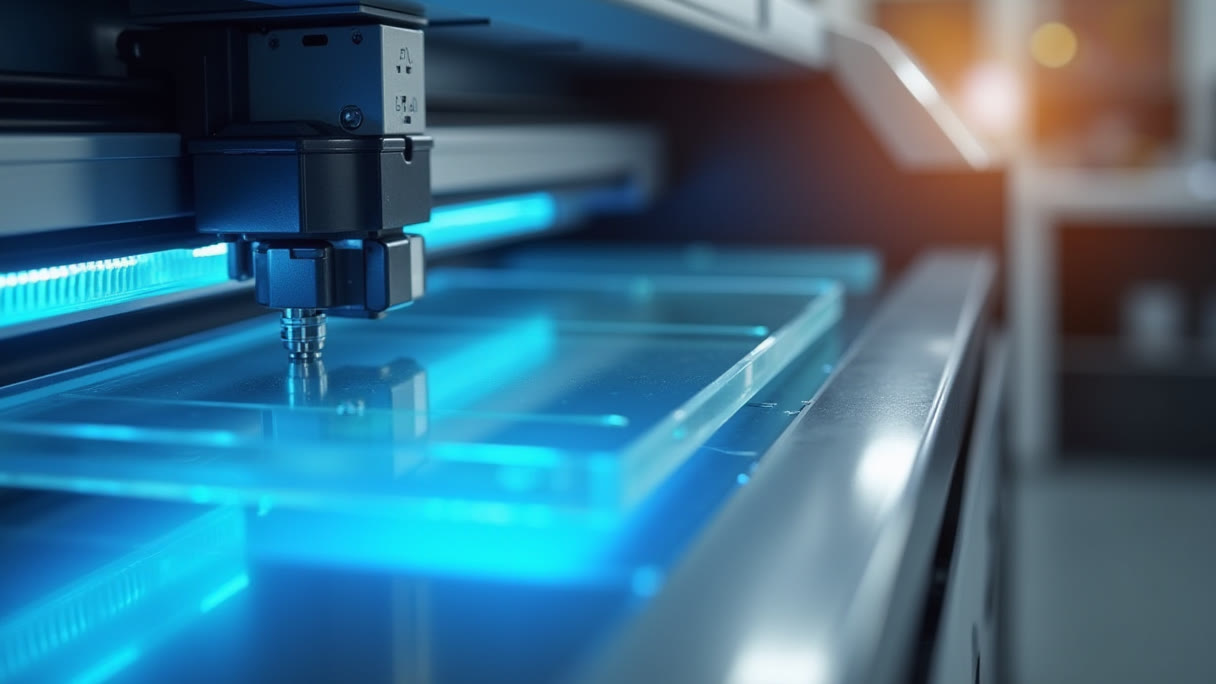
When somebody in Reseda asks us about UV printing, they usually have one of two very different jobs in mind. Either they want a hard panel — an acrylic sign for a lobby on Sherman Way, an aluminum plate for a shop front on Reseda Blvd, a board for a clinic waiting room — printed directly, with no laminate and no visible seam. Or they have seen a business card where the logo is glossy and slightly raised above the stock, and they want that. Both are UV work, and they are the same idea at different scales, but almost nothing else about them overlaps.
We do UV printing at the shop in Sun Valley, a straight run east from Reseda along Sherman Way, and we print for businesses across the west Valley all week. This is the explanation we end up giving on the phone, written down once.
What the UV in UV printing refers to
It is not the artwork and it is not the finish. It is how the ink dries. Conventional ink dries by soaking into paper or by evaporating solvent, which is why it needs paper that will absorb it and time to sit. UV ink dries under a lamp in the print head's own travel: the ink is laid down, the lamp passes over it a fraction of a second later, and the liquid cures into a solid film on the spot.
Two consequences follow from that, and everything else about the process is downstream of them. First, the ink never has to be absorbed by anything, so the material does not have to be porous. Acrylic, aluminum composite, PVC, coated board, glass, wood — a surface that would reject ordinary ink entirely takes UV ink fine. Second, because the ink cures where it lands instead of spreading into fibres, fine detail stays where you put it. Six-point type and hairline rules hold on a rigid panel in a way they do not on absorbent stock.
The cured ink also sits slightly above the surface rather than in it. On a normal print you will never notice. Lay down several passes of the same white or clear in the same place and the height becomes something you can feel with a fingertip, which is the whole basis of raised and textured UV work.
Direct-to-substrate versus print-and-mount
The old way to get a graphic onto a rigid panel is to print it on vinyl or paper, then glue that sheet to the board. It still has its uses. But a directly printed panel has no film on it, which means no edge to lift at the corners, no bubbles, no silvering where the adhesive did not wet out, and no laminate going cloudy after a couple of summers facing a parking lot.
It also means the material shows through. On brushed aluminum, on a warm wood panel, on clear acrylic, the substrate is part of the finished thing instead of something hidden under a sheet of white vinyl. If you chose a material because of how it looks, direct printing is the only way you actually get to keep that choice.
Where mounting still wins is on very large format, on curved or contoured surfaces, and when the graphic is meant to be replaceable — a seasonal panel in a frame gets swapped more cheaply as a printed sheet than as a new board.
White ink is the part people do not expect
On paper, white is the paper. On a clear or dark substrate there is no white unless the press prints it, and UV printing does print it, as its own ink, on its own pass.
That turns into a real decision you have to make before layout. On clear acrylic, a design with no white behind it is transparent — whatever is on the wall behind shows through your logo. Print white behind the color and the artwork reads as solid and opaque. Leave selected areas white-free on purpose and you get a window effect, part of the panel see-through and part of it solid, which is one of the better tricks the process offers.
On dark or metallic substrates, color printed straight onto the surface goes muddy, because the substrate is showing through the ink. A white underbase first, then color on top, gives you the color you designed. Skip it and a bright red on black aluminum comes out as a dull brick.
There is also second-surface printing on clear acrylic: the artwork goes on the back of the sheet, mirrored, so you view it through the thickness of the material. The acrylic itself then protects the ink, and the graphic picks up a depth and gloss you cannot fake from the front. If the panel is going somewhere it will get touched — a counter, a door, a corridor at shoulder height — second surface is usually the right call, and it needs the file set up mirrored, which is a thing to decide early and not after.
Picking the panel
Most of what gets printed for Reseda storefronts and offices lands on one of three materials, and the choice is mostly about where the panel lives and how permanent it needs to look.
[Acrylic printing](/products/acrylic-sign-printing-510) starts at $90 and is the indoor-premium answer: lobby signs, office identity panels, menu boards, art panels. The thickness of the sheet and the shadow it throws off standoffs are doing as much work as the print is. It is what reads as installed rather than stuck up.
[Dibond aluminum](/products/dibond-aluminum-196) starts at $37.42 and is aluminum composite — two thin aluminum skins around a solid polyethylene core. It is rigid, flat, it will not warp the way a plastic sheet does in Valley heat, and it is the standard choice for exterior building signage, parking and directional panels, and anything that has to stay flat across a wide span. If you are putting a sign on the front of a building on Vanowen or Victory and want it to still be flat in two years, this is the material.
[Foam board](/products/foam-board-194) starts at $28.30 and is the opposite bet: light, cheap, indoor, short-term. Event signage, presentation boards, real-estate displays, a CSUN project, something that has to be carried in under one arm and stood on an easel. It dents if you lean on it and it is not an outdoor material. For what it is for, nothing beats the price.
Raised spot UV at business-card scale
The same ink-stacking that gives a panel texture is what makes [raised spot UV business cards](/products/raised-spot-uv-cards-184), from $64.67 for the default run of 50 at $1.29 each. A clear UV layer is printed only over the elements you choose, then built up in passes, so your logo, a monogram, a rule, a pattern stands physically above a matte card and catches light against it.
The design rule is restraint, and it is the one thing people get wrong. Spot UV works by contrast: a small amount of gloss against a large matte field. Flood the whole card and there is nothing for the eye to catch on. It also wants weight — a thin hairline holds much less clear than a solid shape does, so a logo with real mass in it rewards the process far more than a delicate one. And hand us the spot layer as its own file, pure black on white, exactly registered to the artwork, rather than asking us to guess which parts of the design you meant.
Sun, heat and the west Valley
Cured UV ink is a hard film and it handles abrasion and weather well, but the sun here is the sun here. Direct exposure fades the warm end of the spectrum first — reds and magentas, then yellows — while blacks, deep blues and greens hold much longer. A design built on a hot red field will visibly shift over a summer in a way that the same design on a dark blue field will not.
Heat matters for the substrate more than for the ink. An unbacked plastic sheet in full west-facing afternoon sun will bow; an aluminum composite panel will not. If the sign faces the afternoon and has to stay flat, that is a material decision, not a printing one, and it is worth making before the file is built.
Files
Build at final size in inches, in CMYK, with fonts outlined and bleed all round. Keep total ink coverage under 260 percent — heavy four-color blacks on a non-absorbent surface cure worse and look worse than a properly built rich black. Send vector wherever the artwork is vector; that is where UV printing's fine detail pays off.
For photographic content, resolution depends on viewing distance, not on the material. A building panel read from a traffic lane is fine at 100 to 150 ppi at full size. An acrylic panel behind a reception desk that people stand eighteen inches from wants 200 to 300. And any job with white ink or a raised layer needs those as separate, clearly labelled layers or files — white underbase, clear spot layer, and the color artwork they register to.
Angels Print is at 8511 Lankershim Blvd in Sun Valley, printing acrylic, aluminum, board and raised spot UV work for Reseda and the rest of the San Fernando Valley. If your artwork is ready, pick your size and quantity and order online, or start from our UV printing in Reseda page. If you are still deciding between a printed panel and a mounted graphic, whether your sign needs aluminum or acrylic, or how much of your logo should actually be raised, call (818) 806-9006 or bring the file into the shop and we will work through it with you before anything goes on the press.