
If you need yard signs in Los Angeles, the practical answer for almost every job is 4mm coroplast printed at 18x24 inches, starting around $19.15 per sign, with the per-unit price dropping sharply as quantity climbs. Go single sided for fences and walls, double sided with H-stakes for lawns and parkway strips, and order more than you think you need, because volume is where the pricing gets good. Angels Print runs a full-service print shop on Lankershim Boulevard in Sun Valley, and coroplast yard signs are one of our bread-and-butter products, ordered by real-estate agents, contractors, local campaigns, and neighbors announcing a weekend sale. Every option in this guide is configurable online with instant pricing, so you can see exactly what your size, sides, and quantity cost before you commit. The decisions that actually matter are a short list: material, sides, stakes, quantity, shape, and how the sign holds up under Southern California sun.
Coroplast is corrugated plastic, essentially a plastic version of cardboard, with two flat faces and a row of hollow flutes running between them. The standard 4mm thickness is light enough that one person can carry fifty signs, stiff enough to stand up in wind, and waterproof, which matters more for sprinklers in this region than for rain. It takes ink well, so photos, brand colors, and QR codes all print cleanly. This combination is why nearly every sign you see staked into a lawn or zip-tied to a fence in LA is coroplast rather than wood, metal, or foam board. If you want to cut and build something yourself, we also sell blank Coroplast sheets, which makes sense for workshops, set builders, and anyone prototyping a display before committing to a printed run.
Single or double sided, and how stakes change the math
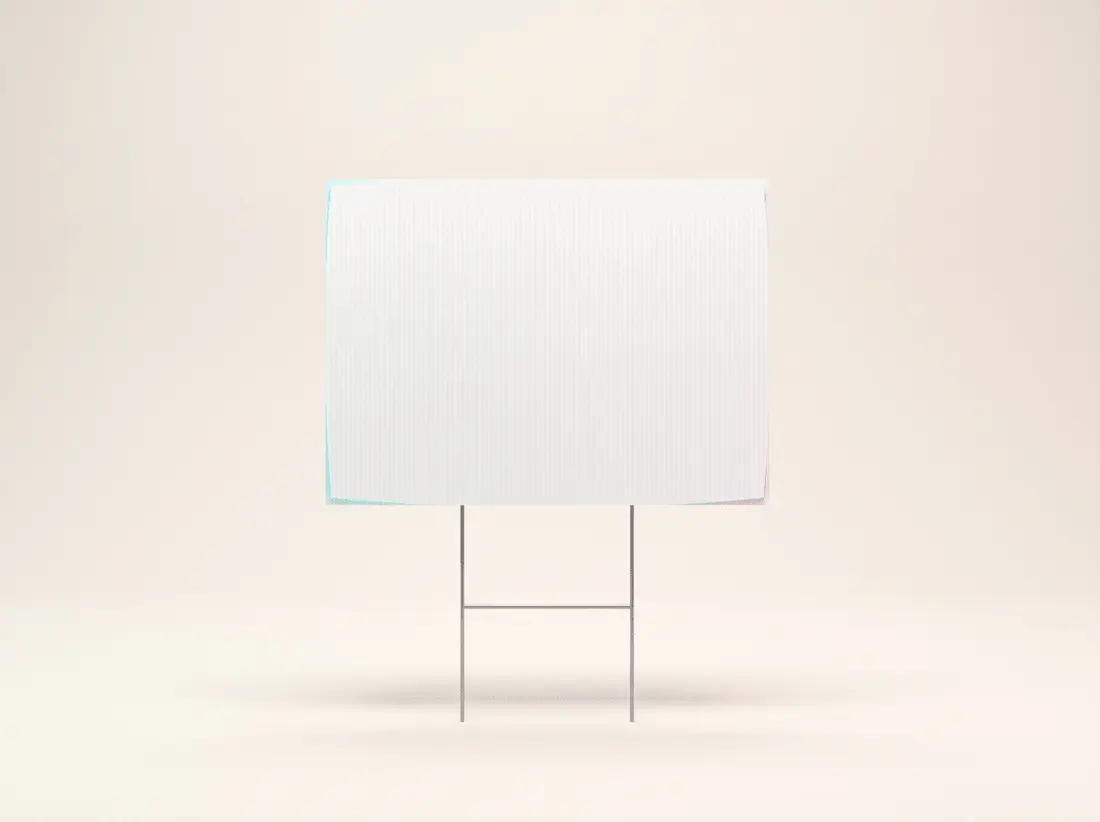
Choose sides based on how the sign will be seen, not on habit. A sign zip-tied flat to a construction fence or leaned in a storefront window only needs one printed face, and single sided is the cheaper configuration. A sign staked in a lawn or parkway strip gets viewed from both directions of traffic, so double sided roughly doubles your effective impressions for much less than double the signs. The standard mounting hardware is the wire H-stake, an H-shaped frame that slides up into the sign's flutes on top and presses into soil on the bottom, which is why the flutes should run vertically on any sign you plan to stake. Add stakes in the configurator when you order so the count matches your signs. If a location has no soil at all, skip the stake and plan on zip ties, screws, or an A-frame instead.
The single biggest lever on yard sign pricing is quantity, because setup is a fixed cost and each additional sign costs less to run. One sign starts around $19.15, but the per-sign price steps down at each quantity break, and the configurator shows the new number the moment you change the count. A real-estate agent working Encino and Sherman Oaks is usually better off ordering a season of generic branded signs at the deep break, then handling property-specific details with riders or flyers, instead of ordering three signs at a time all year. Contractors get similar mileage from a stack of job-site signs printed with company name and license number, staked at every active project from North Hollywood to Burbank, since a lawn sign at a job site is advertising the client is effectively hosting for free. Order once at volume, keep the extras in the truck, and the math works out far better than reordering in small batches.
Political signs and custom die-cut shapes
Political yard signs follow the same coroplast logic, but timing and quantity dominate. Campaigns in places like Panorama City typically order in the hundreds, stake them in waves as election day approaches, and expect to replace a percentage lost to weather, landscapers, and rival enthusiasm, so pad your count from the start. California and local rules govern disclaimers on campaign materials, including what a 'paid for by' line must say and where it appears, and verifying those requirements against current FPPC and local guidance is the campaign's responsibility, not the printer's. We print the artwork you approve, so have your treasurer confirm the disclaimer text before you upload. Many of our products offer rush and next-business-day turnaround options in the configurator, which helps when a race tightens late, but ordering early is still cheaper and calmer. Also check your city's rules on where signs may legally stand, since public medians and utility poles are commonly off-limits.
Standard rectangles are the value play, but shape is a real attention lever. Die Cut Custom Shape Yard Signs are cut along the outline of your design, so an open-house sign can be an arrow, a home-services sign can be a house silhouette, and a mascot can stand in the yard at full profile. A shaped sign costs more than a rectangle of the same size because of the custom cutting, and it usually earns it, since drivers notice an outline that breaks the expected shape. Keep the silhouette simple and avoid thin protruding details, which are fragile at coroplast thickness. If you plan to stake a die-cut sign, keep enough straight vertical flute area in the lower portion for the H-stake to seat properly, or plan an alternate mounting.
How long coroplast survives SoCal sun
The plastic is not the weak point; the print is. A coroplast panel will stay physically intact outdoors through heat, sprinklers, and Santa Ana winds for a very long time, but direct San Fernando Valley sun gradually fades ink, with reds typically going first. As a working rule, expect a sign to look sharp through a full selling season or campaign cycle, and expect noticeable fading somewhere beyond that if it faces south all day, so treat yard signs as durable but not permanent. Match the buy to the lifespan: a garage sale needs the cheapest single-sided signs you can stake on Saturday morning and toss on Sunday, while an agent or franchise running professional installs should order double-sided at volume and rotate fresh panels in as older ones dull. Darker, high-contrast designs also hide fading longer than pale pastels do.
Yard signs get stronger when paired with the rest of a street-visibility kit. An A-Frame Sidewalk Sign, starting around $94.99, is the natural companion for storefronts and open houses, standing on concrete where a stake cannot go and folding flat in a trunk between weekends. Car Magnets turn an agent's or contractor's vehicle into a moving billboard between appointments, using the same artwork as the yard signs so the brand reads identically at the curb, on the door, and down the block. Ordering the set together keeps colors and files consistent, and it usually clears the standard-size free-shipping threshold in one pass. For an open house, the classic combo is directional yard signs on the approach corners, an A-frame at the walkway, and magnets on the car out front.
Ready to price your signs? Open the yard sign configurator at Angels Print, pick your size, sides, quantity, and H-stakes, upload artwork or request design help, and watch the per-sign price update as you adjust the numbers. We print everything at our shop in Sun Valley, CA, standard-size orders over $100 ship free anywhere in the U.S., and questions are welcome anytime at hello@angelsprint.com. Whether it's one open-house arrow for Sherman Oaks or five hundred campaign signs, the order works the same way: configure it online and we'll take it from there.