

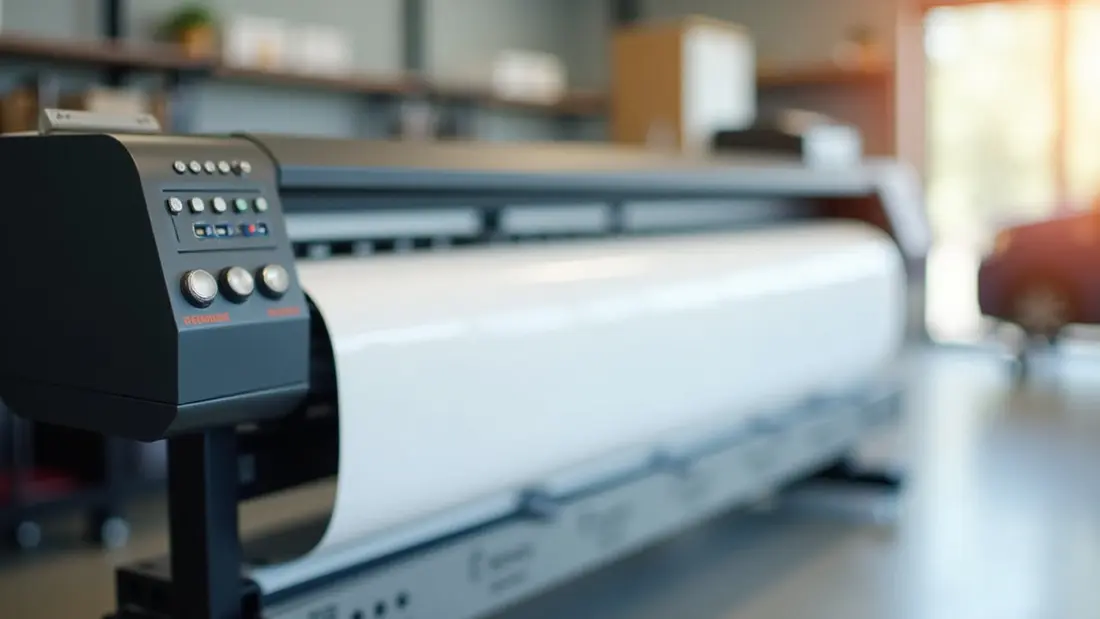
Most people searching for banner printing in Los Angeles already know what they want the banner to say. What they usually have not decided is what it should be made of, and that single choice determines almost everything else: whether it survives outdoors, whether it looks washed out under fluorescent lights, whether it tears off a fence in the first Santa Ana wind, and what it costs. We print banners every week at our shop on Lankershim in Sun Valley, and the same handful of questions come up every time. This is the short version of the conversation we have at the counter.
There are four materials that cover roughly ninety percent of what walks through the door. Standard scrim vinyl is the default: a woven polyester core coated in PVC, printed on one side, and finished with hems and grommets. Fabric is a printed polyester that hangs soft, has no glare, and photographs well, which is why it dominates indoor use. Mesh is vinyl with thousands of small perforations that let wind pass through instead of pushing against it. Blockout vinyl has an opaque black layer sandwiched in the middle so that nothing printed on the back shows through the front. Pick wrong and you will notice within a month.
Vinyl outdoors, fabric indoors
For anything mounted outside — a fence, a building face, a construction site, a grand opening — a vinyl banner is the workhorse, starting at $67. It handles rain, it handles sun, it wipes clean, and it can be rolled and reused for the next event. The tradeoff is glare: vinyl has a slight sheen, so under direct sun or a spotlight it can throw a hot spot back at a camera. Outdoors nobody cares. In a photographed setting, it matters.
Indoors, we steer people toward a fabric banner, from $48. Fabric absorbs light instead of bouncing it, so a step-and-repeat, a trade show backdrop, or a stage banner reads evenly on camera from every angle. It also folds without creasing permanently, which vinyl does not — a vinyl banner folded into a box for three months comes out with a crease line straight through your logo. Fabric goes in a suitcase, comes out, hangs, and looks fine. For anyone who runs a booth circuit or a series of events, that alone justifies the material.
Wind is what actually destroys banners
The single most common failure we see is a large solid vinyl banner zip-tied flat to a chain-link fence. Wind hits it, the banner acts like a sail, and the load concentrates on four grommets until the corners tear out. The banner did not fail — the mounting did, and the material made it worse.
If the banner is going somewhere exposed and it is larger than roughly 4x8 feet, use a mesh banner instead. Mesh starts at $344, which is a jump from vinyl, and the reason is that mesh is what people order for the big jobs: building wraps, scaffolding, long fence runs, stadium and lot perimeters. The perforations cut wind load substantially, which is why construction sites and property managers specify it. Colors read slightly softer than solid vinyl because a percentage of the surface is literally holes, so design accordingly: bigger type, higher contrast, no fine detail.
For solid vinyl in a windy spot, the other fix is wind slits — half-moon cuts that let air through — plus grommets every 18 to 24 inches instead of only at corners, and bungee cords rather than zip ties so the banner can flex instead of tearing. We can set the grommet spacing on request when you order; the default spacing is fine for most jobs but not for a rooftop or a freeway-adjacent fence.
When you need blockout
A blockout vinyl banner, from $63.80, solves two specific problems. The first is double-sided printing: without an opaque core, the artwork on the back ghosts through to the front and both sides look muddy. The second is backlighting — a banner hung across a storefront window or in front of a lit wall will glow, and whatever is printed on the reverse becomes visible. If your banner will hang free with people on both sides of it, or with light behind it, blockout is not an upgrade, it is the correct material.
Sizing, hems and grommets
Measure the mounting location before you pick a size, not after. The two mistakes we see most: ordering a banner the exact width of the space with no allowance for hems and tension, and ordering a banner that fits the wall but not the poles that hold it. Leave a few inches of clearance on each side.
Standard finishing is a welded hem all the way around with grommets at the corners and along the edges. The hem is what keeps the edge from fraying and gives the grommets something to bite into — an unhemmed banner with grommets punched straight through the face will pull out. For pole pockets, tell us the pole diameter and we will size the pocket to it. For a banner going into a retractable stand or a frame, tell us the frame model; those want a specific finished size with no grommets at all.
Setting up artwork so it stays sharp
Banners are viewed from a distance, which forgives a lot, but not everything. A file that looks crisp on your laptop at 100% can be a 900-pixel logo that gets stretched to eight feet. Send vector artwork — PDF, AI, or EPS — whenever you have it, since vector scales to any size without softening. For raster files, 100 to 150 DPI at full finished size is plenty for a banner read from ten feet or more; below that, edges go fuzzy.
Keep critical content — phone numbers, logos, the QR code — at least two inches inside the trim edge, because hems fold over the outer edge and grommets punch through it. Convert text to outlines or send the fonts. And keep the message short: a banner is read at speed by someone in a car or walking past. One offer, one name, one way to contact you. Everything else is decoration.
Angels Print produces banners in-house at 8511 Lankershim Blvd in Sun Valley, serving the San Fernando Valley and greater Los Angeles — retail storefronts, construction and property management, restaurants, schools, churches, event producers and trade show exhibitors. Our digital printing covers the full range of banner substrates, and if the banner is one piece of a larger exterior package, our outdoor advertising and signs work covers the yard signs, A-frames and storefront graphics that usually go with it. If you are unsure which material fits your location, tell us where the banner is going and how long it needs to last, and we will tell you which of the four to order.
Configure and order your banner online — pick the size, material and finishing, upload your file, and see the price before you commit. If you would rather talk it through, call us at (818) 806-9006 or stop by the shop on Lankershim; bring a photo of the mounting spot and we will size it with you.