

August 24, 2026
Cutout Decals in Los Angeles: How Contour-Cut Vinyl Works and Where It Fails
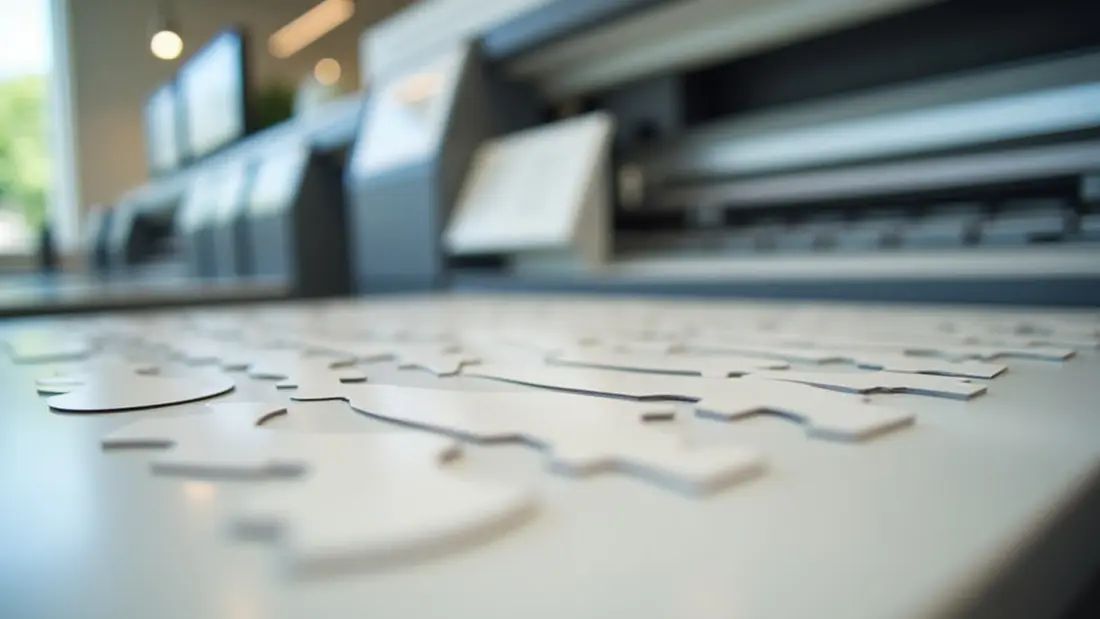
Most people who ask us for cutout decals describe them by what they are not. Not a sticker on a square. Not a sign hanging off a bracket. They want their logo on the glass with nothing around it, or hours lettered on the door with no visible edge, or a mascot on the back wall of the studio that looks painted. That is a contour-cut vinyl decal, and it is one of the cheapest ways to put a permanent-looking mark on a building. It is also the product where the difference between a clean install and a peeling mess comes down to decisions made before anything is printed — the surface, the vinyl, and the cut line in the file. Here is what we check.
What a cutout decal actually is
A cutout decal is printed adhesive vinyl that has been cut along the outline of the artwork by a plotter, so the only material left on the wall or window is the shape itself. The blade cuts through the vinyl and the adhesive but stops at the paper liner underneath — that is a kiss cut, and it is what lets us weed away the waste and hand you a shape rather than a rectangle. Wherever your design has empty space, the wall shows through.
Our cutout decals start at $35.81, and the price moves with size and quantity rather than with how complicated the outline is. Complexity does not cost more to cut; it costs more to weed and to apply, which is a different conversation we will get to below. There is also the older route, cut vinyl with no printing at all — solid-color letters cut straight out of a colored sheet. That is still the right answer for single-color door lettering, because there is no printed film to fade and no white edge to see.
The surface decides more than the artwork
Vinyl adhesive needs a smooth, clean, low-energy-tolerant surface. Glass is the ideal case: non-porous, flat, easy to clean with isopropyl alcohol. Sealed painted drywall, powder-coated metal, finished wood, acrylic, laminate and painted steel roll-up doors all work. What does not work is texture. Orange-peel or knockdown drywall gives the adhesive maybe forty percent contact, and the decal lifts at the corners within weeks. Stucco is worse. Brick and unsealed concrete are not candidates at all.
Two more traps we see constantly in Los Angeles. Fresh paint needs to cure — thirty days is the number to plan around, because the solvents still gassing out of a new coat will keep the adhesive from ever setting. And flat or matte paint, especially the washable low-sheen products landlords like, has a chalky surface that comes off with the decal. If the wall is matte and the decal matters, we would rather print a panel than gamble on the paint.
Cast or calendered, and why it matters in this climate
Calendered vinyl is the standard, thicker film — roughly 3 to 4 mil — made by rolling. It is less expensive, it is dimensionally fine on flat surfaces, and it is what most interior and window decals should be. It does want to shrink back toward its original size over time, which is why a calendered decal on a curved surface eventually reveals a hairline of adhesive at the edges.
Cast vinyl is poured, comes in around 2 mil, has almost no memory, and will lie down over rivets, compound curves and channel letters without fighting back. It costs more and it lasts longer outdoors. In practical terms: if the decal is going on flat glass or a flat wall, calendered is not a compromise. If it is going on a vehicle, a cooler door with a bulge, a curved column or anything that is not one plane, ask for cast and stop thinking about it. Direct west-facing sun on Lankershim will pull the color out of an unlaminated printed decal noticeably faster than the same decal on a north-facing window, so for full-sun exterior work we add a UV laminate, which also gives you a surface that survives being cleaned.
First surface or second surface
On glass you have a choice most people do not know they have. First surface means the decal goes on the outside — full color saturation, but exposed to weather, pressure washing and anyone with a fingernail. Second surface means it goes on the inside of the glass facing out, printed in reverse, so the glass itself protects it. Second surface is the right call for anything permanent on a storefront, and it is why hours and phone numbers on a door usually go inside.
The catch is that a second-surface decal is viewed through glass, so anything with white in it needs a white ink layer printed behind the color — otherwise the light coming through washes it out and the white simply reads as whatever is behind the window. Tell us which side it is going on when you order, because reversing the file and adding the white layer is a production decision, not something to fix at install.
Cut lines, thin strokes and the parts that fall off
Send vector artwork — PDF, AI, EPS or SVG — built at final size with fonts converted to outlines. If you have a specific cut path in mind, put it on its own layer as a spot color named CutContour and leave the rest of the art untouched. If you do not, we will build the contour ourselves with a small offset around the design so there is a sliver of printed color under the blade and no white halo where the cut wanders half a millimetre.
The real constraint is weight. Anything thinner than about an eighth of an inch at final size is fragile: it tears during weeding, it stretches during application, and it is the first thing to lift later. Hairline serifs, thin script connectors and 1-point rules around a logo all fall into this category. Enlarge, thicken, or delete them. Counters — the enclosed holes in an O, an A, an e — are separate islands of vinyl that only stay in position because the transfer tape holds them there, so a font with lots of them on a large decal is a slower install, not an impossible one. Detailed multi-color line art below about ten inches is where we usually recommend a printed decal on a clear or white background instead of a true cutout; the outline stops doing anything for you at that size.
Installing it without bubbles
Decals arrive weeded and pre-masked with transfer tape, which holds every piece in its correct position so you apply the whole design at once. Clean the surface with isopropyl alcohol, not glass cleaner — the ammonia and surfactants in blue cleaner leave a film. Position with masking tape, then use the hinge method: tape a hinge across the middle, peel the liner from one half, lay it down with a squeegee from the centre outward, then do the other half.
Install between roughly 50°F and 90°F surface temperature. In the Valley in August, a west-facing window at 2 p.m. is well past that even when the air is not, and the adhesive grabs instantly and permanently wherever it first touches. Do the exterior work in the morning. On large or detailed pieces, wet application — a light mist of water with a drop of dish soap — buys you repositioning time, at the cost of waiting a day before the bond is at full strength. Leave the transfer tape on for at least twenty minutes, then peel it back on itself at a sharp angle rather than pulling it away from the glass.
Sizing for a storefront
For door lettering, the usual layout is a block of information centred at about 60 inches from the ground, which is eye level for most adults, with the business name largest and hours and phone below it. A logo on a large display window generally wants to occupy something like a third of the pane rather than filling it — a decal that spans the whole window stops reading as a mark and starts reading as a coverage problem. Worth checking before you print: many jurisdictions in Los Angeles County cap the percentage of window area that signage can cover, and building and fire officials care about sight lines into the space. Planning a set of exterior messages across a building or several locations is the sort of thing our outdoor advertising and signs work covers, and permanent identification at the entrance sits under signage and front signs.
Removal, and who owns the wall
Standard permanent adhesive is meant to stay. It will come off, but it wants heat — a hair dryer or heat gun, worked slowly, peeling at a shallow angle — and then an adhesive remover for the residue. On glass, that is a twenty-minute job with a razor and it leaves nothing behind. On painted drywall, a permanent decal that has been up for two years may take paint with it, and even when it does not, the wall behind it has not faded at the same rate as the wall around it, so you get a visible ghost. If the space is leased, or if the graphic is seasonal, ask for removable adhesive up front. It is a different film with a lower initial tack, and it is far cheaper than repainting.
When a decal is the wrong product
A decal cannot be moved and cannot be read from an angle where the glass reflects. If what you actually need is a message on the sidewalk that changes with the day, that is an A-frame sidewalk sign from $94.99, with swappable inserts. If you want your logo to stand off a lobby wall with visible depth and hardware, acrylic business signs start at $46.76 and mount on standoffs. And if the wall is textured, or the graphic is photographic, or you want a full printed panel that can be unscrewed and taken with you, acrylic printing from $90 solves the problem the vinyl cannot. Cutout decals are for smooth surfaces, flat graphics and messages you intend to keep.
Angels Print prints and contour-cuts vinyl decals, window and wall graphics, sidewalk A-frames and acrylic panels at our shop at 8511 Lankershim Blvd in Sun Valley, for storefronts, studios, shops and offices across the San Fernando Valley and greater Los Angeles. If your vector file is ready, pick your size and quantity and order online. If you are not sure whether your wall will hold vinyl, whether the decal should go inside or outside the glass, or whether that script logo survives being cut at four inches, call us at (818) 806-9006 or bring a photo of the surface to the shop and we will tell you before you pay for it.