

August 24, 2026
Doorhangers in Los Angeles: Stock, Die Cuts and How a Route Actually Runs
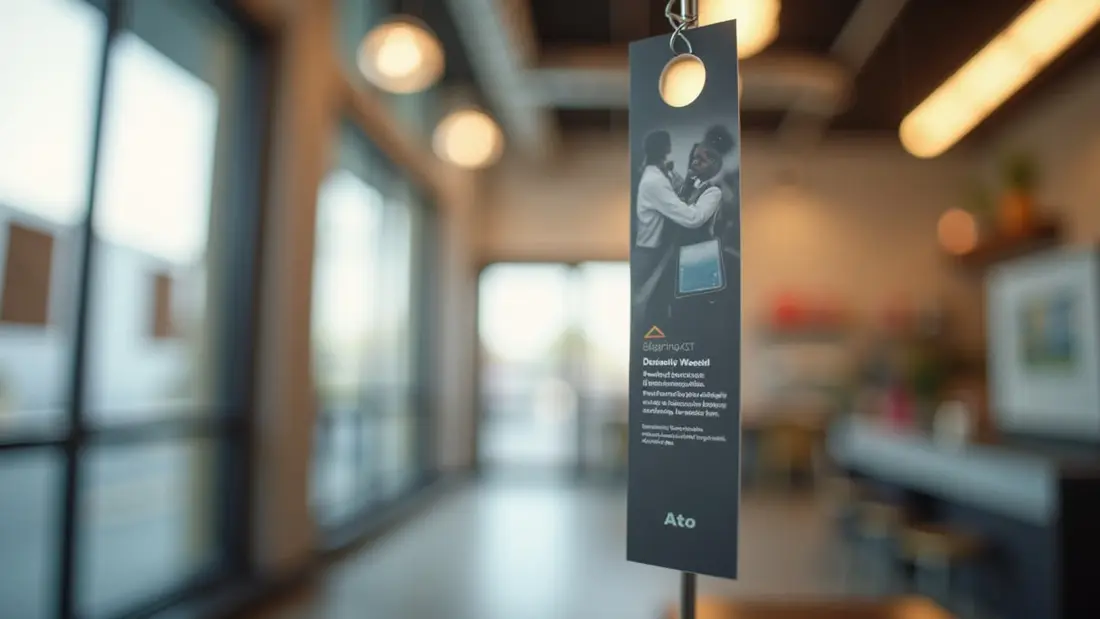
Doorhangers are the last piece of print that still gets touched. Everything else in a mailbox gets carried from the curb to the recycling bin in one motion, unopened. A doorhanger is already on the handle, at eye level, in the way of the door opening — it gets picked up, looked at for a second or two, and then either kept or dropped. That second or two is the whole product. Most of what we tell customers about doorhangers is really about protecting it: what the piece is printed on, how it hangs, what one line it leads with, and what happens on the street when somebody actually walks the route.
Why doorhangers still work here
Los Angeles is a hard direct-mail market. Addresses churn, apartment mailrooms swallow anything unaddressed, and a mailed piece competes with everything else that arrived that day. A doorhanger skips the mailbox entirely. It reaches renters and owners equally, it can be targeted to a single block rather than a carrier route, and it costs nothing per piece to deliver beyond the labor of walking. For trades that work in a service radius — landscapers, roofers, plumbers, house cleaners, pest control, garage door companies — the neighborhood you just finished a job in is the highest-converting list you will ever have, and it is not for sale from any list broker.
Our doorhangers start at $120.35 for a run of 100, which is $1.20 each. That per-piece number surprises people who expect a doorhanger to cost the same as a flyer. It does not, because the die cut is part of the job: the shape has to be cut, not just trimmed, and the setup for that cut is the same whether you order a hundred or a thousand. Which is the practical argument for ordering a real quantity — if you are walking a route at all, walk it with enough pieces to finish the neighborhood.
The hole is the engineering
There are two ways to put a doorhanger on a handle and they behave differently. A plain round hole — usually 1.25 to 1.75 inches — with a slit running up to the top edge is the standard. You slide it over the knob through the slit and it hangs. It is fast for a canvasser, which matters when one person is doing three hundred doors, and it works on almost every residential knob and lever in the Valley.
The alternative is a keyhole or teardrop shape, wider at the bottom than at the top, with no slit at all. It has to go over the knob, which is slower and impossible on some lever handles, but nothing short of a person removes it. Wind will not take it. If your piece has to survive until somebody comes home in the evening, on a street where the afternoon breeze comes down the canyon, the keyhole is worth the slower walk.
The mistake we see most is a slit that is too short. If the slit does not reach the top edge cleanly, the canvasser tears the piece getting it on the knob, and you lose a percentage of the run to damage before anyone reads it. Tell us the hole style you want when you order; if you have never run a route before, take the round hole with a full slit.
Stock: heavier than you think
A doorhanger lives outdoors for hours. It gets rained on in February, baked in July, and pushed against the door by wind the entire time. Fourteen-point card stock is the floor. Sixteen-point is better and is what we would put on anything with a knob-hole under real tension. Text-weight paper — the stuff a flyer is printed on — curls, softens where it touches the handle, and tears through the hole. It looks cheap in the hand, which is the exact opposite of the impression a service business is trying to leave at a stranger's front door.
Coating is a real decision, not a finish upgrade. Gloss resists moisture and makes photographs look better, which suits roofing, remodels, landscaping — anything where a before-and-after image is the argument. Matte or uncoated is writable, and writable matters more than most people expect: if your canvasser hand-writes a name, a quoted price, or "knocked at 2pm, call me" on the piece, that handwriting is often what gets the call. You cannot write on gloss with a ballpoint. Decide which one your route needs before you pick the finish.
What you can and cannot leave at a door
Two rules that cost people money. First, federal: nothing goes in or on a mailbox unless it has postage. A mailbox is postal property, and hanging a piece from the flag or tucking it into the box is a violation — this is the single most common canvassing mistake, and it is the one that generates complaints. The door handle, the gate, a fence — fine. The mailbox — never.
Second, local: a posted "No Soliciting" sign should be treated as binding, and gated communities and many HOAs in the Valley prohibit distribution outright. City rules across Los Angeles County vary on commercial handbill distribution, and a resident who objects will call the city before they call you. Brief whoever is walking the route: skip posted doors, do not enter fenced yards, do not leave a stack, one piece per door. A campaign that generates a code enforcement call has cost you more than the print run.
What actually goes on the piece
A doorhanger has two sides and about two seconds. The front carries one offer and one phone number, in type big enough to read at arm's length while the person is still holding a bag of groceries. Not your service list. Not your history. One reason to call, today.
The back is where the detail goes — services, a photo of finished work, a QR code to a booking page, a small map of the area you serve. Local proof does the heaviest lifting: "we just finished a job on your street" is more persuasive than any adjective, and it is true if you are canvassing the way you should be, immediately around a completed job.
Give the offer an expiry. A doorhanger with no deadline gets put on the counter and lives there. A doorhanger that says the price holds through the end of the month gets acted on or thrown out, and either outcome is better than the counter.
What to hand the people who do call
The doorhanger's job ends at the phone call. What follows it is worth planning at the same time, because printing it in the same batch is cheaper than printing it in a panic later. For a service business, a leave-behind at the estimate does more work than the doorhanger did — a brochure that lays out packages and pricing gives the customer something to show a spouse before they sign.
Two other pieces pair naturally with a door route. Circle and oval magnets start at $130.63 for 100, $1.31 each, and go on the refrigerator instead of in the trash — for anyone whose customers call again (cleaning, HVAC, pest control, pool service), a magnet at the completed job is a year of quiet reminders. And die cut postcards, from $178.94 for 50 at $3.58 each, are the follow-up for the addresses that showed interest: cut to a shape, mailed or hand-delivered, and visibly different from the flat rectangles they arrive with.
If the campaign has a referral or loyalty component, certificates — from $74 for 50, $1.48 each — are the physical version of a discount code. People hold on to a certificate. They delete an email.
Files, bleed, and the safe zone around the hole
Send vector artwork — PDF, AI or EPS — built at final size with 0.125 inch bleed on all four sides and text converted to outlines. Raster images should be 300 dpi at final size; a logo pulled off a website will not hold up at four inches wide.
The doorhanger-specific rule is the hole. Keep all type and any critical part of a logo at least half an inch clear of the die cut and the slit — including on the back, where people forget the hole punches through both sides. Artwork centered on the front will sit uncomfortably low once the top inch is a knob hole, so design around the shape rather than dropping a flyer layout into a doorhanger template. Colors in CMYK, not what your monitor showed. Our digital printing is what runs these, so short quantities and variant versions — different neighborhoods, different offers on otherwise identical pieces — are practical; just name the files clearly and tell us the split before we start.
Angels Print prints doorhangers, postcards, magnets and certificates at our shop at 8511 Lankershim Blvd in Sun Valley, for contractors, service businesses and campaigns across the San Fernando Valley and greater Los Angeles. If your artwork is ready, configure size, stock, hole style and quantity and order online. If you are still deciding between a slit and a keyhole, or between gloss and something your crew can write on, call us at (818) 806-9006 or come by the shop and put the stocks in your hand before you commit to the run.