

August 24, 2026
Double Sided Retractable Banners in Los Angeles: When the Second Face Is Worth It
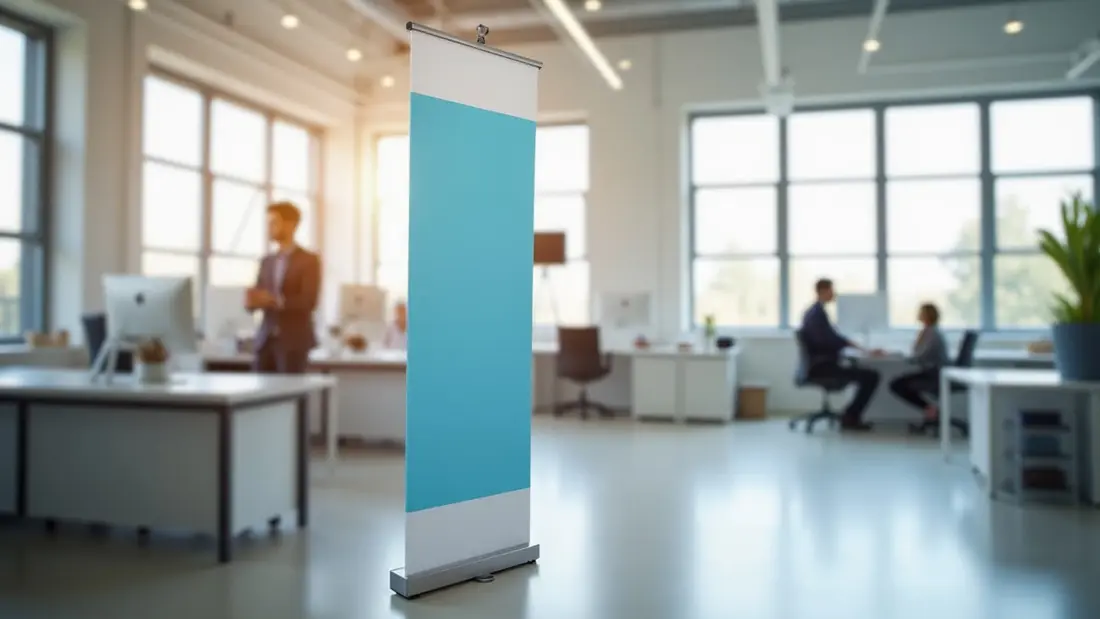
The question comes to us in almost the same words every week: we need a retractable banner, printed on both sides, and we need it for a show downtown. The banner part is easy. The both sides part is where the money is, and it is where most of the decisions get made without anyone realizing a decision was being made. A double sided retractable is not a single sided one with extra ink. It is a different piece of hardware — a different base, a different tension mechanism, twice the printed area, and a substrate that has to stop light from passing through it. That is why the price jumps the way it does, and it is why we ask three or four questions before quoting instead of just taking the order.
Our double sided retractable banner starts at $282.09. A black stand retractable banner printed on one face starts at $62.50. That gap is the whole conversation. If the second face earns its keep, $282.09 is cheap for a display you will use for years. If it does not, you just paid four times over for a graphic nobody stands behind.
Where people actually walk
Stand in the space and watch the traffic before you decide. This sounds obvious and it is the step nearly everyone skips, because the banner gets ordered weeks before anyone sees the room.
A 10×10 trade show booth against a back wall is the classic single sided case. Attendees approach from the aisle, they see one face, and the back of your banner is looking at pipe and drape. A corner booth is not — people come down two aisles and half of them read the banner edge-on or from behind. An island booth is emphatically double sided. So is a banner in a hotel lobby where the elevators are on one side and the ballroom on the other, a banner in a hospital corridor, a banner at the entrance to a farmers market where the crowd flows both directions, and a banner set in the middle of a showroom floor rather than against a wall.
The other honest double sided case is repeat use in unknown rooms. If the same stand goes to twelve events a year and you do not control the layout at any of them, both faces means you never have to care which way the doors face. For a company that does the Los Angeles Convention Center in March, a hotel ballroom in Woodland Hills in June, and a community event in a parking lot in September, that flexibility is the product.
The mechanics, and why the base is fatter
A single sided roll-up has one cassette, one spring-loaded roller, and a graphic that rolls into the base with the printed face inward. A double sided unit has two rollers in one housing — two independent spring assemblies, two graphics, and a base wide enough to hold them side by side. That is why the footprint is deeper and the unit is heavier, and the weight is a feature: a taller graphic on a light base tips over, and a double sided base is more stable at 33 inches wide than most single sided ones.
Two rollers also means two tension springs that have to be balanced against each other. Retract one side quickly and let it snap, and you can throw the tension out on that cassette while the other side still sits perfectly. The habit worth teaching whoever sets this thing up: guide both graphics down with your hand, never let go of either bar mid-travel, and pop the support pole out only after both faces are seated. Most failed retractable banners we see did not fail from wear. They failed from one fast retraction.
Blockout film is not optional
On a single sided banner you can get away with a lighter vinyl, because the back of the graphic faces a wall and a little light bleed through the material never shows. Turn that same stock into a double sided unit and you have a problem: light from behind the banner — a window, a spotlight, a bright booth across the aisle — passes through and the reverse image ghosts through the front face. Dark type on side B shows up as a gray smear on side A.
The fix is a blockout layer, an opaque core laminated between the two printed faces or built into the stock itself. It stops light dead. In practice, on a double sided retractable each face is a separate graphic on opaque material, so this is handled by the construction — but it is the reason double sided stock costs more per square foot than the standard roll-up material, and it is the reason a cheap double sided banner from an online seller with no blockout looks wrong the moment it stands near a window. If you are comparing our price to something noticeably lower, this is usually the difference.
Two faces, two jobs
The most common file we receive for a double sided order is one artwork, duplicated. It works, and it is a wasted opportunity. Because the two faces are never seen at the same instant, they can say different things.
The pattern that works well: the face pointing toward the heavier traffic direction carries the brand and the hook — the thing that stops a person from 15 feet away. The other face carries the detail — what you do, the QR code, the booth number, the offer. Someone walking the opposite direction still gets a complete message, and someone who circles the stand gets two.
Keep both files built at the finished graphic size in vector where you can, with text converted to outlines, and remember that the bottom four to five inches of the banner disappear behind heads at a busy event. Nothing you need read should live down there. Nothing critical should sit within an inch of either vertical edge either — the graphic can drift slightly in the cassette between setups.
What else is in this category
Retractables are one answer to a vertical display, and not always the best one. A 3FT SEG fabric stand from $195 is a different animal: a silicone-edge fabric graphic tensioned into an aluminum frame, no cassette to throw out, a matte fabric face that does not glare under trade show lighting, and a graphic you can fold into a bag and wash. Changing the message means a new fabric skin, not a new stand. If your display gets rebuilt on-site by people who are not gentle with hardware, fabric on a frame survives handling that a spring roller does not.
If the goal is a wall behind you rather than a marker beside you, a backdrop banner from $189.99 is the correct product — step-and-repeat, photo walls, the background for a booth or a press moment. Backdrops are single sided by nature, and people occasionally try to solve a backdrop problem by lining up three retractables. That works, but you will see the seams, and the three units cost more than one backdrop.
The realistic kit for a company doing several events a year is one double sided retractable that goes anywhere, one or two single sided units for wall positions, and a backdrop if you ever shoot photos or video at your booth.
Using it outside the show floor
A retractable is an indoor product. The base is designed for a flat floor, the spring assumes no lateral load, and a light breeze on a 33×80 sail with a narrow footprint is enough to lay it down. Put one in a courtyard on a Santa Ana day and you will be picking it up. For outdoors, a weighted or staked structure is the answer, and for anything permanent at the property itself, that belongs to signage and front signs rather than a portable display.
Indoors, though, a double sided unit is useful in more places than trade shows. Lobbies, clinic waiting rooms, gyms, school open houses, dealership showrooms, retail floors during a promotion, restaurant entries during a limited menu run. Anywhere people move past a fixed point in both directions and the message changes every few months, this is the cheapest display that still looks deliberate. All of it prints on the same equipment as the rest of our digital printing work, so the color on your banner matches the color on the flyers sitting next to it.
Angels Print prints double sided and single sided retractable banners, SEG fabric stands and backdrops at our shop at 8511 Lankershim Blvd in Sun Valley, for trade shows, offices, clinics and storefronts across the San Fernando Valley and greater Los Angeles. If your artwork is ready, configure size and sides and order online. If you are still deciding whether the second face is worth $282.09, or whether a fabric stand suits your handling better than a spring cassette, call us at (818) 806-9006 or come by the shop — we keep both standing on the floor and you can retract them yourself before you buy.