

August 27, 2026
Foil Business Cards in Los Angeles: What the Shine Actually Costs and How to Design for It
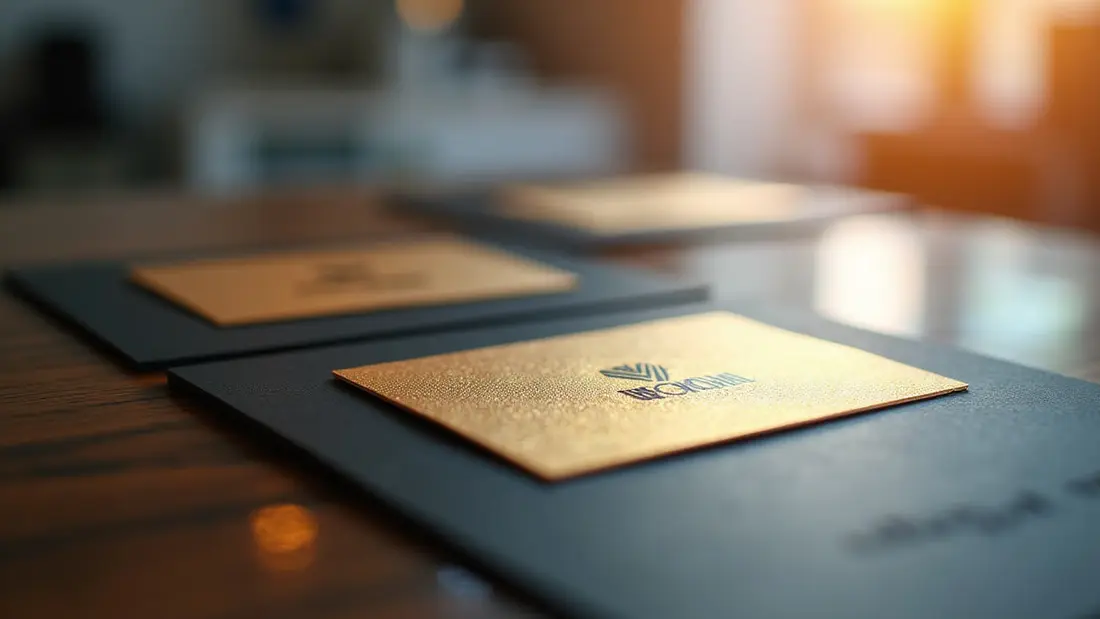
Almost every foil business card order starts the same way: someone hands us a card they picked up at a gallery opening in Culver City or a restaurant on Ventura Blvd, tilts it under the light, and says they want that. What "that" is varies a lot more than people expect. Sometimes it is hot foil stamped into a thick cotton stock with a visible dent you can feel with a thumbnail. Sometimes it is a digital foil laid flat on a laminated card. Sometimes it is just metallic ink, which is a completely different animal and usually a disappointing one. The three look similar in a photo and behave nothing alike in the hand, on press, or in the price. Here is how we sort it out before anything gets printed.
Three things people call foil
Hot foil stamping is the traditional method. A metal die is engraved with your artwork, heated, and pressed through a roll of metallic polyester film into the paper. The foil transfers only where the die touches, and because the die is pressing into the sheet, you get a slight deboss along with the shine. That deboss is most of the reason a stamped card feels expensive — the eye reads the light, but the fingertip reads the depression. Stamping needs a die made for your specific artwork, so it carries a setup cost that does not change with quantity. At 50 cards that setup is the majority of what you pay. At 1,000 it disappears into the run.
Digital foil skips the die. The card is printed first, then a foil film is bonded to specific areas using the toner or an adhesive laid down by the press, and the rest of the film peels away. No engraving, no setup die, and no deboss — the foil sits flush on the surface. The advantage that matters most: because there is no physical die, foil can vary card to card. Names and titles in gold across a staff of thirty, each one different, cost the same as thirty identical cards. With stamping that is thirty dies.
Metallic ink is not foil at all. It is CMYK-compatible ink loaded with metallic pigment, and it is translucent. On a white sheet it reads as a slightly shimmery grey or tan; on a dark stock it mostly vanishes, because there is nothing behind it to reflect. If you have a black card and you want the logo to look like actual gold, ink will not do it. Foil is opaque and it will.
What it costs here
Our foil business cards start at $93.14, and the default run is 50 pieces, which works out to $1.86 a card. For comparison, classic business cards start at $25.70 for 50 — 51 cents each. So foil is roughly three to four times the cost of a plain card at the smallest quantity. That ratio narrows fast as the run grows, because the fixed portion of foil work spreads out while the paper and printing scale linearly. If you are deciding between 50 and 250, price both in the configurator before you decide; the per-card number usually surprises people.
That $1.86 is worth thinking about in terms of what a card is for. If you go through 500 cards a year handing them to vendors and delivery drivers, foil on all of them is money spent on people who will not look. What a lot of our customers do instead is run two cards: a plain stock for volume and a foil card for the fifty conversations a year that actually matter. Two SKUs, one design system, and the expensive one never sits in a drawer going stale.
The file is where foil orders go wrong
Foil is binary. There is foil or there is no foil — no tints, no gradients, no 40% gold. If your logo has a soft metallic gradient in the mockup, that gradient has to be resolved into a solid shape before it can be stamped or bonded. Send us vector artwork with the foil elements on their own layer, as a 100% solid spot color, with fonts converted to outlines. Name the layer something unambiguous like FOIL. Everything that prints in normal ink stays on the other layer.
Line weight is the constraint that bites hardest. Hairline rules and thin serifs that look elegant at screen size do not transfer cleanly — thin foil either breaks up into a dotted line or, on stamping, fills in and spreads where the die pushes the paper aside. Keep foil strokes at roughly 1 point or heavier at final size, and be honest about script logos with hairline connectors: at a business card's scale those connectors are often under half a point. Enlarge them, thicken them, or put the script in ink and foil only a solid mark next to it.
Two more rules. Do not print ink on top of foil — foil is a plastic film and standard inks do not key to it reliably, so anything overprinting a foil area is at risk of scuffing off. And leave breathing room between foil and other elements: registration between the foil pass and the print pass has a tolerance, so a gold outline sitting exactly on the edge of a printed shape will look off-centre on some cards in the stack. Design so that a shift of about a thirty-second of an inch is invisible, and it will be.
One that costs people real money: do not foil a QR code. Foil is a mirror. Phone cameras hunting for contrast get a glare-blown rectangle instead of a code, and the failure depends on the room. Print codes in flat black ink and put the foil somewhere else on the card.
Stock does half the work
Foil on a thin, glossy, coated card looks cheap in a way that is hard to explain until you see the two side by side. The shine of the foil and the shine of the coating compete, and the foil stops registering as metal. The pairings that work are foil against something matte and heavy: uncoated stock, soft-touch laminate, or a thick double-thick card where the edge itself is part of the impression. Dark stocks are the other reliable move — gold, copper or holographic foil on a near-black card is the highest-contrast thing you can do with a business card, and it is exactly the case where metallic ink fails.
If you are stamping rather than using digital foil, thicker and softer stock takes a deeper, cleaner deboss. Thin stock resists the die and can show the impression as a ghost on the reverse side, which matters if the back of your card has content. Double-sided foil on thin stock is where we push back hardest.
The other ways to make a card feel expensive
Foil is not the only route, and sometimes it is not the best one. Clear plastic business cards start at $92.60 for 50 — about the same as foil — and get their effect from transparency rather than reflectance. They photograph well, they survive a wallet indefinitely, and white ink on clear reads as a floating mark. If your design is one strong shape, this is worth pricing against foil.
Die cut business cards start at $129.14 with a default run of 100 pieces, $1.29 each. Here the effect is the silhouette: rounded corners, a cut-through shape, a card that is not a rectangle. A die cut card gets noticed at a distance across a table, where foil only works once it is in someone's hand and tilted. Different mechanism, different moment.
And rounded corners plus a heavy uncoated stock, with no foil at all, gets you most of the way to "considered" for the price of a plain card. We would rather tell you that than sell you foil you do not need.
Proof it before you commit
Metallic finishes are the hardest thing to judge on a monitor, because a screen renders gold as a yellow-brown flat fill and shows you none of the behaviour that makes foil worth paying for. A PDF proof confirms placement, spelling and which elements are foiling — it tells you nothing about how the gold will look against your particular stock under the fluorescent lights of a conference room. If the card matters, order the smallest run first, live with it for a week, then order the volume. At 50 pieces the cost of being wrong is $93.14, and the cost of being wrong on 1,000 is not.
Foil sits under our business card printing work, and the underlying colour printing on those cards is standard digital printing — same process, same colour handling, with the foil as an added pass.
Angels Print prints foil, plastic, die cut and standard business cards at 8511 Lankershim Blvd in Sun Valley, for studios, agencies, restaurants, contractors and offices across the San Fernando Valley and greater Los Angeles. If your vector file is built with the foil on its own layer, choose your stock and quantity and order online. If you are not sure whether your logo survives being stamped at card size, whether your card should be foil or clear, or how gold is going to look against the stock you have in mind, call us at (818) 806-9006 or come by the shop — bring the card that started this, and we will tell you which of the three things it actually is.