

August 26, 2026
Folded Business Cards in Los Angeles: Fold Types, Scoring, and What to Put Inside
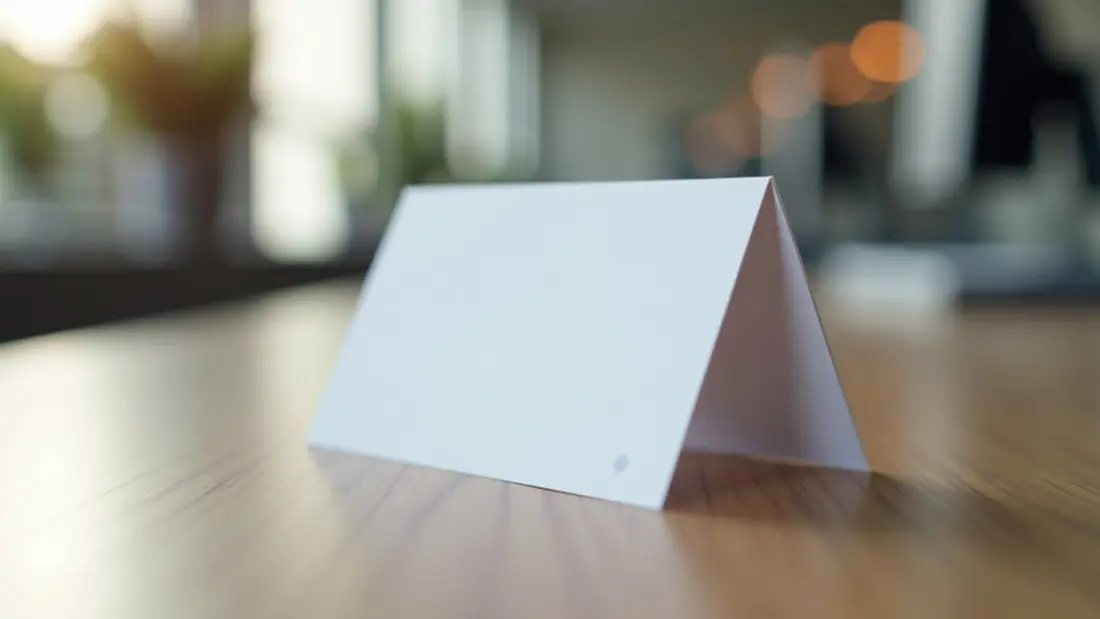
A folded business card is a normal business card that has been printed twice as wide or twice as tall, scored down the middle, and folded. Closed, it is the same 3.5 × 2 inches everyone's wallet expects. Open, it is four printable panels instead of two — which is why we see them most often from people who need a card to carry more than a name: a stylist with a price list, a contractor with a service menu, a consultant with a short bio, a restaurant using them as table tents. They are also the business card most likely to arrive with a cracked spine if nobody thought about the paper before printing. Here is what we check when the order comes in.
What you actually get for the money
Our folded business cards start at $43.97, and the default run is 50 pieces at $0.88 each. For comparison, classic business cards start at $25.70 — 50 pieces at $0.51 each. So the fold roughly doubles the per-card cost, which makes sense: you are buying twice the paper, plus a scoring pass and a folding pass that a flat card never goes through.
That is the honest arithmetic to run before you commit. If the extra two panels are going to hold a genuine price list, a map, a calendar of class times or an appointment reminder that saves you a phone call, the fold pays for itself immediately. If the inside is going to hold a mission statement, buy flat cards and put the money into a heavier stock. We have printed plenty of folded cards where three of the four panels were empty space, and the customer would have been happier with a thicker flat card at half the price.
The four folds, and which one your content wants
Short fold (top fold). The card is printed 3.5 × 4 inches flat and folds down to 3.5 × 2. This is the standard, and it is the one to pick unless you have a reason not to. It opens like a tiny greeting card — front cover, two inside panels facing you, back panel. It also stands up on its own on a counter, which is why it doubles as a mini table tent.
Side fold (left fold). Printed 7 × 2 flat, folding to 3.5 × 2. It opens like a book. The panels are long and narrow, which is excellent for a list of services with prices running down the right side, and poor for anything with a wide image.
Gate fold. Two side panels fold inward to meet in the middle, so the card opens from the centre. It looks good and it is the fussiest to build — the two flaps must be cut slightly narrower than half the width or they collide at the seam. If you want a gate fold, tell us before you build the file and we will send back the exact panel widths.
Roll fold and Z-fold. Three panels on a 10.5 × 2 sheet. Genuinely useful for a step-by-step or a timeline, genuinely bulky in a wallet. Same warning as the gate fold: on a roll fold the innermost panel has to be shorter so it does not buckle.
Scoring is not optional, and grain direction is real
Business card stock is thick — typically 14 pt or 16 pt cover. Fold thick coated stock without scoring it first and the coating on the outside of the bend has nowhere to go, so it splits. That white line down the spine is called cracking, and on a dark or heavily inked cover it is extremely visible. Scoring solves it: a rounded rule presses a channel into the sheet, displacing the fibres rather than tearing them, and the paper then folds along that channel cleanly. Every folded card we produce is scored before folding. Nobody should be selling you one that is not.
Paper has a grain — the direction the fibres lie, set when the sheet was made. Folding with the grain is smooth; folding across the grain fights the fibres and raises the risk of a rough spine even on a scored sheet. We lay out folded cards so the fold runs with the grain wherever the sheet size allows. You do not have to specify this, but it is the reason a folded card sometimes has to be imposed differently from a flat one on the same press.
One more thing worth knowing about coatings: a heavy gloss or a soft-touch laminate on the cover makes cracking more likely, not less, because the film is stiffer than the paper under it. Matte finishes fold best. If you want a folded card with a laminate, expect a very slightly visible hinge and decide whether you care.
Building the file so the panels land right
Build the artwork flat, at the unfolded size, with 0.125 in bleed on all four outside edges and everything important kept at least 0.125 in inside the trim. Send a PDF with fonts outlined. Put the fold position on its own layer as a guide, or just tell us in the order notes — do not print a visible fold line, we score by position, not by looking for a printed rule.
The part people get wrong is panel orientation. On a short-fold card, the back panel is upside down relative to the cover in the flat file. Lay it out the way it will be read when open, then let us handle imposition; if you rotate it yourself and we rotate it again, the back of your card prints inverted and nobody notices until the box is on the counter. When in doubt, fold a printed piece of paper in half and write on it. Two minutes of paper mockup catches more layout errors than any proof.
Keep type off the fold. A logo that straddles the spine looks intentional in a mockup and looks broken in the hand, because folding shifts a hair of material and the two halves never line up perfectly. Give the fold a quarter inch of clearance in both directions.
What actually goes inside
The uses that keep coming back to our shop: a service menu with prices, for salons, barbers, detailers and mobile repair; appointment reminder lines the front desk fills in by hand, which is the single most practical thing a folded card does; a short before-and-after or portfolio image for trades where the work is the pitch; class or tour schedules; a punch-card loyalty grid on an inside panel; and a QR code with a sentence explaining what happens when someone scans it, which matters more than the code itself.
What does not earn its panel: a paragraph about your values, a list of every service you have ever performed, or a second copy of your contact details. The contact block goes on one panel, once.
When a different card is the right answer
A folded card is bulky. It does not sit flat in a card case, and a stack of fifty is noticeably taller than a stack of fifty flat cards. If what you actually want is for the card to feel like an object rather than to carry more information, the fold is the wrong tool. Clear plastic business cards start at $92.60 — 50 pieces at $1.85 each — and get remembered because you can see through them. Die cut business cards start at $129.14 for a run of 100 at $1.29 each, and get remembered because the outline is the shape of what you do. Both stay flat and both cost more per piece than a fold.
And if the job is a hand-out at a trade show table where nobody will open anything, a heavier flat card at $0.51 apiece beats every other option in this article. We would rather tell you that up front than fold four panels you did not need. Folded, flat, plastic and die cut all sit under the same business card printing work, and the short-run economics on all of them come from digital printing — which is also why 50 pieces is a sensible quantity rather than a penalty.
Angels Print prints, scores and folds business cards at our shop at 8511 Lankershim Blvd in Sun Valley, for salons, contractors, restaurants, studios and offices across the San Fernando Valley and greater Los Angeles. If your artwork is built flat with bleed, pick your stock and quantity and order online. If you are not sure which fold your content wants, whether your cover ink will crack on the spine, or how wide to cut the flaps on a gate fold, call us at (818) 806-9006 or bring the file to the shop and we will fold a proof on paper before anything goes to press.