

August 30, 2026
Updated
Pearl Business Cards in Los Angeles: How the Shimmer Works and Which Artwork Survives It
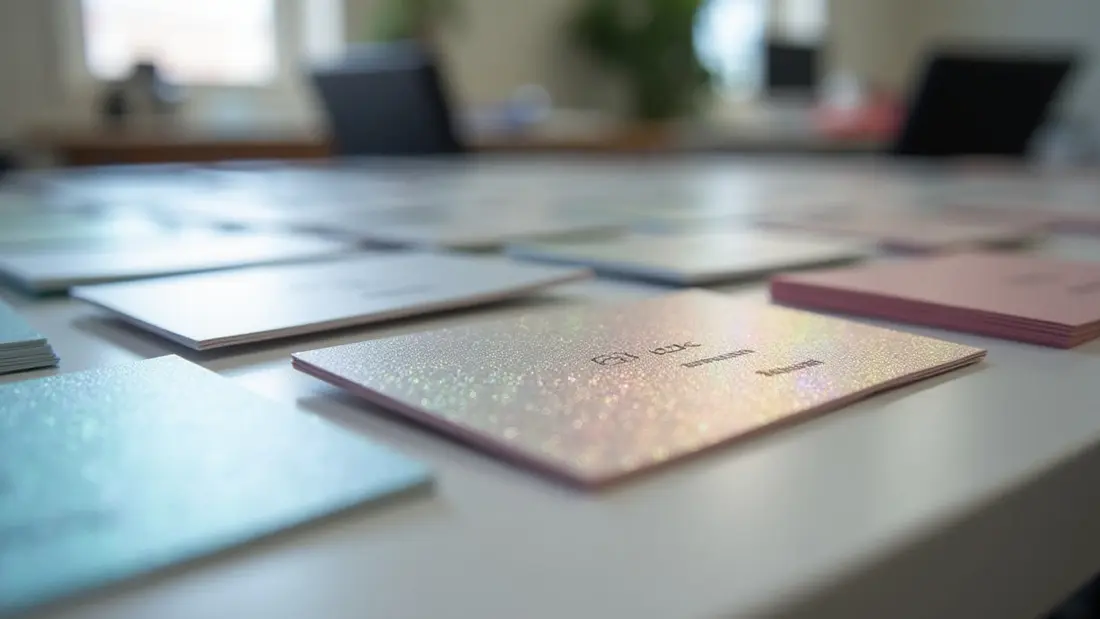
Pearl is the card people order because they saw one at a wedding expo or a salon front desk and remembered how it caught the light. It is also the card that comes back looking flat, muddy or nothing like the screen more often than any other stock we run. The finish is not a coating we apply at the end — it is built into the paper, and it changes how every colour in your file behaves. We print pearl cards at the shop on Lankershim most weeks, and nearly every disappointment traces to the same misunderstanding about what the shimmer is and where it comes from.
What pearl stock actually is
A pearl sheet is paper with a pearlescent pigment layer — mica particles in a clear binder — applied to one or both sides at the mill. Mica is a mineral that splits into extremely thin transparent flakes. Light hits the flakes, part of it reflects off the top and part off the bottom, and the two reflections interfere with each other. That interference is what produces the shifting, iridescent look that changes as you tilt the card. It is the same optical mechanism as an abalone shell or a car's pearl paint.
The important consequence: the shimmer lives under your ink, not over it. There is no metallic ink, no foil, no top coat doing the work. Whatever the press lays down sits on top of the mica layer and competes with it for the same light. This one fact decides everything about which designs work.
Our pearl business cards start at $30.28, with a default run of 50 pieces at $0.61 each. That is roughly a dime a card over a standard uncoated business card, which is why people order them without thinking hard about the artwork — the price of the upgrade is small enough that nobody stops to ask whether the design suits it.
Which artwork the shimmer flatters, and which it kills
Ink on pearl behaves like a filter over a mirror. The more ink, the less light reaches the mica and bounces back out. So:
Light coverage wins. A card that is mostly bare stock with a logo, a name and three lines of contact detail is the ideal pearl job. The eye reads the shimmer across the open areas, and the type reads crisp black on top of it. Salons, photographers, event planners, jewellers, wedding vendors — the categories that buy pearl most often are also the ones whose designs tend to be sparse, which is not a coincidence.
Heavy solid coverage loses. A card with a full-bleed dark background has almost no exposed mica left. You paid for a pearlescent sheet and then covered it. Worse, dark solids on pearl often look slightly dusty or grey compared with the same black on a smooth uncoated sheet, because the mica layer scatters light back through the ink film. If your design is a solid navy field with white type, pearl is the wrong stock and a standard sheet will give you a deeper, cleaner result for less money.
White does not print. This surprises people every time. We print CMYK — there is no white ink. Anything you leave white in the file is the bare pearl sheet showing through, which means every "white" area on a pearl card is actually pearl-coloured and slightly warm. If your logo has a white knockout inside a coloured shape, that knockout will shimmer. Sometimes that is beautiful. Sometimes it wrecks a brand mark that is supposed to sit on clean white.
Pale tints go strange. Light pastels are thin ink films, and thin films over mica shift colour as you tilt the card. A pale grey can read faintly pink or green depending on the angle. If your brand colour is a soft neutral and it has to be exact, test it before committing to a run.
The photograph problem
Pearl and photographs are usually a bad marriage. Photographic images depend on a controlled tonal range, and the mica underneath adds an uncontrolled specular component to every mid-tone and highlight. Skin tones go waxy, shadows lose separation, and the whole image reads slightly veiled. If your card is built around a headshot or a product shot, print it on a normal coated stock and put the pearl budget into something else.
The exception is a small, deliberately high-contrast image treated as graphic rather than photographic — a silhouette, a line illustration, a single-colour mark. Those survive the finish and often benefit from it.
Front and back, one side or two
Pearl sheets come coated one side or both. A card coated on one side only has an ordinary paper back, which is not a defect — it means the back takes ink normally and is easier to write on. If you need someone to note an appointment time or a price on the back of the card, a one-side pearl sheet is genuinely more useful than a two-side one, because pearl coating is slick and ballpoint pens skate on it.
Tell us which side matters before the file is built. Flipping which face is pearl after the artwork is finished usually means reworking the design, since the side you can leave open is the side that shows the shimmer.
When another card is the better buy
Pearl is a surface effect, and there are two other ways to make a card memorable that do not involve one.
If the design is dense — full colour edge to edge, a dark field, a photograph — the shimmer will be invisible and you are paying for something you cannot see. Our classic business cards start at $25.70 for 50 at $0.51 each, and on a heavy design they will look better than pearl, not worse.
If what you want is a card nobody has seen before rather than a card that catches light, clear plastic business cards start at $92.60 for 50 at $1.85 each. They are a solid plastic substrate — waterproof by construction, with real transparency. They do the same job pearl is being asked to do (make the card get kept) by a completely different route, and they are three times the price, so the question is how many cards you actually hand out.
And if the differentiator should be shape rather than surface, die cut business cards start at $129.14 for 100 at $1.29 each — a rounded profile, a tab, a cut-out silhouette. Pearl and die cutting can be combined, but keep interior corners generous; the mica layer is a coating and tight notches are where coatings want to chip.
Building the file
Set the artwork at final size with an eighth of an inch of bleed all round, keep type and logos at least an eighth of an inch inside the trim, and build in CMYK at 300 dpi at final size — or supply vector with fonts outlined. Standard rules, same as any card.
Two additions for pearl. First, do not use white as a design element unless you want it to shimmer; if a mark needs a true white background, that mark needs a different stock. Second, expect your screen to lie more than usual. A monitor renders colour as emitted light and cannot simulate an interference effect at all, so a pearl card always looks different in the hand than in the file — generally warmer and lighter than the proof suggests. Short runs go through our digital printing process, so colour holds consistent piece to piece within a run, but consistency within a run is not the same as matching your monitor.
If you are ordering pearl for a small VIP set and something plainer for daily handouts, our business card printing in Los Angeles covers the standard formats, and running both from one artwork file keeps the two versions recognisably the same brand.
The Los Angeles part
Two practical local notes. Pearl cards are handed out at events — bridal shows in the Valley, trade floors downtown, open houses — and event lighting is usually overhead and harsh. That is the best possible condition for pearl, because directional light is what makes mica move. The card that looks subtle at your desk will look considerably more dramatic under a booth spotlight, which is worth remembering when you are judging a proof in a dim office.
Second, storage. A box of cards left in a car through a Valley summer will curl, and a pearl sheet under pressure while hot can take a burnish mark where the coating flattens — a dull patch that does not come back. Keep the box flat, indoors, out of the sun.
Angels Print prints pearl, classic, die cut and clear plastic business cards at our shop at 8511 Lankershim Blvd in Sun Valley, for salons, photographers, event vendors, realtors and small brands across the San Fernando Valley and greater Los Angeles. If your artwork is ready, pick your size and quantity and order online. If you are not sure whether your design has enough open space to show the finish, whether your brand colour will hold on a mica sheet, or whether one side of pearl would serve you better than two, call us at (818) 806-9006 or bring the file to the shop and we will look at it with you before you commit to a run.