

August 31, 2026
Political Yard Signs in Los Angeles: Flutes, Placement Rules and the Signs That Disappear
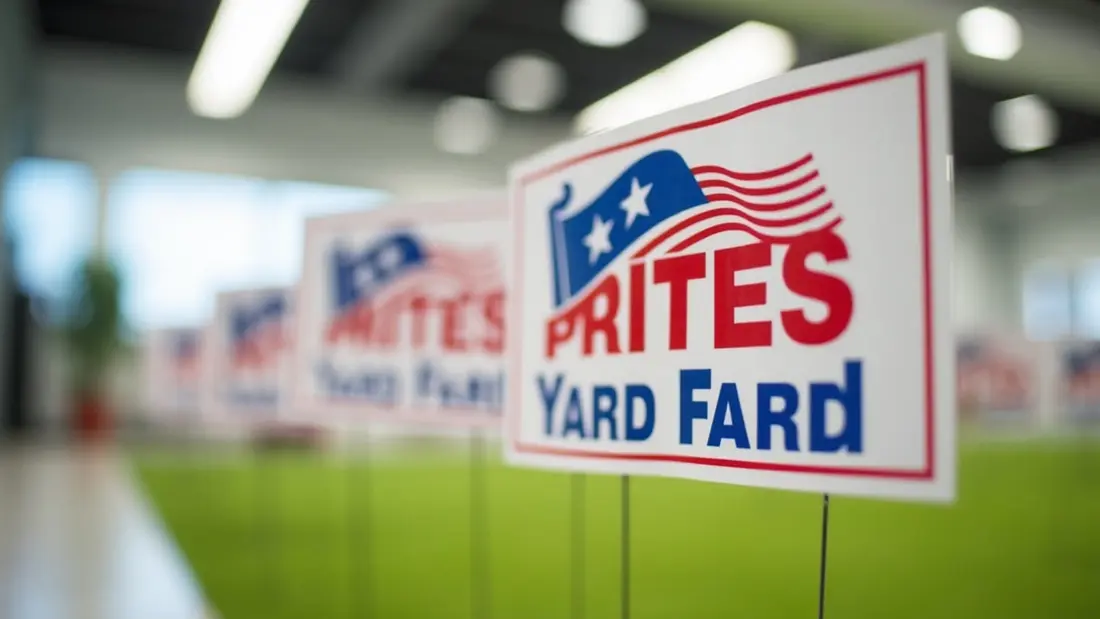
A yard sign has never changed a vote by itself, and anyone who tells you otherwise is selling signs. What it does is narrower and genuinely useful: it turns a private preference into a public one. A street with fourteen signs for the same council candidate tells every driver on it that this is what the neighbours have already decided, and no mailer buys that kind of social proof. We print political signs at our shop on Lankershim for city council, school board, judicial, county measure and state assembly campaigns around Los Angeles, and the runs that disappoint go wrong for four reasons, in this order: the flutes run the wrong way, the design is unreadable at speed, the disclaimer was never in the file, and nobody budgeted for the signs that vanish.
What you are actually buying
A standard political yard sign is 4mm corrugated polypropylene — coroplast — printed with UV-cured ink that sits on the surface of the plastic and cures instantly. It is a hollow sheet: two skins with vertical or horizontal channels running between them, which is why it is light, stiff for its weight and cheap enough to put a hundred of them on lawns. Our political yard signs start at $19.15, and the per-piece number falls sharply with quantity, which is the single biggest lever you have on a campaign print budget.
The board is only half the object. The other half is the wire H-stake that goes into the ground, and the two have to be ordered to match each other and to match the lawn they are going into. Order stakes one to one with signs plus a healthy handful of spares — they bend, volunteers lose them in trunks, and a sign without a stake is a sheet of plastic in a garage.
Flute direction decides whether the sign survives
This is the detail people skip and then pay for. The flutes — the internal channels — run one way through the sheet, and the H-stake's two prongs slide up inside them. If you are staking into a lawn, the flutes must run vertically, top to bottom, so the stake has something to grip along its full length. Order the same sign with horizontal flutes and the prongs have nothing to enter; the sign sits on the stake, catches the first gust and comes off.
Horizontal flutes are not wrong, they are for a different job. If the signs are going onto chain link, a construction fence, a pole or a railing with zip ties, horizontal flutes give you strong tie points across the width and the sheet resists sagging between them. Most campaigns need both: staked signs for lawns and parkways, tied signs for fences and commercial frontage. Tell us the split before we print, because it is a production setting, not something anyone can fix afterwards with a knife.
Single-sided, double-sided, and the angle to the street
A single-sided sign works when traffic only ever approaches from one direction — a one-way street, a driveway, a corner where you can aim it. Double-sided costs more per piece and is worth it on any two-way street, because half your audience is otherwise reading the back of a blank sheet.
Whichever you buy, the placement rule is the same: turn the sign so its face is close to perpendicular to the line of sight of an approaching car, not parallel to the kerb. A sign set flat along the street edge is a one-inch-wide line to the driver who matters. Volunteers plant them square with the sidewalk by instinct — put the correction in the walk sheet.
The design has about one second
Use the standard sign rule of thumb: roughly one inch of letter height for every ten feet of viewing distance. A driver reads a lawn sign from around thirty feet, so your largest element wants to be about three inches tall — which on an 18 by 24 board means the candidate's surname and almost nothing else.
That is the whole discipline. Surname first and biggest. The office being sought, small, underneath. A ballot designation or the word "re-elect" if it applies. No portrait, no slogan, no website nobody can transcribe at speed, no QR code — nothing scans a code from a moving car. Set it in a heavy sans-serif, keep maximum contrast between ink and background, and avoid saturated red type on saturated blue: the two colours vibrate against each other at distance and the edges of the letters dissolve. Dark on light survives dusk better than light on dark.
The disclaimer belongs in the file, not on a sticker
California campaign advertising carries committee disclosure requirements, and what applies to your specific race, committee type and sign size is a question for your treasurer or the FPPC — not for your printer. We are not going to quote you the current rules, because they are amended and because the answer depends on facts we do not have.
What we will say is this: get the exact disclaimer text, in writing, before we go to print. Slapping a printed label onto a thousand finished boards later looks exactly as improvised as it is, costs volunteer hours you do not have in October, and the labels peel in the sun. It is a fifteen-word text field that has to be right the first time.
Where the signs can legally go
Private property with the owner's permission is always safe, and it is also the only placement that carries any signal — a sign in a front yard implies a resident behind it. Everything else is regulated, and the regulation changes at every city line. Los Angeles, Burbank, Glendale, San Fernando and unincorporated county areas each treat parkways, medians and public right-of-way differently, and California has a separate statute for temporary political signs placed within sight of state highways that limits size and requires prompt removal after the election. Look up the rules for the specific jurisdictions your precincts fall in before the first walk, not after the first complaint.
Two things are reliably a bad idea anywhere: utility poles and street furniture, and freeway overpass fencing. Signs on those get removed, sometimes with a citation attached to your committee's name. And assign the takedown before election day — someone with a truck, a list of locations and a deadline. Abandoned signs are the cheapest possible way to annoy the neighbourhood you just spent six months courting.
Order more than you need
Plan on losing signs. Some are taken by opponents, some by residents who moved, some by gardeners who do not read English signage while running a mower, and some by wind. Twenty per cent over your placement count is a reasonable starting overage for a contested local race, and it is far cheaper bought in the original run than as a panicked reorder in the last three weeks.
Store the surplus flat, indoors, out of the sun. Coroplast stacked on edge in a hot car through a Valley August takes a bow it never fully loses, and UV ink is durable but not immortal — a sign that sits in direct south-facing sun for a full cycle will read lighter than the one that went out the same day into shade.
The pieces that are not yard signs
A campaign office is a storefront for six months, and it needs different objects. An A-frame sidewalk sign, from $94.99, is what you put outside the HQ, at a canvass launch, at a farmers market table or beside a voter registration table — it is freestanding, it folds, it moves with the crew, and it does not need anybody's lawn. It is also the right tool for events where staking is not permitted, which is most of them.
For the office itself, or for a permanent business or nonprofit that just happens to be doing advocacy, acrylic business signs start at $46.76 and read as an organisation rather than a campaign, and acrylic printing starts at $90 for a wall piece with real depth to it — a donor board, a district map, a lobby panel. If you are working out what belongs outdoors versus what belongs on a wall, our signage and outdoor advertising pages lay out the substrates side by side.
Building the file
Set the artwork at final size with an eighth of an inch of bleed all round, keep all type and the disclaimer at least half an inch inside the trim, build CMYK at 150 dpi at final size or supply vector with fonts outlined — a yard sign is viewed from thirty feet and does not need 300 dpi. Send the two sides as separate files, clearly named front and back, and tell us the flute direction with the order. Avoid thin borders parallel to the trim; they magnify any cutting variation across a run of hundreds.
Angels Print prints political yard signs, A-frames and acrylic signage at 8511 Lankershim Blvd in Sun Valley, for campaigns and committees across the San Fernando Valley and greater Los Angeles. If your artwork and disclaimer are approved, pick your size and quantity and order online. If you are still working out the staked-to-tied split, how many boards a precinct actually absorbs, or whether the design holds up at thirty feet, call us at (818) 806-9006 or bring the file to the shop and we will sort it out before you pay for a run.