

August 31, 2026
Raised Foil Business Cards in Los Angeles: How the Foil Gets There, What It Costs, and When to Skip It
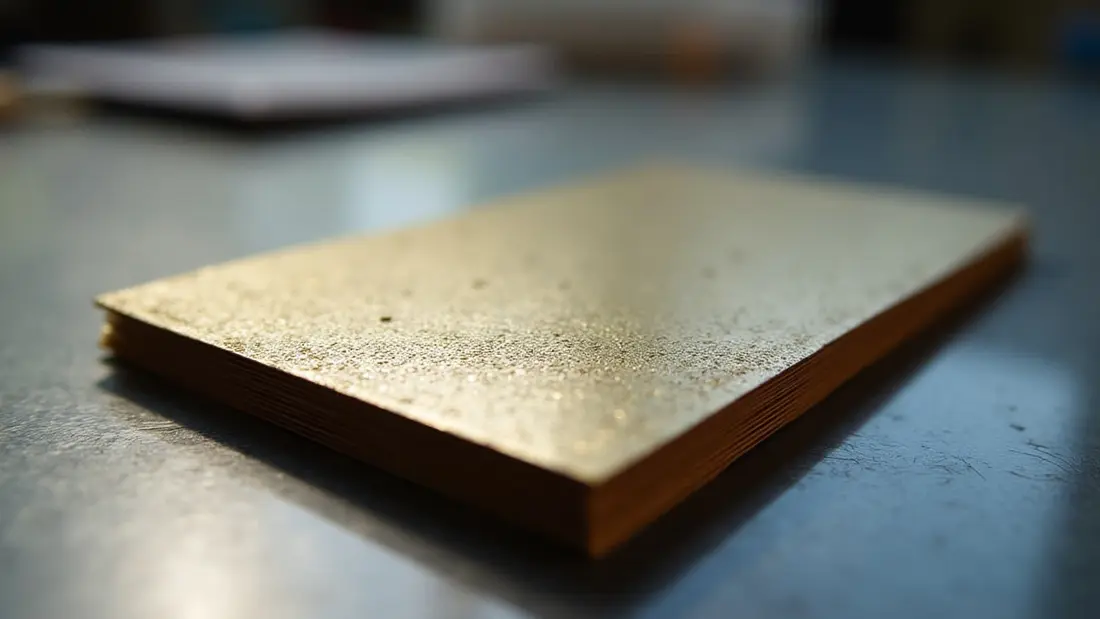
Most people meet raised foil before they know what it is called. Someone hands you a card, your thumb finds a logo that is standing up off the surface and catching the light, and you look at it twice instead of pocketing it. That double-take is the whole product. It is also the only thing you are paying extra for, which makes raised foil a very easy decision to get wrong — a card with foil on the wrong element, at the wrong size, over the wrong background costs the premium and buys none of the effect. We print these at the shop on Lankershim for agents, designers, salons, studios and consultants across the Valley, and the difference between a card that lands and a card that just cost more is almost always decided in the file, not on the press.
What "raised foil" actually means
Traditional foil stamping is a metal die: your logo is etched into a plate, the plate is heated, and it presses foil into the card under pressure. It works beautifully and it comes with a die charge and a die lead time, which is why it lives on wedding invitations and not on a run of a hundred business cards.
Raised foil is the digital route to the same look. The card is printed normally, then a clear raised layer is applied exactly where the foil belongs, and metallic foil is fused onto that layer under heat and pressure. No etched die, no plate to pay for. The result is genuinely dimensional — the foil sits physically above the card surface, so it reads by touch in the dark and by reflection under a light. Run a fingernail across it and you can feel the edge of every letter.
Two consequences follow from "it sits on top." First, the foil is opaque, so it shows on a black card as clearly as on a white one — unlike metallic ink, which mixes with what is under it. Second, nothing prints over foil. Whatever is foiled is finished; you cannot lay type across it or knock text out of it afterwards.
The price, next to what else you could print
Our raised foil business cards start at $83.62, with a default run of 100 pieces at $0.84 each. Hold that number against classic business cards, which start at $25.70 with a default run of 50 at $0.51 each. Per card, foil is a bit over sixty cents more.
That is the entire argument, and it is worth stating plainly because people talk themselves into and out of foil on vibes. Sixty cents is the price of the card being examined rather than filed. If you hand out four cards a week at open houses and networking events, foil costs you about ten dollars a month. If you print two thousand cards and leave stacks of them on counters where nobody looks at them individually, foil is money spent on an effect nobody experiences, and classic stock does the job.
For comparison in the other direction: die cut business cards start at $129.14, default run 100 at $1.29 each, and clear plastic business cards start at $92.60, default run 50 at $1.85 each. Those change the card's silhouette or substrate. Foil changes its surface. If the memorable thing about your brand is a shape, cut it. If it is a mark, a monogram or a name set in something distinctive, foil it.
Building the foil layer
The press needs to be told where foil goes, and it will not guess. Supply your artwork with a separate layer or a separate file containing only the elements to be foiled, drawn in solid 100% of a single spot colour and named clearly — "FOIL" is fine. Everything on that layer gets foil. Anything at 50% grey, anything with a gradient, anything with a drop shadow or a soft edge is a problem: foil is on or off, with no tonal range at all. A gradient in the foil layer will come back as a hard-edged blob.
Weight matters more than you expect. Hairlines and very small type are where raised foil disappoints, because the raised layer has to build enough height to hold foil and a two-point rule does not have the surface area to do it cleanly. Keep foiled strokes reasonably substantial, avoid text below about eight points in the foil layer, and treat serif faces with fine hairline strokes as risky — the thick parts will foil and the thin parts may go patchy. If your logo has fine detail, foil the solid mass of it and let the detail live in ordinary ink.
The rest is standard card prep: final size with an eighth of an inch of bleed all round, text and logos an eighth of an inch inside the trim, CMYK at 300 dpi at final size or vector with fonts outlined. One extra rule specific to foil — do not design elements that require the foil to register perfectly inside a printed outline. A thin printed keyline around a foiled shape will look centred on some cards and slightly off on others, and it will be the only thing you see. Let foiled elements stand alone, or overlap them generously.
Choosing what gets foiled
The discipline here is subtraction. Foil everything and the card reads as a mirror with words on it; nothing is emphasised because everything is. The cards that work usually foil one thing: the logo, or the name, or a single graphic element, with the rest in flat ink.
Put ordinary information in ordinary ink. Phone number, email, address and title should be plain, dark and matte, because they are read at arm's length under bad light — a phone number in shiny foil on a glossy card is legible only when you tilt it. Foil is for the element you want touched; ink is for the element you want read.
And do not foil a QR code. Foil is a mirror, a phone camera needs contrast between dark and light modules, and a metallic code under a ceiling light is frequently unreadable. Print codes in solid black ink on a light matte field and let the foil do its work elsewhere on the card.
Stock, backs and the writing problem
Raised foil goes on a thick coated stock, and the contrast that makes it land is texture: a matte or soft-touch surface next to a mirror-bright element. On a high-gloss card the whole surface shines and the foil has nothing to be brighter than.
That same matte surface solves a problem people forget about. If you are a contractor, a stylist or an agent, somebody is going to write an appointment time on the back of your card. Foil takes ballpoint about as well as a window does, and heavily coated stock is not much better. Leave a clear, uncoated-feeling area on the back — or leave the back mostly blank — so a pen actually works.
Foil is normally applied to one side. If you want it on both, say so when you order, because it changes the job. Short-run cards go through our digital printing process, and if brand colour has to match something already in the field — a sign, a vehicle, a packaging run — ask for a printed sample before committing to a large quantity, since the raised layer and the coating both affect how the ink underneath reads.
The Los Angeles part
Two things we see locally. The first is heat. Coated and soft-touch cards left in a car through a Valley summer can block — stick to each other in the stack — and the foil face is the side that suffers. Keep your working stack in a case in the bag, not loose in the glovebox, and keep the boxes indoors.
The second is that a lot of business here happens outside, on patios and at open houses, in raking afternoon sun. That is the best possible lighting for foil and the worst for a fine matte print detail. If your card is going to be handed over in daylight, foil earns its money; if it lives in a folder inside a leave-behind packet, it may not. Match the finish to where the card is actually used, and consider a small foil run for handoffs alongside a larger plain run for the packets — the ordering pages under business card printing will price both in a couple of minutes.
Angels Print prints raised foil, classic, die cut and clear plastic business cards at our shop at 8511 Lankershim Blvd in Sun Valley, for businesses across the San Fernando Valley and greater Los Angeles. If your foil layer is already separated and named, pick your quantity and order online. If you are not sure whether your logo has enough weight to foil cleanly, or which single element should carry the shine, call us at (818) 806-9006 or bring the file to the shop and we will look at it with you before you pay for a run.