

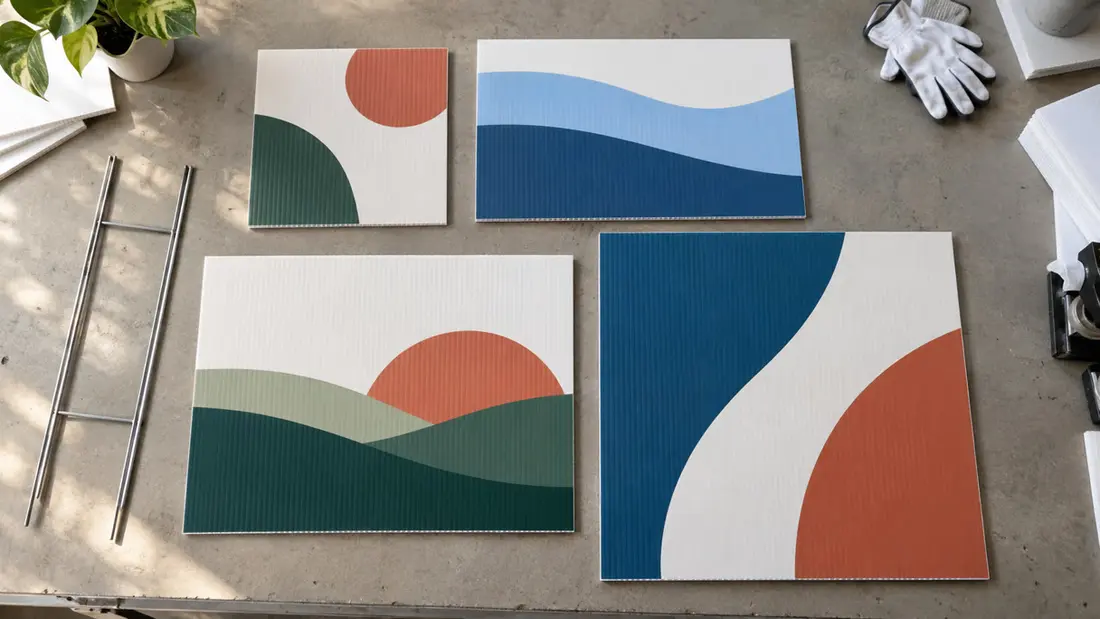
A common standard yard sign size is 24 × 18 inches. That's 24 inches wide and 18 inches tall, giving a short headline and direction arrow useful room. Start there, then check the fit. Your choice depends on viewing distance and installation space. Angels Print lists 12 × 12, 18 × 12, 24 × 18 and 24 × 24 inches, plus Custom Size.
Start with the message. For this comparison, use OPEN HOUSE, SAT 1–4, and a right-pointing arrow on every sign. Keeping the copy fixed shows what extra width buys: larger letters and enough separation that the arrow doesn't compete with the headline.
Which standard yard sign size gives your words enough room?
Read dimensions as width × height. The four sizes on our Yard Signs product page suit different layouts: a square gives you vertical stacking room, while a wider rectangle lets a headline stretch across one line.
12 × 12 inches: Stack OPEN above HOUSE, with SAT 1–4 and the arrow below. This compact format is a candidate for a nearby walking audience. Vertical space gets tight quickly. Enlarging the headline leaves less room between the hours and arrow.
18 × 12 inches: Try OPEN HOUSE on one line, with the hours and arrow underneath. You gain 6 inches of width over the 12-inch square. Height stays the same. That helps the headline, but doesn't make room for several additional lines.
24 × 18 inches: Keep the two-line arrangement and enlarge the lettering. This panel is 6 inches wider and 6 inches taller than 18 × 12. Give the arrow more room. Use the remaining space to separate the headline from the hours before adding information.
24 × 24 inches: Put OPEN HOUSE at the top, SAT 1–4 on its own row and the arrow below. You gain 6 inches of height over 24 × 18, but no width. The benefit is vertical breathing room. The same single-line headline won't automatically become larger.
Compare proportional outlines before choosing. At 1:6 scale, the four signs become 2 × 2, 3 × 2, 4 × 3 and 4 × 4-inch illustrations on paper. Sketch the same message inside each to compare spacing. These are planning illustrations. They aren't production templates or reading-distance tests.
Will people walk past or read from a moving vehicle?
A person on foot may stop to read the hours; someone passing in a vehicle has less time to recognize the message and direction. Give OPEN HOUSE and the arrow priority for that audience. A phone number takes space. Don't shrink the headline and arrow to squeeze it in.
Distance still matters on foot. A sign across a broad entrance needs a different lettering decision from one beside a walking route. Check the actual viewing position, including the approach angle. Viewed obliquely, the face appears narrower and a tightly packed headline becomes harder to separate.
Make a full-size paper mockup. Ask another person to identify the headline and arrow from the intended distance without telling them the wording first. If they struggle, shorten the copy or enlarge the letters. A larger panel helps only if the artwork uses the added space.
Panel dimensions alone can't promise readability at a particular distance. Letter style and contrast affect the result, as do viewing conditions. Test your actual message. Our yard signs guide for Los Angeles covers broader effectiveness questions.
How much installation space do you actually have?
Measure the clear width and height where the sign face will sit. A 24-inch-wide panel won't fit within an 18-inch-wide opening. Then check the approach view. A panel may fit while planting or another obstruction hides its bottom line.
Panel size isn't the complete installed footprint. Both products list H Stakes as Yes or No, along with grommet choices. Confirm support dimensions and mounting needs separately; selecting a sign size doesn't establish its installed height.
Choose Front Only or Front and Back according to the approaches you need to serve. Two printed faces can address opposite directions. Check each face for obstructions. Resolve any hidden lettering before laying out the bottom row.
How much text fits inside a custom shape?
Our Custom Shape Yard Signs list Custom Shape and Circle options. Custom Shape lists 12 × 12, 18 × 12, 24 × 18 and 24 × 24 inches; Circle lists 12 × 12 and 24 × 24. Custom Size is also listed. Check the configurator for available combinations.
Outside dimensions aren't usable text dimensions. A circle narrows toward its top and bottom, leaving a headline near the top less room than a square of equal width. Roof slopes reduce space in a house-shaped outline. Narrow projections may add little lettering room.
Repeat the comparison inside your proposed outline. Keep OPEN HOUSE in the broad central portion, with separation from the cut edge. Don't stretch words into a roof peak just because it falls within the overall height. Awkward line breaks need attention. Ask Custom Design to help balance the outline and message.
What else belongs in the size comparison?
Both products list 4mm White Coroplast. A matte or gloss finish isn't established by the supplied options, so confirm any finish requirement before ordering. Hold material and printed sides constant while comparing dimensions.
Quantity menus include individual signs and selected quantities up to 200. Yard Signs has a listed starting price of $1001.78, associated with a default run of 93 pieces. Custom Shape Yard Signs starts at $1008.82, associated with a default run of 78 pieces. Those runs aren't directly comparable. They aren't matched quotes for these layouts.
Compare configurations at the same quantity. Review your intended size and shape alongside printed sides and hardware selections, since those choices belong in the cost comparison. The final checkout price applies to the selected configuration.
What should you check before submitting artwork?
Build the file for your selected dimensions, following the upload's stated file types, bleed and safe-area requirements. Sketch margins aren't production specifications. Ask for missing requirements before preparing final artwork, especially around a custom outline.
Check raster image resolution at final print size. Enlarging a small layout can soften a logo even if its text looks acceptable on screen. A preview doesn't confirm production readiness. Neither does uploading the file.
A digital proof is available on request, and manufacturing starts immediately after payment. Resolve layout questions before paying. Order your Yard Signs configuration online, or call Angels Print at (818) 806-9006 to discuss dimensions and readable lettering. You can also bring your message and installation measurements to 8511 Lankershim Blvd, Sun Valley, CA 91352.
Frequently asked questions
What is the standard yard sign size?
A common size is 24 × 18 inches. Width is listed first. Angels Print also lists 12 × 12, 18 × 12 and 24 × 24 inches. Choose according to your message, viewing position and installation space.
Is an 18 × 12 yard sign big enough?
It can suit a short message viewed nearby, but offers less room for large lettering than 24 × 18. Test it at full size. Use the intended viewing position before choosing this size for passing traffic.
Does a larger yard sign need larger lettering?
If readability is why you're buying a larger panel, enlarge the main message and separate it from supporting details. Extra words can defeat the purpose. Keeping the original letter size while adding copy may waste the added room.
Do custom shape yard signs have less room for text?
The outline makes the difference. Curves, roof slopes and narrow projections can reduce lettering space compared with a rectangle of the same outside dimensions. Fit the message inside the actual outline and follow the selected product's safe-area requirements.