

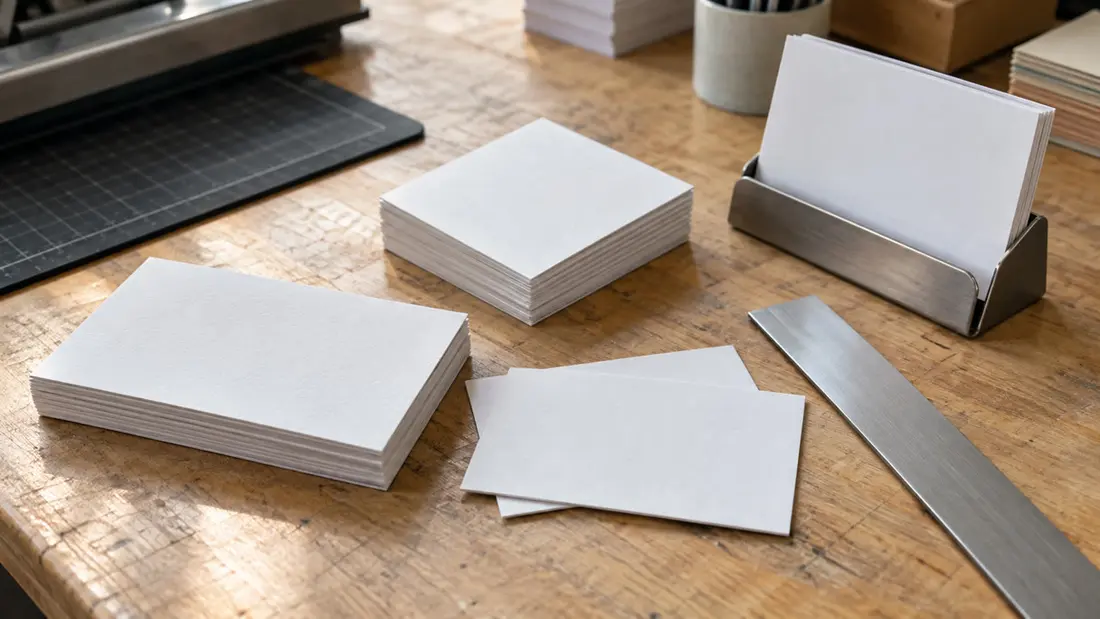
In the U.S., the standard answer to “what size is a business card” is 3.5 × 2 inches, or 88.9 × 50.8 millimeters. Those are the finished dimensions after cutting, not necessarily the dimensions of your artwork file. Square cards use different finished sizes, including the 2 × 2-inch option at Angels Print.
Start with the finished card. Then establish the file requirements for that exact selection before arranging your text. Confusing these measurements can leave a background short of the cut edge or put a phone number too close to it.
Beyond the standard, what size is a business card?
The familiar 3.5 × 2-inch rectangle gives you horizontal space for a name, title and contact details. Turn the layout vertically and the same card becomes 2 inches wide by 3.5 inches tall. Its physical size hasn't changed.
Angels Print's Classic Business Cards ordering options include a 3.5 × 2-inch rectangle and a 3.35 × 2.16-inch rectangle. The product also lists a 2 × 2-inch size for its square and circle selections. Match the size to the selected shape in the configurator.
The Square Business Cards sizes and options include 2 × 2, 2.5 × 2.5 and 3 × 3 inches. Both products list Custom Size, with width and height limits of 1.5 to 4 inches. The configurator confirms which combination is available.
Use this inches-to-millimeters table for finished sizes only. One inch equals exactly 25.4 millimeters; none of these measurements includes an allowance for bleed.
Format Inches Millimeters
Classic rectangle 3.5 × 2 88.9 × 50.8
Alternate rectangle 3.35 × 2.16 85.09 × 54.864
Small square 2 × 2 50.8 × 50.8
Medium square 2.5 × 2.5 63.5 × 63.5
Large square 3 × 3 76.2 × 76.2
Which format gives your information enough room?
Choose the rectangle if long lines drive the layout. An email address or website often fits more comfortably across 3.5 inches than across a 2-inch square. A square can suit a centered logo with shorter contact lines, but shrinking an existing rectangular design can make the type unnecessarily small.
Rearrange it instead. Both products offer Front Only or Front and Back printing, so a second face can hold information that would otherwise crowd the first. Print a paper mockup at actual size and check the smallest text before deciding the layout is readable.
Measure your intended holder too. A 2.5-inch square is taller than a standard 2-inch-high card, and a 3-inch square needs more space again. The square business card format guide covers the broader format decision; here, the first check is whether the finished dimensions suit the way you'll carry and distribute the cards.
Where do trim, bleed and the safe area sit?
Trim is the intended cut boundary. A classic card ordered at 3.5 × 2 inches finishes at that size. Slight trim variation is normal in physical printing, which is why artwork needs room on both sides of the intended cut.
Bleed is background artwork extending outside the trim boundary. It gives the cutter room to move slightly without exposing an unintended white edge. Extend edge-reaching photographs or background colors into the required bleed area.
Safe area sits inside the trim boundary. Keep contact details and other content you cannot afford to lose inside the specified safe boundary. Bleed protects the background; the safe area protects the information.
Conceptual diagram, not to scale. The outer box shows artwork including bleed; the middle box shows the finished card; the inner box shows the protected content area.
┌──────────────────────────────────┐
│ ARTWORK EDGE │
│ Bleed outside the trim │
│ ┌──────────────────────────┐ │
│ │ TRIM: finished card │ │
│ │ 3.5 × 2 in, classic │ │
│ │ ┌──────────────────┐ │ │
│ │ │ SAFE AREA │ │ │
│ │ │ Keep text here │ │ │
│ │ └──────────────────┘ │ │
│ └──────────────────────────┘ │
└──────────────────────────────────┘
The diagram explains the relationship, not Angels Print's production offsets. Rounded corners also remove material near each corner. Both products list 1/8-inch and 1/4-inch round-corner options, but those corner measurements do not establish the required safe-area inset.
What artwork dimensions should you actually use?
Use the actual template or artwork requirements for your selected product and size. The supplied product information does not include downloadable templates or numeric bleed and safe-area specifications. There is therefore no verified basis here for prescribing a particular oversized canvas for either product.
Ask Angels Print for the matching template and missing measurements before preparing the file. Don't borrow a bleed value from an unrelated printer or assume the classic and square products share one. A catalog size establishes the intended finished size, not every production-file dimension.
The calculation is straightforward once the allowance is confirmed. If the template specifies equal bleed on every edge, artwork width equals trim width plus twice that bleed; artwork height follows the same rule. A specified equal safe inset reduces each usable dimension by twice the inset.
Follow the file types listed beside the artwork upload. A print-ready PDF can be useful for a finished layout, and image resolution should be checked at final print size. Uploaded files are attached as supplied; an upload or preview does not confirm production readiness.
Do stock and finish change the size decision?
Stock changes how the card feels and how many cards a holder can accommodate. Both products list 14PT and 16PT coated stocks. Square Business Cards also lists 28PT Coated Both Sides (2 Layers). Thickness and face dimensions are separate choices.
Finish affects the surface. Classic offers glossy, dull matte and UV high-gloss choices on compatible stocks, while Square includes matte and soft touch lamination options. Square also lists foil and raised spot UV. Availability depends on the other selections, so confirm the complete configuration before designing around a finish.
How should you compare quantities and prices?
Classic Business Cards starts from $1000.00; Square Business Cards starts from $1000.06. Their supplied default runs differ: 17450 pieces for Classic and 12754 pieces for Square. Those starting prices aren't a comparison of equal quantities or matched specifications.
The listed quantity menus also differ. Classic includes selections from 50 through 20000, with gaps; Square includes selections from 50 through 5000, also with gaps. Check the quantity actually selected rather than treating the default run as every available ordering choice.
Compare matching quantities where available, then review size, stock, printed sides and finishing together. These selections can affect cost. Checkout shows the final price for the chosen configuration; the Business Card Printing service provides a starting point for discussing the job.
What should you check before paying?
Avoid narrow borders close to the cut, where small trim shifts become easy to notice. Check both faces at actual size and make sure a square layout was rebuilt rather than stretched from a rectangle. Confirm the template's bleed and safe boundaries before exporting.
A digital proof is available on request, and manufacturing starts immediately after payment. Resolve file questions before checkout. If you need help adapting the layout, Custom Design can assist, with scope and timing confirmed for the project.
Order Classic Business Cards or Square Business Cards online once your finished size and file requirements are settled. For the matching template or setup guidance, call Angels Print at (818) 806-9006 or visit 8511 Lankershim Blvd, Sun Valley, CA 91352. Pickup is always free.
Frequently asked questions
What size is a standard business card in inches and millimeters?
A standard U.S. business card is 3.5 × 2 inches, equivalent to 88.9 × 50.8 millimeters. These are finished dimensions after cutting. Artwork may need to extend beyond them, according to the bleed requirements for the selected product.
What size should business card artwork be with bleed?
Use the dimensions in the selected product's actual template. For equal bleed on every edge, add twice the specified bleed to each finished dimension. Angels Print's supplied product information does not state numeric bleed requirements, so ask before setting up the file.
What sizes do square business cards come in?
Angels Print lists 2 × 2, 2.5 × 2.5 and 3 × 3 inches for Square Business Cards, plus Custom Size. These are finished sizes. Confirm the selected combination in the configurator and measure any holder before choosing a larger square.
What is the safe area on a business card?
The safe area is the region inside the trim boundary reserved for content that must survive cutting, such as your name and phone number. Follow the selected product's specified inset. A rounded-corner radius does not tell you the required safe-area measurement.