

September 8, 2026
Table Runners in Los Angeles: The Cheapest Piece of Booth Signage, and How to Not Waste It
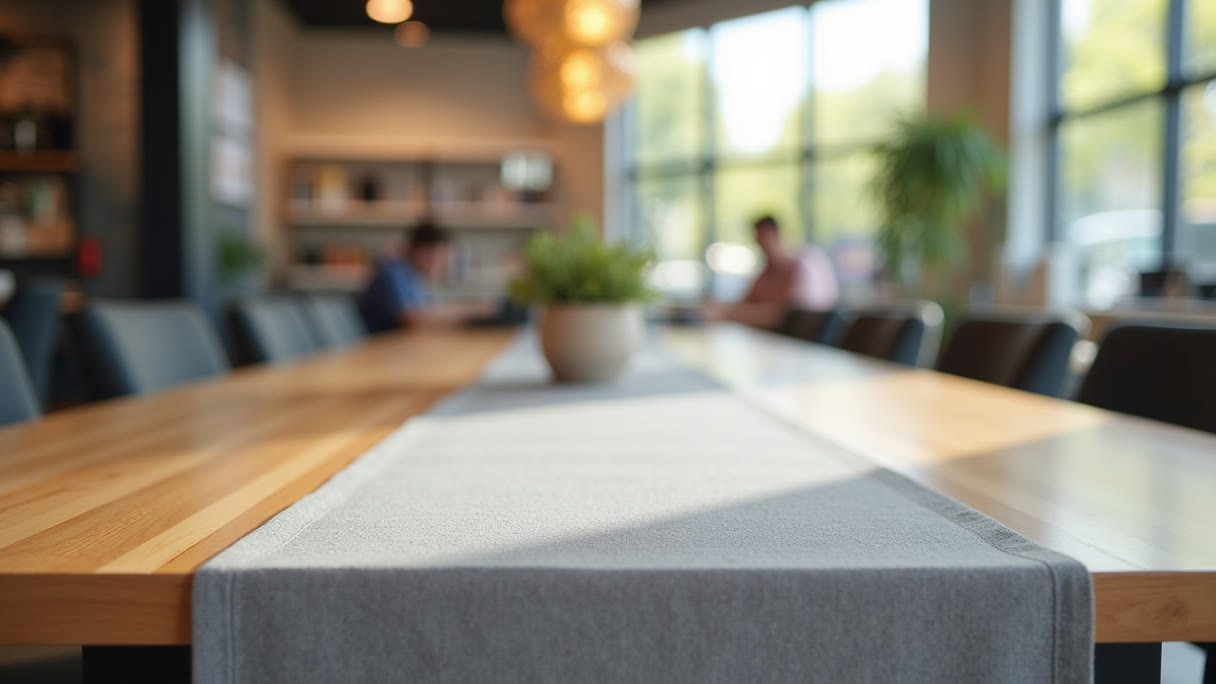
Walk down a row of booths at a weekend market anywhere in Los Angeles and you can sort the tables from thirty feet away. Some of them have a name on the front. The rest are a folding table with a bedsheet over it and a stack of product on top. The difference is usually a printed runner, and it is one of the cheapest pieces of booth signage there is, because it uses furniture the venue already gave you. We print table runners at the shop on Lankershim for farmers market vendors, craft fair sellers, school and church groups, trade show teams and anyone else who gets handed a six-foot folding table and thirty minutes to make it look like a business.
This is what we go through with people before they send us a file.
What a runner covers, and what it leaves showing
Our table runner starts at $62. It is a printed panel of fabric that lies over the table from front to back — down the front edge, across the top, down the back — leaving the tabletop on either side of it bare.
That is the whole idea, and it is worth saying out loud, because a fair number of people order a runner picturing a tablecloth. A runner is a vertical stripe down the middle of your table, not a cover for it. Which is why nearly everyone lays a plain cloth underneath first — black, white, or whatever neutral your brand tolerates — and drops the printed runner on top of that. The plain cloth hides the folding legs and the scuffed particleboard; the runner carries the name.
The piece that does the work is the front drop. A standing customer is looking at your table from about ten feet out, and from there the tabletop is a shelf they see edge-on. The front panel of the runner is the only part of that table sitting at eye level. Everything you spend on the design should be spent there.
Design for the front drop, not for the whole panel
When people lay out a runner they tend to open the file, see one long rectangle, and centre the logo on it. The centre of that rectangle is the tabletop, and the tabletop is going to be under a cash box, a card reader, three trays of product and somebody's elbow within ten minutes of opening. Centred artwork is invisible artwork.
Put the name and one line on the front drop. Business name, and three or four words for what you sell — "cold-pressed soap," "hand-thrown ceramics," "resin and epoxy art." That is the whole brief. A stranger walking past at conversational speed reads one line, not a paragraph, and certainly not your full service list.
Sit that artwork high on the drop. The lower part of the front panel is behind shoulder bags, folding chairs, boxes of restock and people's legs all day. Keep the important marks in the top portion of the drop, close under the table edge, where nothing is parked in front of them.
Leave the top run mostly quiet. The strip that crosses the tabletop is not wasted, but it is for the person already standing at your table with a wallet out. A subtle repeat of the mark or a flat brand colour is enough. Loud pattern up there fights the product, and the product is what you are actually selling.
Do not put a QR code on the front drop. Knee height, in a crowd, on fabric that moves — nobody is going to crouch and scan it. Codes belong on something rigid at reading height on the table itself.
Skip the phone number in giant type. Nobody at a market calls you; they either buy now or they photograph the sign. Legibility of your name beats completeness of your contact details every time.
What else belongs around the table
A runner solves the front of the table and nothing else, and the booths that pull people in usually have two more things going.
In front, on the ground, an A-Frame sidewalk sign starting at $94.99. This is your reach sign. It sits out in the aisle, points down the row, and gets read by somebody who has not decided to walk toward you yet. Because it is double-sided and freestanding, it catches foot traffic from both directions, and it is the piece to put a promotion or a today-only price on — the runner should stay generic so it works at every event, while the A-frame carries whatever is true this weekend.
On the table, acrylic business signs starting at $46.76. Small rigid standing pieces at arm's length: prices, flavours, sizes, the QR code, "we take Venmo." These answer the questions you would otherwise repeat two hundred times a day, and they hold their shape in wind in a way that paper taped to the front of a table never does.
Behind the table, if you have any wall or easel at all, acrylic printing starting at $90 gives you a photo-grade panel with real depth to it. This is where a product shot or a large logo goes at head height, above the crowd, visible when three people are standing at your table blocking the runner entirely. That last part is worth thinking about: at your busiest moment, your busiest customers are hiding your best sign.
If the booth is one piece of a bigger picture — a storefront that needs the same identity on the door, or a stand you take to several events — that is our signage and front signs work, and the aisle-facing, weather-exposed side of it sits under outdoor advertising and signs.
Colour, files and what to send us
Fabric is not paper. Ink sits into the weave rather than on top of a coated surface, so deep blacks read slightly softer and a fluorescent-looking colour on your monitor comes back as a strong ordinary colour on cloth. That is the material, not a printing error. Build in CMYK and choose colours that hold up when they are one step calmer than you imagined.
Send vector artwork with fonts outlined wherever possible. If you only have raster — a photo, a scan, a logo pulled off a website — remember that large format is viewed from a distance, so you do not need 300 ppi, but you do need real pixels at final size. A 600-pixel-wide logo blown up across a table front will show every edge.
Pick size and fabric in the configurator, then build the artwork at that size with bleed all round, and keep anything you cannot afford to lose well inside the edges. Also mark on your layout roughly where the table edge falls, so you know which part of your design is on the vertical drop and which part is lying flat. Designs get approved on screen as flat rectangles and then discovered as folded objects at the event.
The part nobody thinks about until event ten
A runner is fabric, and fabric creases. It lives in a car trunk or a bin with your tent poles, gets pulled out at seven in the morning, and either looks sharp or looks like laundry. Fold it the same way every time so the creases land in the same places, or roll it around a tube, and keep a travel steamer in the kit. Ten seconds of steam on the front drop is the difference between a booth that looks run by a business and one that looks run out of a garage.
Also think about what happens if you get a longer or shorter table than you were promised, because at some point you will. A runner is far more forgiving here than a fitted cover — it does not care how long the table is, only how deep. That flexibility is a genuine reason to start with a runner rather than a full fitted throw, especially if you do a mix of markets, expos and pop-ups where the furniture changes every time.
One more practical note: order the runner before you order the rigid signs. The runner sets your colours in the real world, and it is much easier to match a small acrylic sign to a printed fabric you are holding than to guess both at once and hope they agree on the day.
Angels Print prints table runners, A-frame sidewalk signs, acrylic business signs and acrylic panels at 8511 Lankershim Blvd in Sun Valley, for vendors and businesses across the San Fernando Valley and greater Los Angeles. If your artwork is ready, pick your size and quantity and order online. If you are still working out how much of your design lands on the front of the table and how much disappears under the cash box, call us at (818) 806-9006 or bring the file into the shop and we will lay it out with you first.