

September 8, 2026
Table Tent Cards in Los Angeles: The Four Seconds They Get, and How to Not Waste Them
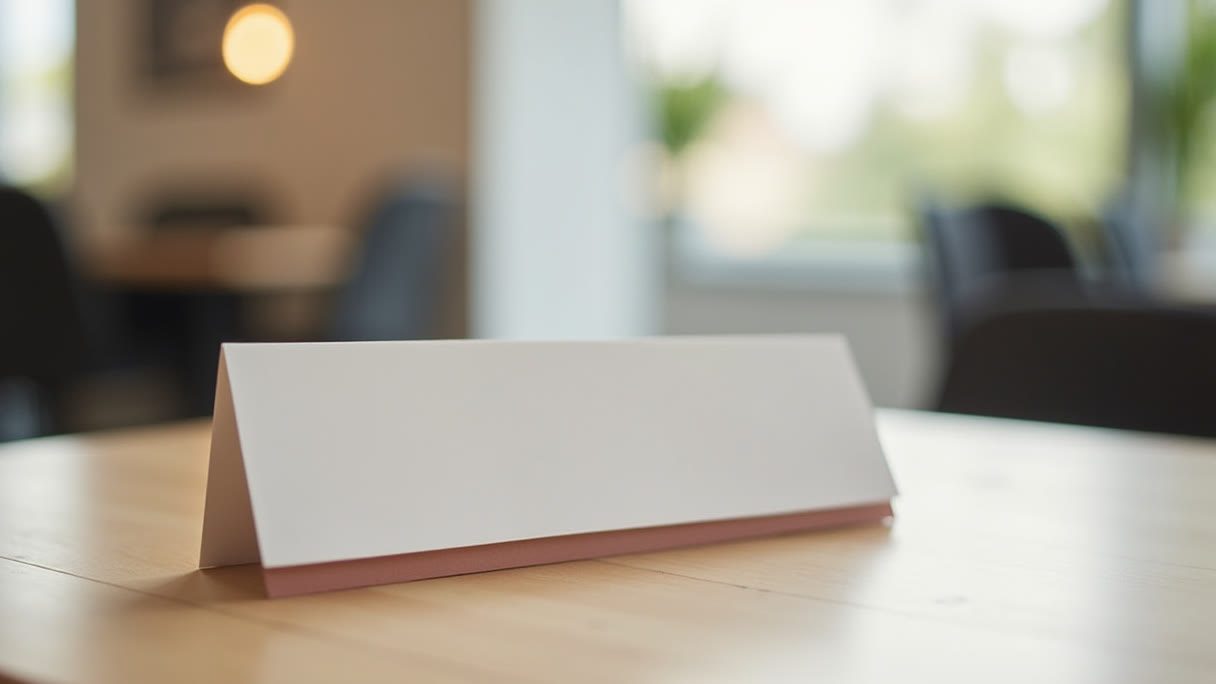
A table tent is the only piece of print in a restaurant that people read voluntarily. Nobody asks for a flyer. Nobody wants the door hanger. But a person sitting at a table in Los Angeles with a drink coming and a phone they have already scrolled through will pick up the small folded card in front of them and read all of it, both sides, because it is there and because waiting is boring. That is a captive audience that costs you two dollars a table.
We print table tent cards at the shop on Lankershim for restaurants, bars, coffee shops, hotel front desks, salons, gyms, tasting rooms and conference organizers across the San Fernando Valley and greater LA. They start at $53.05, and the default run is 25 pieces — $2.12 each. What follows is what we tell people at the counter, including the parts that talk them out of things.
What you are actually buying
A table tent is a flat sheet, printed, scored and folded into a standing triangle or a folded card that props itself up. The important word there is scored. A fold that has been creased along a scored line stands square and stays square; a fold made by pressing a sheet with your thumb cracks the ink along the spine, bows outward, and leans. On heavier stock the difference is not subtle — an unscored fold on a thick sheet will split the coating on the outside of the bend and leave a white line down the middle of your logo.
The second thing you are buying is the base. A tent stands because its two lower edges push against each other and against the table. If the sheet is too light, the tent bows in the middle and topples the first time someone sets a glass down hard, and once one falls over on a busy Friday nobody on staff is going to walk the floor standing them back up. Stock and finish are chosen in the configurator; the reflex to save a few dollars by dropping to a lighter sheet is the single most common way a table tent run ends up in a drawer behind the register.
Design for a person sitting down
You are designing for someone whose eyes are about eighteen inches away and roughly level with the top of the card, looking down at maybe thirty degrees. That is not how you look at your monitor, and it is why table tents that looked fine in the file come back feeling cramped.
Put the message in the top third. The bottom of a tent is behind the salt, the napkin holder, the condiment caddy or somebody's phone. Anything below the halfway line has a real chance of being invisible for the entire meal. Headline high, detail low, and nothing you actually need in the last inch.
One offer per tent. The happy hour, the loyalty program, the new seasonal cocktail and the private events email do not belong on the same card. A tent has two or four panels and each one gets a single idea, because a person reads one panel, decides, and puts it back down. If you have four things to say, you have a brochure, not a table tent.
Type bigger than feels right. Body copy at eight points reads fine on a card you are holding. It does not read across a dim dining room in a booth. Twelve points is a floor for anything you expect a customer to actually read, and the headline should be legible from the next table over — that is what recruits people who have not sat down yet.
QR codes want light behind them. If the tent points at a menu, a reservation page or a review link, give the code a clean white field of at least an inch and a quarter square and leave the quiet margin alone. Codes printed small, printed on a dark photo, or printed with a gloss finish under a hard downlight are the three ways this fails in a room, and none of them show up on screen.
The panels people forget they paid for
A four-panel tent has an outward face on both sides. Most people print one and leave the other with the same artwork, which is fine, but it is also a whole surface you already bought. Different sides of a table face different people. In a booth, one side faces the wall and one faces the room. At a bar, one side faces the customer and one faces the bartender.
So put the customer-facing offer on one side and something the staff or the room needs on the other — the wifi password, the specials, the number for takeout, the fact that you cater. We have printed tents where the back panel was just the Instagram handle in large type, and that was the panel that did the work.
Where table tents fail
Grease and moisture. A card sitting between a bread basket and a water glass gets touched with wet hands, splashed, wiped down and set back. Uncoated stock absorbs all of that and looks tired within a week. If your tents live on tables where food is served, choose a coated or laminated finish in the configurator and plan to accept that they are a consumable.
The drink ring. A tent standing near the edge of a two-top will get a glass parked against it. Nothing prevents this. What you can do is design so a two-inch stain at the bottom of the panel does not destroy the message, which is another argument for keeping everything important in the top third.
Staff throw them away. Bussers clear tables fast, and a leaning, stained, folded-over tent looks like trash and gets treated like trash. Order enough that swapping a damaged one costs you nothing, and tell the front of house that replacing them is part of the reset.
How many to order
Count your tables, then count again for the bar top, the host stand and the patio. That is your live number. Then double it, because half of your run should be sitting in the back as replacements and because a promotion that runs eight weeks will chew through the first set.
Twenty-five is the default run and is genuinely right for a small café or a single-room bar with a dozen tables. A full-service restaurant with a patio should be ordering in the fifties or hundreds. And if the tent promotes something seasonal — a summer menu, a holiday prix fixe, a two-month happy hour — order for that season and reprint, rather than printing a generic tent that says nothing and stays on the table for two years being ignored.
When a tent is not the object you want
If it needs to leave with them, a tent is wrong — it is designed to stay on a table, and a folded card in a pocket is a crumpled card. Die cut postcards start at $178.94 with 50 pieces as the default run, $3.58 each. A shaped card that goes out with the check or into the bag is a takeaway; a tent is a billboard.
If it needs to survive a year, print a magnet instead. Circle and oval magnets start at $130.63, 100 pieces at $1.31 each. That is cheaper per piece than the tent and it ends up on a refrigerator, which is a longer engagement than any card on a table gets.
If it is going on a wall, not a table, you may be describing a certificate — a food handler card, a wine list award you actually hold, a staff recognition piece for the back of house. Certificates start at $74, 50 pieces at $1.48 each, on stock built to be framed rather than folded.
Files and finishing
Send vector artwork with fonts outlined, built flat at full unfolded size with an eighth of an inch of bleed on every edge, and mark where the folds go. Keep anything that must not be cut or creased at least a quarter inch clear of the trim and the score lines — a phone number that crosses a fold is a phone number with a crease through it. Build in CMYK; a saturated red that glows on a laptop comes back calmer on coated paper, and that is physics, not a mistake. Raster elements at 300 ppi at final print size.
Short runs like this go through the same digital printing presses we run everything else on, which is why 25 pieces is a real quantity here and not a minimum you have to argue for. If you are reprinting seasonally, keep the file layered and keep the fold marks in it — the next run is usually the same tent with a different price on it.
Angels Print prints table tent cards, postcards, magnets and certificates at 8511 Lankershim Blvd in Sun Valley, for restaurants and businesses across the San Fernando Valley and greater Los Angeles. If your artwork is ready, pick your size, stock and quantity and order online. If you want to see how a tent stands on a real table before you print a hundred of them, or you are not sure whether the message belongs on a tent or a takeaway card, call us at (818) 806-9006 or bring the file into the shop and we will work through it with you.