

September 8, 2026
Table Throws in Los Angeles: Sizing, Fabric, and the Mistakes That Show Up on Camera
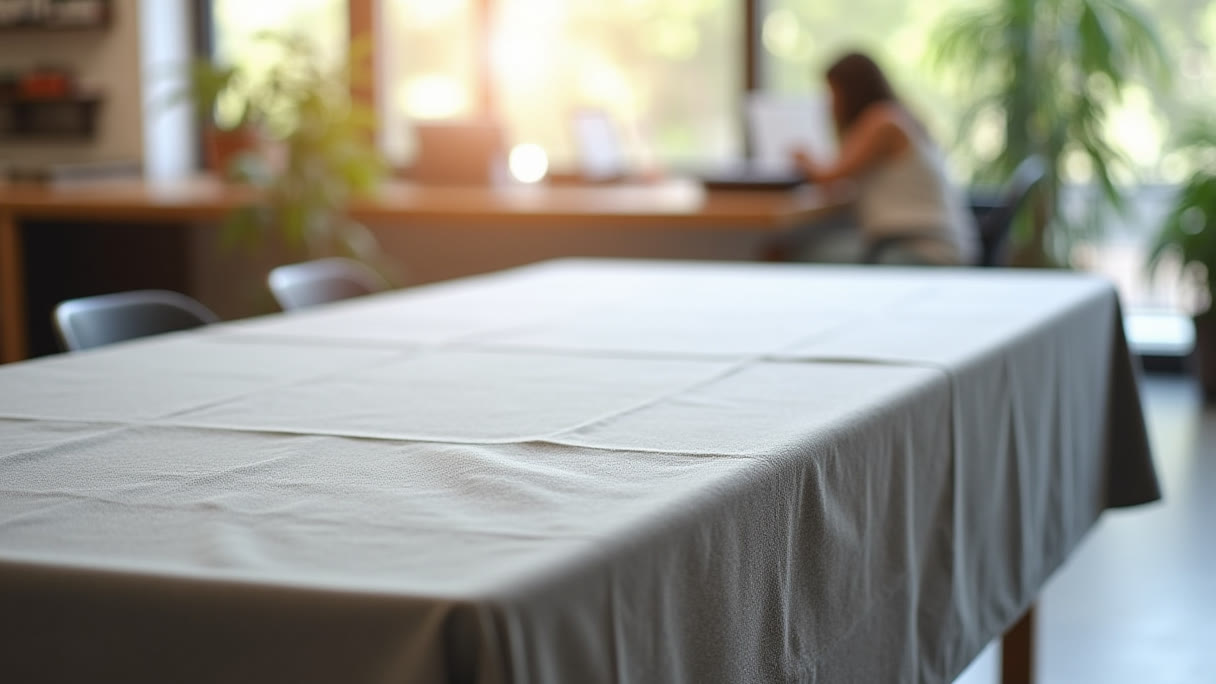
Walk any expo hall in Los Angeles — the Convention Center, a hotel ballroom in Burbank, a school gym in the Valley, a farmers market on a Sunday — and the tables are all the same. Six feet of folding plastic, sometimes eight, occasionally a four-foot cocktail round. What separates the booths is what is draped over them. We print table throws at the shop on Lankershim for exhibitors, churches, breweries, real estate teams, nonprofits and campaign volunteers across the San Fernando Valley and greater LA, and it is consistently the piece people underthink and then regret.
Here is what we go through at the counter before a throw goes to print.
Measure the table, not the booth
Our table throw starts at $175, with size, fabric and print coverage picked in the configurator. The single most important number in that configurator is the table length, and it is the one people guess.
A standard folding table is 6ft or 8ft long, 30 inches wide, and 29 to 30 inches tall. Those are the two sizes almost every venue supplies. But the venue is not obligated to give you the size on your floor plan, and a 6ft throw on an 8ft table is a disaster you cannot fix on site — the fabric will not reach the ends, the corners hang wrong, and your logo sits off-centre for two days. An 8ft throw on a 6ft table is merely untidy: it pools on the floor and drags at the corners, and you can usually tuck it.
So the rule we give people is to call the venue and confirm the table dimensions in writing, and if you exhibit at more than one kind of event, buy for the size you will see most often. If you genuinely alternate between 6ft and 8ft rooms, the honest answer is that you need two throws rather than one compromise.
Also decide the drop style before you order. A full-length throw covers all four sides to the floor and hides everything you have stashed underneath — boxes, backup stock, a power strip, your bag. An open-back throw leaves the rear panel out so you can sit behind the table and reach your inventory without crawling. Open-back is the practical choice for a two-person booth you will be standing at for eight hours. Full coverage is the choice for a table that gets photographed from multiple angles or sits in the middle of a room.
Front panel, or all the way around?
Printing the full throw costs more than printing only the front, and for a lot of booths the front panel is genuinely all that is seen. If your table is backed against a pipe-and-drape wall in a row of ten-by-ten booths, nobody will ever look at the sides.
But think about where the table actually stands. A registration desk in a lobby gets approached from the left and the right. A sampling table at a street fair gets walked past on both sides. A corner booth shows two faces. In those cases the side panels are not decoration — they are the surface people read while they are queuing.
The compromise we suggest most often: print the front full-colour with the logo and the offer, and run a solid brand colour on the sides and back. It is cheaper than full coverage, it photographs as a complete piece, and it avoids the thing that ruins a throw — a logo repeated four times at four different scales because someone tried to fill every panel.
Fabric, wrinkles, and the fact that it lives in a car
A table throw is polyester fabric, and the reason it is polyester rather than vinyl is that it has to fold into a bag, ride in a trunk, and come out looking presentable an hour later. Dye-sublimation printing puts the ink into the fibre rather than on top of it, so the colour does not crack along the fold lines the way a coated surface would, and the fabric stays soft enough to drape rather than stand out stiffly at the corners.
That still leaves creases. Fold the throw rather than balling it, and if you can, roll it around a tube instead. Most wrinkles hang out overnight if you drape the throw over the table the evening before. If you are setting up the same morning, a handheld steamer in the car is the difference between a booth that looks run and a booth that looks rented.
Washing: cool, gentle, and let it air dry. Heat is what warps polyester and puts a permanent shine on the areas that touch a hot dryer drum.
Design for eye level, not for your laptop
The centre of a table throw front panel sits roughly two feet off the ground. Anyone standing at your booth is looking down at it, and anyone across the aisle sees it partly blocked by other people's legs. Meanwhile the top third of the panel is often obscured by whatever you put on the table — product, a laptop, a bowl of samples, an iPad on a stand.
So the working area is narrower than the fabric. Put the logo and the one thing you want read in the middle band of the front panel, keep it large, and accept that the bottom few inches near the floor are essentially decorative. Fine print, a URL in 14pt, a QR code down by the table legs — none of that gets read at an event. If you need a QR code scanned, put it on a small sign standing on the table where a phone can reach it, not on the throw.
Colour behaves differently on fabric than on paper or screen. Deep saturated colours print beautifully; very light greys and pale pastels tend to read as off-white under warm ballroom lighting. And if your table sits on carpet in a hall with heavy overhead lights, a dark throw hides scuffs and shadow far better than a white one, which shows every mark from every setup.
Send artwork as vector where you can, with fonts outlined, built at final panel size. Raster elements should be at least 150 ppi at print size — fabric does not resolve fine detail the way a business card does, so a giant sharp file is less critical here than it is elsewhere, but a logo pulled off a website at 400 pixels wide will still look soft at three feet across.
What stands behind the table
A throw alone is a low horizontal band of branding. Everything above it is whatever the venue's back wall happens to be, which in most halls is grey drape. The booths that read as professional are the ones that put something vertical behind the table.
The cheapest fix is a black stand retractable banner at $62.50. It goes up in under a minute, packs into its own case, and gives you a tall panel for the message that does not fit on the throw. Two of them flanking the table is a common and effective setup.
The step up is a 3FT SEG fabric stand at $195. The graphic is a fabric panel with a silicone edge that tucks into a frame channel, so there is no visible hardware and no curl at the edges — it matches the material of the throw and reads as one designed piece rather than two purchases.
The full wall is a backdrop banner from $189.99, which is what you want if your booth doubles as a photo background — sponsors, press, headshots, anything where people will stand in front of it. Match the colour of the throw to the backdrop and the whole booth reads as a single unit from across the hall.
All of it comes off the same digital printing side of the shop, so the brand colours are being handled by the same operators on the same day rather than by three vendors in three cities. If the event branding also has to become something permanent afterwards — a lobby sign, a storefront piece, a wall logo — that moves over to signage and front signs.
Order the throw before the rest
One practical sequencing note. The throw is the piece with the least flexibility: it must fit an exact table, its colour is the anchor everything else matches to, and it is the piece you will keep for years while banners get reprinted for each campaign. Settle the throw first, then match the vertical pieces to it. Doing it the other way round is how people end up with a navy backdrop and a slightly-different-navy throw, which is far more visible in person than it ever is on screen.
Angels Print prints table throws, backdrops, retractable banners and SEG fabric stands at 8511 Lankershim Blvd in Sun Valley, for events across the San Fernando Valley and greater Los Angeles. If you know your table size and your artwork is ready, pick the size and coverage in the configurator and order online. If you are not sure whether the venue gives you a 6ft or an 8ft table, or you want us to look at how your logo sits on a front panel before it goes to fabric, call (818) 806-9006 or bring the file into the shop and we will work it out with you.