

September 9, 2026
Textured Wall Adhesive Vinyl in Los Angeles: Printing on Stucco, Brick and Orange-Peel Walls Without It Peeling Off
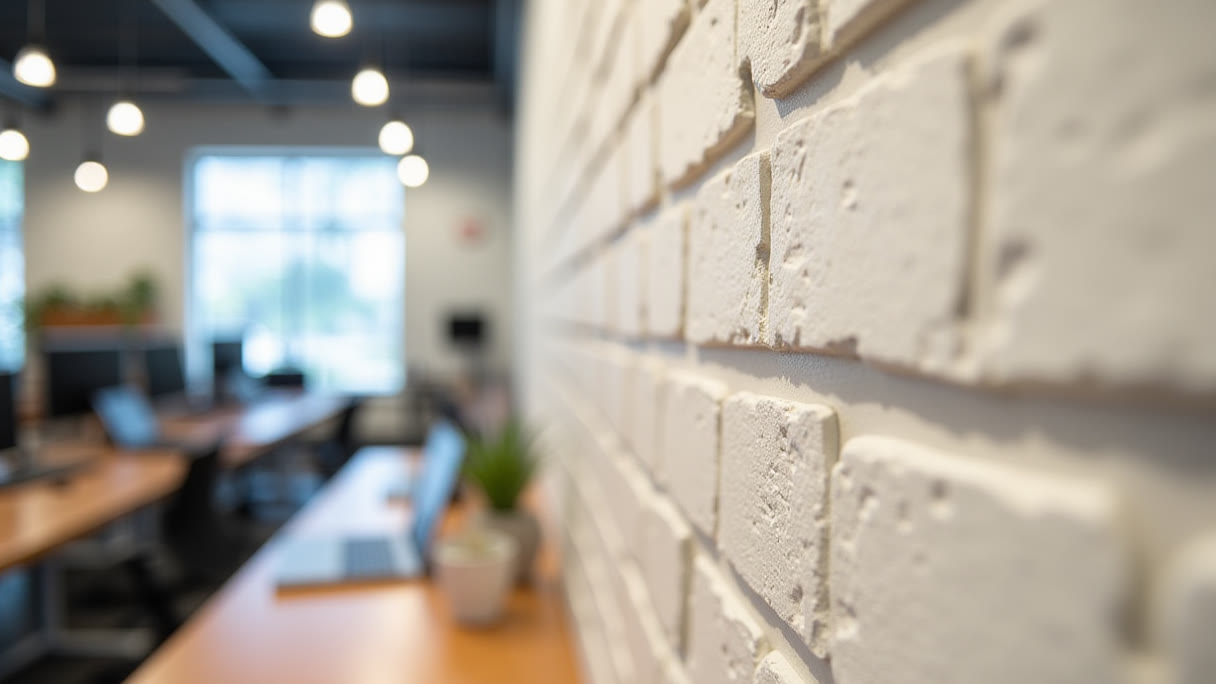
The wall somebody wants to print on in Los Angeles is almost never flat. It is stucco with a heavy sand float, or split-face block on the side of a warehouse in Sun Valley, or the orange-peel drywall every apartment and office build-out in the Valley got sprayed with since about 1985. People bring us a design, we ask what the wall is made of, and the answer changes the product.
Ordinary adhesive vinyl — the calendered sticker stock that goes on glass and flat panel — will not survive any of those surfaces. It bridges the low spots instead of settling into them, so it is holding on with maybe half of the adhesive it thinks it has, and air pockets under the bridges expand in the heat and lift the edges. We have seen a wall graphic go up beautifully on a Friday and start curling at the corners by Monday, and the material was the only thing wrong with it.
Our textured wall adhesive vinyl starts at $74.33, and this is what it is for.
What "textured" means in the material, not the design
The name confuses people. It is not vinyl with a texture printed on it. It is vinyl made to go onto texture.
Two things make that possible. First, the film is soft and conformable, so it stretches down into a valley in the stucco instead of tenting across it. Second, the adhesive is aggressive and high-tack, engineered to grab a porous, dusty, uneven mineral surface rather than a clean pane of glass. Between them you get contact with the actual wall — the whole wall, including the parts that are a millimetre or two lower than the rest.
The trade-off is honest and worth knowing before you order: high tack means it does not want to come off gently, and a soft conformable film means it is easier to distort while you are handling it. This is not the product to hand to somebody who has never applied vinyl and ask them to do a nine-foot logo in a lobby by themselves at four in the afternoon.
Which walls it actually works on
Light and medium stucco. The standard around here. Sand float and light dash textures take it well. Heavy dash, lace and anything with sharp aggregate sticking out is a different conversation — the peaks can perforate the film and there is genuinely nothing at the bottom of those valleys to stick to.
Orange-peel and knockdown drywall. Interior walls in almost every recent Valley office. These are the easiest textured surfaces, and the ones where regular vinyl fails most deceptively — it looks fine for two weeks and then the edges tell on it.
Brick and split-face block. Possible, and the results can be striking, but understand you are printing on a surface with deep mortar joints. The graphic will show every one of them. Design for that, not around it.
Painted concrete and CMU. Fine, provided the paint itself is sound. If the existing coat is chalking or flaking, the vinyl will hold to the paint and the paint will let go of the wall.
Bare, unsealed masonry and fresh stucco. This is where we say wait or say no. Raw porous masonry drinks adhesive and off-gasses moisture; new stucco needs to cure. A sealer or a coat of paint first turns a bad wall into a workable one.
Prep is most of the job
Every failed wall graphic we have been asked to look at failed for the same reason, and it was not the ink. It was dust.
A stucco or block wall in Los Angeles is holding a layer of fine grit that you cannot see and can absolutely feel with a clean hand. Adhesive that lands on grit is stuck to grit, not to the wall. Brush the surface down properly — a stiff brush, then a wipe, then let it dry completely. Not damp, dry. If the wall gets washed, give it a day.
Temperature matters more than people expect. Applying in direct afternoon sun on a west-facing wall in July means the film is hot, soft and stretching while you position it, and it will pull itself crooked as it cools. Early morning on a shaded wall is a better job than late afternoon on a hot one, and that is worth scheduling around.
Heat, pressure, and the tool that does the work
On glass you use a squeegee. On texture a squeegee only touches the high points, which is exactly the failure you are trying to avoid.
The tool for a textured wall is a stiff bristle brush, plus a heat gun. You warm a section of the film until it is pliable, then work it down into the texture with the brush — firm, repeated strokes, from the centre outward, driving the vinyl into the low spots rather than skating across the tops. Then you go back over it with more heat to set the adhesive, and again along every edge. Work in panels of a couple of feet at a time and check your alignment as you go; on a long run the drift accumulates.
Edges are where it lives or dies. An edge that has been heated and pressed properly will still be there next year. An edge that got a quick pass with a thumb is the corner that lifts first.
Designing for a surface that eats detail
A textured wall is a low-resolution display. Whatever the print quality, the surface is going to swallow fine work.
Go big on the type. Thin strokes, small legal lines and delicate serifs disappear into stucco at any real viewing distance. Heavy weights and generous sizes read; hairlines do not.
Expect the texture to show through the colour. Solid fields of flat colour will look like painted stucco, because functionally that is what they are now. That can be a good thing — many of our customers want the graphic to feel like it belongs to the building rather than sitting on top of it — but a design built on smooth gradients is not going to survive the translation.
Simple shapes beat photographs. Logos, type, big graphic blocks and single-subject images hold up. A busy photograph with fine detail in the shadows turns to mud.
Measure the real wall, including the obstacles. Downspouts, conduit, hose bibs, electrical boxes, expansion joints. Send us the measurements with those marked and we lay the artwork out around them instead of over them.
When a rigid sign is the better answer
Sometimes the honest recommendation is that the wall is not the right substrate at all — the texture is too aggressive, the surface is failing, or the tenant wants the graphic off in a year without touching the paint.
In that case you mount instead of stick. Acrylic business signs start at $46.76 and hang off standoffs, so the wall behind them can be as rough as it likes; the sign is holding onto four anchor points, not on ten square feet of stucco. For larger printed panels, acrylic printing starts at $90 and gives you a clean, durable face that reads sharply at close range in a way no textured wall can.
And if the goal is really to catch people on the sidewalk rather than to decorate the building, an A-frame sidewalk sign at $94.99 puts the message at eye level where the foot traffic is, moves indoors at closing, and does not need a landlord's permission at all. We would rather talk you into the right one of these than sell you a wall graphic that comes down in six months.
Removal, and the question your landlord will ask
High-tack adhesive on a porous wall is a commitment. Removal usually means heat and patience, and on painted drywall or older paint it is realistic to expect touch-up paint afterward. On exterior stucco you are more likely to leave adhesive residue than to pull material off, but plan on repainting the area either way.
If you are in a leased space and the lease has a restoration clause, say so before you order. That single sentence is often what moves a project from wall vinyl to a standoff-mounted panel, and it is much cheaper to hear it now than at move-out.
What to send us
Vector artwork with fonts outlined, built at final size, in CMYK. Give us the true wall dimensions and a photograph of the actual wall taken in flat light — the photo tells us more about whether the surface will hold vinyl than any description does. If there is an existing paint colour or a building standard the graphic has to sit within, send that too.
Wall vinyl is usually one piece of a bigger set. If you are working through a whole storefront or interior, that is our signage and front signs work; if the graphic is going on an exterior wall that faces a street, look at outdoor advertising and signs for how it fits with everything else the building says to the sidewalk.
Angels Print prints textured wall adhesive vinyl, acrylic signs and sidewalk signage at 8511 Lankershim Blvd in Sun Valley, for businesses across the San Fernando Valley and greater Los Angeles. If your artwork and measurements are ready, pick your size and quantity and order online. If you are not sure whether your wall will hold vinyl, call us at (818) 806-9006 or bring a photo of it into the shop and we will tell you straight whether to print it or mount it.