

September 8, 2026
Styrene Boards & Signs in Los Angeles: The Cheap Rigid Sheet That Is Right More Often Than You Think
Somebody calls the shop on Lankershim and says they need "a sign." Not a banner, not a decal — a flat rigid thing that stands on an easel, sits in a window, hangs off a wall or leans against a table at an event. Nine times out of ten the honest answer is styrene, and the tenth time is when it is going outside for more than a season.
We print styrene boards and signs starting at $29, which makes it one of the cheapest rigid substrates in the catalogue. That price is also why people get it wrong in both directions: they buy it for jobs it cannot survive, or they skip it and overspend on acrylic for a sign that will be replaced in six weeks anyway. This is what we tell customers at the counter.
What styrene actually is
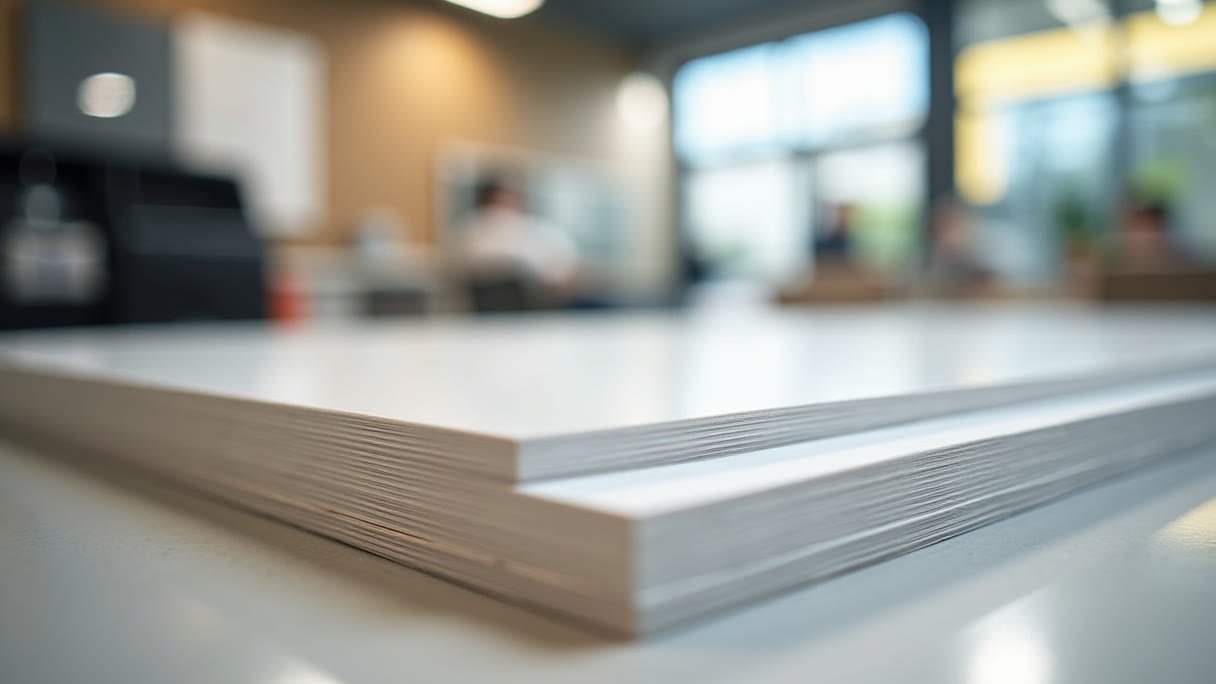
Styrene is high-impact polystyrene — a solid plastic sheet, not a foam and not a corrugated board. It comes in thin gauges, typically somewhere from about 0.02 inches up to an eighth of an inch, and it is bright white with a smooth, slightly matte face.
That surface is the point. Because it is solid and non-porous, ink sits on top of it cleanly, so photographic images and large flat colour fields come off sharp with no texture fighting the artwork. Foam board has a paper face that can dent and show every knuckle. Coroplast has flutes running through it that you can see through the print at an angle, especially in a solid colour. Styrene has neither problem — from three feet away a printed styrene panel reads like a photographic print mounted on something invisible.
The other property that matters is that thin styrene has a little flex to it. An eighth-inch sheet is stiff and behaves like a board. A twenty-thou sheet will bow gently, which is either a defect or a feature depending on what you are doing: it will curve into a display fixture or a shelf channel, but it will also sag if you hang it from two corners and walk away.
Where we send it, and where we don't
Indoor signage, all day. Lobby directories, price boards, clinic and salon information panels, retail signage, school and church notice panels, museum-style caption boards. Styrene is light enough to hang with double-sided tape or a couple of standoffs, and cheap enough that you can reprint when the price list changes rather than living with a sticker patched over the old number.
Point of purchase and events. Easel signs, table signs, shelf talkers, header cards, product cards, sponsor boards, welcome signs. Anything that goes up on a Saturday and comes down on a Sunday should almost never be acrylic.
Windows, from the inside. Behind glass, out of direct rain, styrene is a good window card. Facing due west on Lankershim in August, in full sun, it is a different story — see below.
Photo-quality mounts. If the artwork is a photograph, a portrait, a floor plan, a rendering or a map, the smooth face is worth choosing on purpose.
Where we push back is outdoors and unattended. Styrene is a thermoplastic. It expands, contracts and eventually warps with heat cycling, and San Fernando Valley summers are a heat cycle machine — a panel that is flat in the morning can bow by afternoon and not come all the way back. It also gets brittle in a way that matters: hit a cold or aged styrene sheet on a corner and it cracks rather than dents. For a yard, a construction fence, a parking lot or a roadside, coroplast, PVC or aluminum composite are the materials that belong there, and we would rather sell you the right one than reprint the wrong one.
Gauge, size and the sag question
Two decisions do most of the work: how thick, and how big.
Thin gauge is for anything that will be mounted flat to a wall, a fixture, a foam core backing or a stand where the substrate is not doing structural work. It is the cheapest way to get a smooth printed panel, and it ships and stores easily.
Thicker gauge is for anything freestanding, anything going in an easel, anything a person will pick up and carry, and anything wider than roughly two feet. The rule of thumb we use is simple: the longer the unsupported span, the thicker the sheet, and if you cannot decide, decide by how the sign will be handled rather than how it will look. Signs that get moved need stiffness; signs that get screwed to a wall do not.
Double-sided printing is worth a mention because the material is opaque and white, so a two-sided styrene panel has no show-through — useful for hanging signs, aisle markers and anything a customer walks past from both directions.
What to spend more on, and when
When it lives on the sidewalk. An indoor sign propped outside the door is a bad indoor sign. Our A-frame sidewalk sign starts at $94.99 and it is a different object entirely — a frame built to stand up in wind, take a kick, get dragged in at close and put back out at open, with printed panels sized to the frame. If your styrene sign keeps ending up on the pavement, this is the product that was supposed to have that job.
When it represents the business, permanently. Acrylic business signs start at $46.76 and buy you something styrene cannot fake: depth. Acrylic has a polished edge that catches light, real thickness in the hand, and it holds up next to a reception desk for years rather than months. A lobby sign, a suite sign, a logo panel behind a counter — that is acrylic work, and the difference is obvious from six feet away because of the edge, not the print.
When the artwork is the product. Acrylic printing starts at $90 and is what we run when a photograph, an artwork or a large graphic needs the glass-like face — printed panels where the depth of the substrate is part of what people are looking at. Styrene is a print on a board; acrylic printing is closer to a framed piece with no frame.
Put plainly: styrene is for information that will change. Acrylic is for identity that will not.
Getting the file right
Build artwork at final size with an eighth of an inch of bleed on all four edges, and keep text and logos well inside the trim — a sign gets cut, and a border sitting a millimetre off the edge is the first thing anyone notices on a flat white panel.
Send vector art with fonts outlined wherever you can. Anything raster should be 300 ppi at print size for a small counter sign; for a large panel viewed from several feet away you can drop lower, but do not take a 900-pixel logo off a website and stretch it across two feet and hope. Build in CMYK — a saturated screen blue will land calmer on a printed sheet, and that is physics, not an error.
One thing specific to styrene: it is bright white and the finish is not glossy, so contrast does more work than colour tricks. Dark type on white reads across a room. Light type reversed out of a mid-tone reads much less well than it does on your monitor, especially under the mixed fluorescent and daylight most retail interiors run.
How this fits the rest of a sign package
Most people who order styrene are not ordering only styrene. A storefront usually needs an interior set and an exterior set, and those are two different material conversations. The interior set is what we have been describing here. The exterior set — the thing above the door, the thing on the sidewalk, the thing facing traffic — is signage and front signs work, and the campaign-scale version, flags, banners, frames and everything that has to hold up in weather, is outdoor advertising and signs.
Ordering them together is not upselling, it is how you avoid the situation we see most often: a beautiful printed interior panel taped to the inside of the glass doing a job the glass side of the door should have been doing.
Angels Print prints styrene boards and signs, A-frames, acrylic business signs and acrylic panels at 8511 Lankershim Blvd in Sun Valley, for businesses across the San Fernando Valley and greater Los Angeles. If your artwork is ready, pick your size, thickness and quantity in the configurator and order online. If you are not sure whether your sign wants styrene or something that can take the sun, call us at (818) 806-9006 or bring the file into the shop and we will tell you which one it is before you print it.