

September 10, 2026
Tuck Top Boxes in Los Angeles: The Folding Carton Most People Mean When They Say "Custom Box"
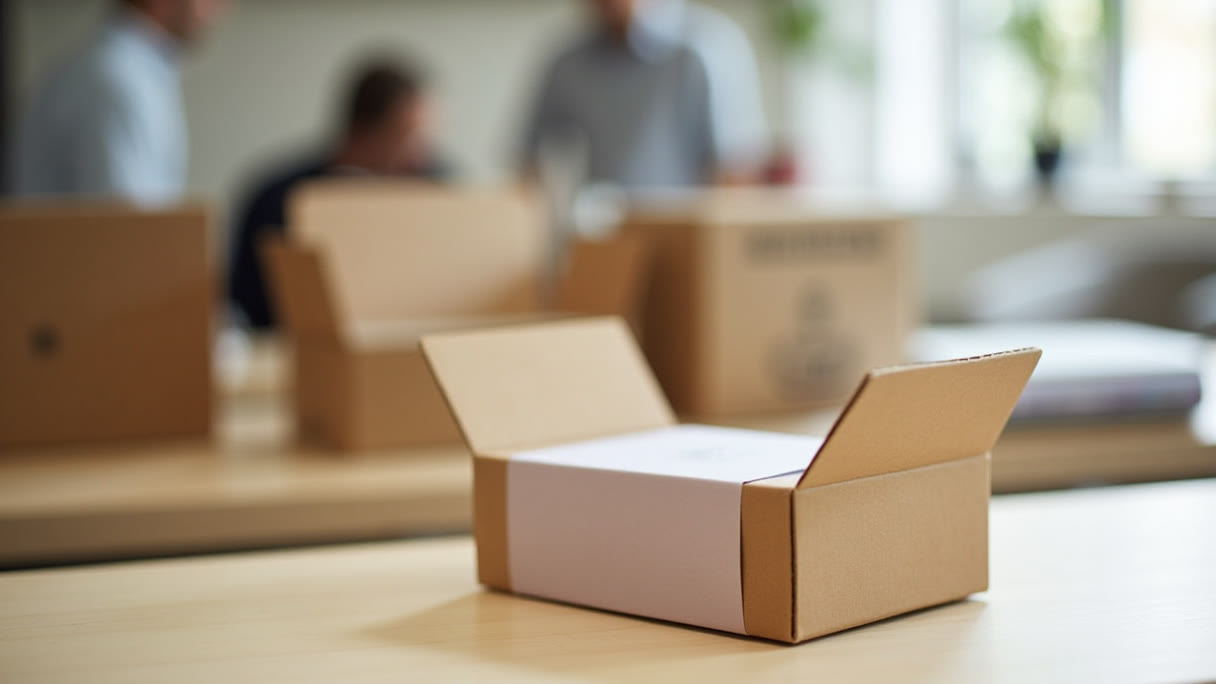
Almost every week someone comes into the shop on Lankershim with a product in one hand and a phone in the other, showing us a photo of a box they saw at a trade show. Nine times out of ten the box in the photo is a tuck top folding carton: flat paperboard, printed on the outside, glued on one seam, shipped to you dead flat, and folded into a rectangle in about four seconds by whoever is packing your orders. It is the soap box, the candle box, the supplement box, the cosmetics box, the cartridge box, the thing your retail product sits inside on a shelf.
We print tuck top boxes at the shop in Sun Valley for brands across the San Fernando Valley and greater Los Angeles. They start at $414.23, and the default run in the configurator is 250 pieces, which works out to $1.66 each. That per-piece number is the one worth holding onto, because it is where most of the conversations below end up.
Straight tuck or reverse tuck
There are two common ways to build the same box, and they are not interchangeable even though the flat footprint is nearly identical.
Straight tuck end has both flaps folding in from the same side — the back panel. The top tucks down from the back, the bottom tucks up from the back. The advantage is that the front panel of the box, the one facing the customer on the shelf, is a clean uninterrupted rectangle with no flap edge cutting across it. The trade-off is that the bottom is slightly less secure under weight, because the tuck is relying on friction rather than on the geometry fighting itself.
Reverse tuck end has the top flap folding from the back and the bottom flap folding from the front. Mechanically it is a little more forgiving and it is the one most people default to, but you now have a flap edge and a score line landing on your front panel near the bottom, which matters if your artwork has a logo or a rule running through that zone.
If your box will spend its life face-out on a shelf and the front artwork is doing the selling, ask us for straight tuck. If it will be handled a lot, or picked up and put down by customers, reverse tuck holds together better. Either way, decide before the artwork is finished, not after.
A tuck top box is a carton, not a shipper
This is the single most expensive misunderstanding we run into. Folding carton board is flat paperboard — typically in the range of 14 to 24 point caliber, roughly the thickness of a stiff greeting card up to a heavy cover stock. It is designed to present a product, protect it from dust and scuffs, and give you a printable surface. It is not designed to survive a shipping network.
Put a tuck top carton in a padded mailer and hand it to a carrier and it will arrive with crushed corners, popped tucks and scuffed edges, and the customer opening it will read that as a cheap product rather than as a shipping problem. Cartons go inside something: a corrugated mailer, a poly-lined box, a shipper carton with dunnage. The carton is the retail face; the corrugated is the armor.
If you sell direct to consumer and there is no retail shelf in the picture at all, you may not need a carton — you may need the corrugated box to be the pretty one. That is a different product and a different price structure, and we get into it below.
Caliber, and why the same dieline behaves differently at two thicknesses
Board caliber is the number that decides whether your box feels like a product or like a cereal liner. A lightweight caliber is cheaper, folds easily and is fine for something almost weightless — a sheet mask, a small enamel pin, a single bar of soap. A heavier caliber holds its shape when the box is empty, resists denting in a customer's bag, and is what people are unconsciously reading when they say a box feels premium.
The thing to know is that thicker board needs more allowance at every fold. The same dieline that closes perfectly in a thin caliber can end up with tucks that will not seat and side panels that bow outward in a thick one, because the material is stealing millimetres at each score. This is why we ask what you are putting in the box and roughly what it weighs before we settle on a stock, and why a dieline you were given by a different printer for a different board is a starting point rather than a finished file.
Bring the actual product to the shop if you can. Measuring the product yourself and giving us three numbers is fine for a rigid item like a bottle; it is much less reliable for a pouch, a folded garment, a jar with a domed lid, or anything with a cable coiled next to it.
Cracking at the score, and dark boxes
Fold a printed sheet and the ink layer on the outside of the fold is being stretched over the board. If the coverage is heavy and the board is thick, the coating can split along the crease and show a hairline of white board through your color. On a pale box nobody sees it. On a deep navy, matte black or saturated brand color, a white line down every vertical edge of the box is the first thing anyone notices.
There are ways to reduce it — score depth, running the fold with the grain rather than across it, adjusting how much ink is laid down in the crease zone — but the honest answer is that a solid dark box is a harder box to make look perfect than a light one, and that is worth knowing before you commit a brand identity to it. If your palette is dark, tell us at the quoting stage and we will talk through what to expect on the edges.
Keep in mind too that our shop rule is device CMYK with total ink coverage held at or below 260%. A rich black built as four channels at full strength will not print the way it looks on your monitor, and a heavy build in the fold zone is exactly where cracking gets worse.
What to send us
Send vector artwork with fonts outlined, built on a dieline, with your bleed and your safety margin already in place. If you do not have a dieline, do not guess one — give us the internal dimensions of the box you need and what is going inside it, and the die layout follows from that.
Two things people forget. First, a folding carton has panels that are not the front: the two sides, the back, the top tuck, the bottom tuck, and the dust flaps. Every one of them is printable and most artwork we receive treats them as an afterthought, which is a shame, because the side panel is what the customer sees when the box is racked in a row of twelve. Second, we do not change the colors in your file. We take the values you send, print them, and then compare the result against your original — so if a brand color needs to be adjusted, that adjustment happens in your file, with you, before anything runs.
For anything printed at reading distance, raster elements want to be 300 ppi at final size. Ingredient panels, small legal type and barcodes should be vector wherever possible; a barcode that has been rescaled from a JPEG is a barcode that will fail at the register.
When the box should be corrugated instead
If your product ships to the customer rather than sitting on a shelf, run the numbers on corrugated before you commit to a carton.
[Corrugated mailer boxes](/products/custom-mailer-boxes-867) start at $298.10, with a default run of 25 pieces at $11.92 each. That is the tab-lock e-commerce box that opens like a book, survives the carrier, and is printable on the inside as well as the outside. At 25 pieces it is also the realistic option for a brand that is not ready to hold 250 of anything.
[Corrugated product boxes](/products/corrugated-product-boxes-868) start at $272.56, default run 25 pieces at $10.90 each. This is the sturdier shelf-and-ship hybrid — heavier products, kits, anything where a paperboard carton would flex under the weight of what is inside it.
Compare those per-piece figures against $1.66 for a tuck top carton and the structure of the decision becomes obvious. Cartons are cheap per unit and expensive per order, because the setup is spread across a long run. Corrugated is expensive per unit and cheap to start. A brand doing 40 orders a month should probably be in corrugated. A brand putting product into 30 stores should probably be in cartons, with a shipper around them.
The rest of the counter
If you are a café or a food brand rather than a product brand, the same folding-carton press does the small stuff around the counter. Coffee sleeves start at $172.88 with a default run of 100 at $1.73 each, and they are the cheapest piece of branded packaging most cafés will ever buy, because the customer carries it down the block for you.
All of this sits under the same custom packaging work we do, and if you are putting together a full set — carton, shipper, sleeve, sticker seal — it is worth looking at the whole packaging and boxes range at once rather than ordering piece by piece, because the board choices and the color builds want to agree with each other.
Angels Print prints tuck top boxes, corrugated mailers, product boxes and coffee sleeves at 8511 Lankershim Blvd in Sun Valley. If you already have a dieline and know your caliber, set your size and quantity in the configurator and order online. If you are still deciding between straight and reverse tuck, not sure whether your product needs a carton or a corrugated box, or want us to see the thing that is going inside before we cut a die, call (818) 806-9006 or bring the product into the shop and we will work out the box with it in front of us.