

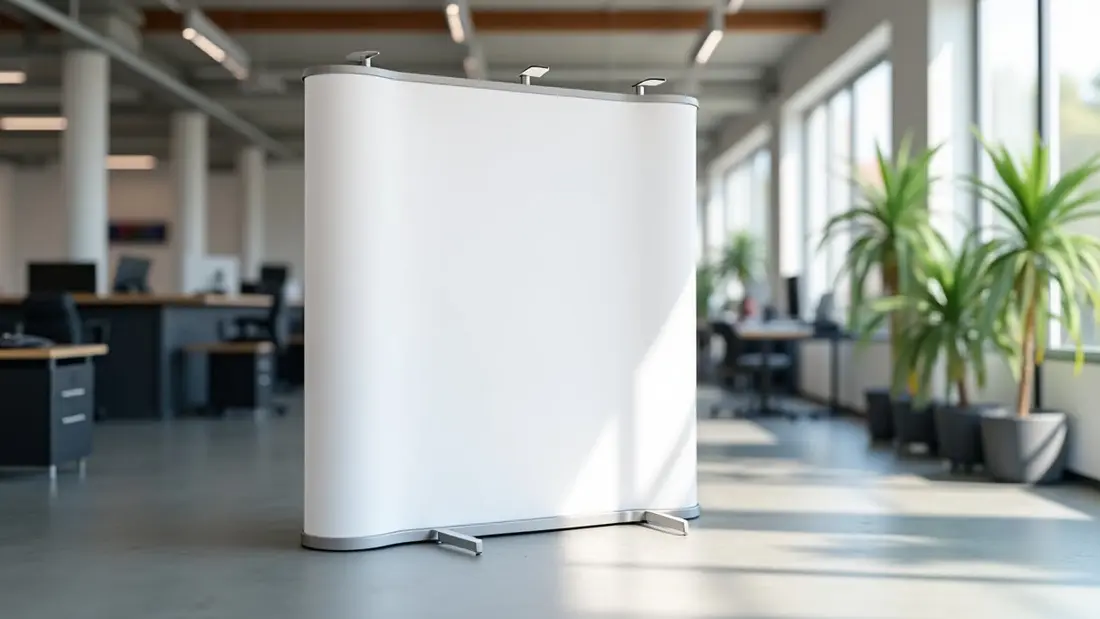
The searches that land people on this page are usually specific in one way and vague in another: they know they want a fabric stand, they know it needs to be about three feet wide, and they are not sure whether that is the same thing as the backdrop they saw at a trade show, a pull-up banner, or the curved thing in a competitor's lobby. Those are three different products with three different price points, and the fabric-versus-vinyl question is separate again. This is the sorting we do at the counter before anyone picks a size.
SEG means the graphic tucks into a groove
SEG stands for silicone edge graphic. The printed fabric panel has a thin silicone strip — a bead, basically — sewn around its entire perimeter. The aluminum frame has a matching channel milled into its face. You start at one corner and press the bead into the channel with your thumb, working around the frame, and the fabric pulls itself flat as you go. There is no velcro, no clamp bar, no grommets, no bungees, and critically, no visible hardware anywhere on the front face. What you see from three feet away is an edge-to-edge printed surface with a hairline of aluminum around it.
That mechanism is why SEG has taken over trade-show and retail display work over the last decade. The old way to get a taut fabric panel was to sew a pole pocket and hope, or to velcro the fabric to a frame and live with the ripple. Silicone edge is the version that comes out flat every time, including the third time, including when somebody else on your team sets it up.
The frames are extruded aluminum and they come apart. That matters more than it sounds. A 3FT SEG fabric stand from $195 breaks down into a handful of tubes, a base and a rolled-up graphic, which is a bag you can put in a back seat rather than a crate you need a van for. For a business doing a farmers market in Studio City on Saturday and a lobby display on Monday, that is the entire argument.
What actually fits across three feet
Three feet of width is roughly a person standing behind it, or a table end, or the gap between two doors. It is not a wall. Before you commit, look at what the panel has to say from ten feet away and from three.
At ten feet — someone walking past your booth aisle — three feet of width carries a logo and one line. "Angels Print" and "Signage & Printing." That is it. Anything longer either shrinks below reading size or eats the whole panel. At three feet — someone already standing at your table — you can add a short list, a QR code, and a phone number down at the bottom, because that reader has stopped and is looking at the panel deliberately.
The mistake we see most often is treating a 3ft panel like a website homepage: six services, an address, three photos, social handles and a paragraph of copy. Printed at that width it reads as a grey texture. If your list has more than four items, either cut it or size up to a wider frame and put the list on a second panel.
Height is where three-foot stands get interesting. Most freestanding SEG stands in this width run tall — somewhere in the 7 to 8 foot range — which puts the top of the graphic well above head height in a crowd. Put the logo in the upper third. The bottom foot and a half of any floor-standing display is blocked by a table, a chair, or a person, at every event, always.
Fabric versus vinyl, honestly
Fabric graphics for SEG are dye-sublimated: the ink is turned to gas and bonded into the polyester fibers rather than sitting on top as a film. Three consequences follow from that, and they are the reasons to choose fabric over vinyl.
First, the print is matte and has effectively no glare. Under the hard spotlights of a convention hall or a showroom, a glossy vinyl panel throws a hot spot straight into the photos people take of your booth; fabric does not. Second, the graphic folds. You can roll it, fold it, stuff it in a bag, and the creases relax out — hang it overnight, or steam it lightly, and it comes back flat. A vinyl banner creased in the same way keeps the crease. Third, fabric is washable, which for anything that lives in a restaurant, gym or clinic is not a small thing.
What you give up: fabric is not for outdoors in wind, the color sits slightly softer than the same file on gloss vinyl, and back-lighting bleeds through unless the panel is built for it. If the display is going on a sidewalk on Lankershim in an afternoon breeze, you want a weighted rigid setup, not a fabric stand. Our digital printing work covers both sides of that choice, and the file you send us is the same either way.
SEG stand or retractable banner?
This is the real fork, and price makes it look more obvious than it is. A black stand retractable banner from $62.50 is roughly a third the cost of a fabric stand, sets up in about fifteen seconds, and for a lot of jobs it is genuinely the right answer — a job fair, a recruiting table, a one-week promotion, anything where the message will be obsolete before the hardware wears out.
Where retractables lose is repetition and appearance. The graphic lives permanently attached to a spring-loaded roller, so you cannot change the print without buying new hardware, and the mechanism is the part that fails — a retractable that has been set up two hundred times starts to drift, curl at the edges, or refuse to retract straight. The graphic also curls at the bottom and shows the roller housing at your feet.
A SEG frame is hardware you keep. New season, new message, new panel — the frame does not know the difference. If you rebrand once a year, or run different graphics for different events, the fabric-only reprint is the recurring cost and the aluminum is a one-time purchase. Roughly speaking, if you expect to change the graphic more than twice, SEG has already paid the difference.
When three feet is not the size
Two directions to go if the 3ft panel is wrong. If you need a photo wall — step-and-repeat, press backdrop, something people stand in front of — three feet is far too narrow, because the subject has to fit inside the frame with margin on both sides. That is what a backdrop banner from $189.99 is for, and the planning number is simple: measure the widest group you expect to photograph, add three feet, and that is your minimum panel width.
If the display is permanent rather than portable — a showroom, a reception desk, a clinic waiting area — a flat panel is often the wrong shape entirely. A curve velcro fabric display from $504.90 stands on its own footprint without a wide base and reads as architecture rather than as event equipment, which is why these end up in lobbies and stay there. It is a different budget, and for something that will be seen every working day for years it is usually the right one. For anything that mounts to a wall or a storefront instead, that is signage territory rather than a stand.
Getting the file right
Build the artwork at the finished panel size, not at the frame size — they are not the same number. The silicone bead consumes material around the perimeter, and the fabric is pulled into the channel, so a strip along every edge disappears behind aluminum. Send us the frame model and we will give you the exact template; what you must not do is design to the outside dimension of the frame and assume it will all show.
Keep every logo, word and phone number at least two inches inside the trim on all four sides. Full-bleed backgrounds should extend past the trim, not stop at it. Vector artwork — PDF, AI, EPS — with text converted to outlines is ideal. Raster is fine at these sizes if the image is genuinely large: for a panel this tall, roughly 100 to 150 dpi at final size is plenty, and a logo pulled off a website at 800 pixels wide is not going to hold up when it is three feet across, regardless of how good it looks on your screen.
One color note specific to fabric. Dye-sub on polyester renders deep solid blacks and heavy ink coverage slightly differently than the same file on paper or vinyl — large flat black backgrounds are where the difference is most visible. If your brand depends on an exact color, tell us the value and ask about a swatch before we run the full panel.
Care, storage and the reprint cycle
Roll the fabric rather than folding it if you have the room, and keep it away from the aluminum in transit — the frame tubes are what scuff a graphic in a bag, not the venue. Wrinkles from packing relax on their own once the panel is tensioned; a handheld steamer on low, held a few inches off the surface, speeds it up. Machine wash cold and hang dry when it needs it, and skip the dryer entirely.
Store the frame assembled if you have somewhere to put it. The most common repair we see on portable hardware is a stripped or lost connector, and connectors get lost in bags, not on stands.
Angels Print prints and supplies SEG fabric stands, backdrops, retractable banners and fabric displays at our shop at 8511 Lankershim Blvd in Sun Valley, for businesses across the San Fernando Valley and greater Los Angeles. If your artwork is ready, configure the size and order online. If you are still weighing a 3ft stand against a full backdrop, or fabric against vinyl for where this thing is actually going to live, call us at (818) 806-9006 or come by the shop — it is a lot easier to decide with the fabric in your hands and the frame standing next to you.