

August 20, 2026
Updated
A-Frame Sidewalk Signs in Los Angeles: Placement, Materials and What Actually Survives the Street
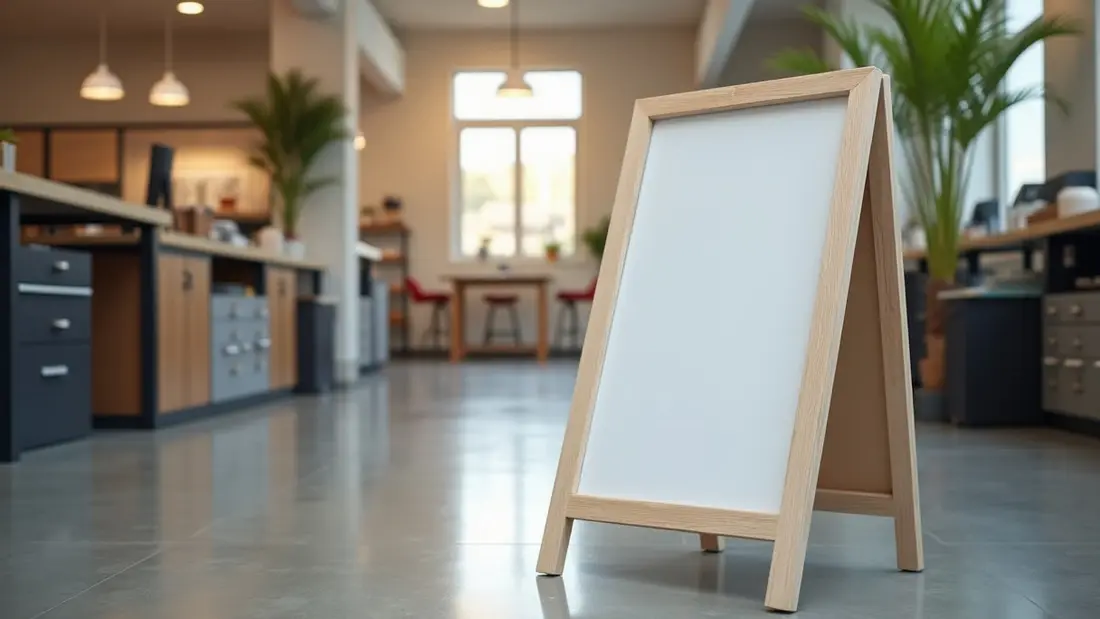
The A-frame is the most-used and least-thought-about sign in Los Angeles retail. It costs less than almost anything else that puts your name on the street, it needs no permit process on private property, no electrician and no wall anchors, and it can be dragged out at nine and dragged back in at six. That flexibility is exactly why most of them are bad: nobody plans them. Somebody prints a panel with eleven lines of text, drops it in a frame that weighs nine pounds, and by month three it has blown over twice, the vinyl is chalking on the sun side, and the copy still doesn't say anything a person walking past can read in the two seconds they have. This is what we ask before a sidewalk sign goes into production.
The sign has to earn its two seconds
Everything about an A-frame follows from where the reader is standing. A pedestrian on Lankershim reads yours from about six to fifteen feet, at walking speed, usually at an angle. A driver reads it — if at all — from thirty or forty feet while looking for a parking spot. Those two audiences want different panels, and you can only optimize for one.
The working rule we design to is roughly one inch of capital letter height for every ten feet of viewing distance, and that is a minimum for legibility, not a target for comfort. On a standard 24×36 panel, a 4-inch headline reads reliably at forty feet. Which means you get one headline, maybe a second line at half that size, and nothing else. Hours, the website, the phone number, the list of services — those belong on the door, on the window, or on a menu holder people step up to. Put them on an A-frame and they compete with the one thing the sign is there to do.
The most effective sidewalk panels we produce say what you sell and give one reason to turn now. "Walk-ins Welcome." "Open — Fresh Today." "Print & Ship Here." Not the whole business, one door-opening sentence.
Placement is a legal question before it's a marketing one
This is the part that costs people money. In Los Angeles — and in every incorporated city around it — the sidewalk itself is public right-of-way, and rules for putting a private sign on it vary by jurisdiction, by district, and sometimes by whether your block is in a BID. Some cities permit A-frames in a defined zone with a permit; others prohibit them on the public sidewalk outright and enforce on complaint. Los Angeles, Burbank, Glendale and the county's unincorporated pockets do not all say the same thing, and none of them will tell you it was fine because the last shop did it.
Check with your own city's planning or code enforcement counter before you buy, and ask them specifically about the sidewalk portion, not about signs generally. The answer that never gets you a citation is to place the sign on your own property: in the forecourt, on the entry landing, at the head of your parking lot, just inside the property line. It works nearly as well, and nobody carries it away.
Wherever it ends up, leave a clear, continuous pedestrian path. A wheelchair or stroller needs an unobstructed route, and an A-frame set in the middle of a five-foot walk is both an accessibility problem and the first thing a passerby reports. Against the building face or at the curb edge — never in the middle.
Frame and insert are two separate decisions
An A-frame is a hinged holder plus a graphic panel, and they wear out on completely different schedules. The frame is a five-year purchase; the panel is a seasonal one.
The A-Frame Sidewalk Sign offers a complete set or replacement prints. One complete set contains a white or black stand and two printed panels; the replacement option contains two prints without a stand. The listed graphic size is 24×36 inches on 1/8-inch white PVC. Choose the set type and whether the two faces use the same or different artwork before comparing the configured price.
For this A-frame product, the listed panel material is 1/8-inch white PVC. Corrugated plastic and aluminum composite are different materials; their general uses do not make them selectable inserts for this set. If you already have another holder, check its panel dimensions, thickness allowance and retention method before ordering replacements. The 24×36-inch graphic size does not establish compatibility with every frame.
A practical trick that saves reprints: make one face permanent identity and the other face the message. The identity panel outlives four message panels, and you only ever pay to reprint half the sign.
Wind, weight and Santa Ana season
An A-frame is a sail with a hinge. A 24×36 panel is six square feet of surface per side, held up by a structure whose entire job is to be light enough to carry. In the Valley, the winds that matter are not the ocean breeze — they are the fall and winter Santa Ana events that come through hot and dry and knock things over in a straight line.
Ballast solves it and nothing else does. Sandbags across the lower crossbar, a water-fillable base, or a weight plate at the hinge; all three work, and all three have to actually be used rather than kept in the back room. The second half of the fix is discipline: bring it in at close. A sign that spends nights indoors avoids wind events, avoids the sprinklers, avoids the marine layer condensing on it, and does not get walked off with. Overnight is when most sidewalk signs disappear.
Sun is the slower version of the same problem. A panel facing south or west on an unshaded sidewalk takes full UV all afternoon, and the first colors to go are the saturated reds and the deep blues. Designing with fewer, stronger colors and heavy contrast — dark on light or light on dark — buys you months of readable life, because a faded high-contrast panel still reads and a faded pastel one does not.
When an A-frame is the wrong sign
Sidewalk signs are for the message that changes. For the message that doesn't — the business name at the door, the suite number, the hours plate, the wall behind the counter — a permanent panel does the job better and stops costing anything after it goes up.
Acrylic Business Signs start at $46.76 and are the straightforward version of that: a printed panel for a door, a reception wall, or a window-side display, indoors or under cover. Acrylic Standoff Signs start at $37.50 and mount off the wall on metal barrels, which throws a shadow behind the panel and reads considerably more expensive than it is — that is the sign for a lobby, an office entry, or the wall a customer faces while waiting. When the piece is larger or the artwork carries the whole effect, acrylic printing from $90 handles the display-grade panels.
Most storefronts we work with end up with both categories: something permanent at the door and an A-frame out front carrying whatever this week is about. They are not competing purchases. If you are sorting out the whole exterior at once, that is what our signage and front signs work covers, and the broader street-facing side of it — banners, sidewalk units, anything meant to be read from outside — sits under outdoor advertising and signs.
What to have ready when you order
Send vector artwork if you have it — AI, PDF, EPS, with text converted to outlines. If you only have a raster logo, it needs to be large: at panel size, a 24×36 face wants roughly 100 to 150 DPI at final dimensions, which is a much bigger file than the version sitting in your email signature. A logo pulled off a website will look soft the moment it is three feet tall.
Keep at least an inch of margin inside the panel edge clear of anything critical, because the frame lip covers a strip on all four sides and the exact amount varies with the holder. Decide the two faces before you send files — same artwork both sides, or identity front and message back. And tell us where the sign will stand: a panel that lives in full afternoon sun on Sherman Way gets designed differently from one under an awning.
Angels Print produces sidewalk signs, storefront signage and printed panels at our shop at 8511 Lankershim Blvd in Sun Valley, for businesses across the San Fernando Valley and greater Los Angeles. If your artwork is ready, configure the size and quantity and order online; if you are still weighing corrugated against aluminum, or want to see how a headline reads from across a parking lot before you commit, call us at (818) 806-9006 or bring your logo by the shop.