

August 20, 2026
Updated
Black Stand Retractable Banners in Los Angeles: What the Hardware Actually Buys You
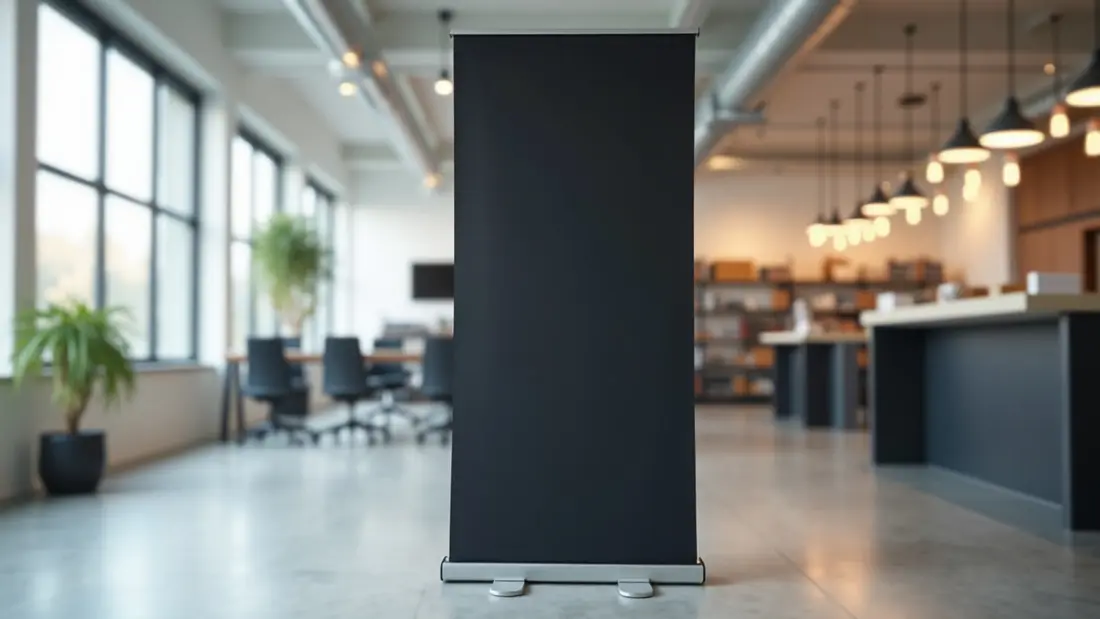
People almost never call us asking for a "retractable banner stand with a powder-coated aluminum cassette." They call asking for the black one — the one they saw at a conference at the LA Convention Center, or in the corner of a clinic lobby in Van Nuys, or behind a founder in a video their agency shot. The black base is a real, specific thing to want, and it is worth understanding why before you order, because the stand outlives the graphic. You will likely print two or three banners over the life of one good base, and the choices that matter are mostly in the hardware and the sizing, not in the ink.
Why the base color is the thing people search for
A retractable stand is a rectangular aluminum housing that sits on the floor with the rolled banner inside it. Silver or brushed anodized is the default in the trade because it is the raw finish of extruded aluminum. Black is a coating applied on top, and it does three things silver does not. It disappears against dark carpet, black stage decking and trade show floor tile, so the graphic appears to float rather than sitting on a bright metal bar. It does not throw a hot specular highlight back into a camera or a photographer's flash, which is the single most common complaint we hear about silver bases in filmed settings. And it hides the scuffing that every base collects along the bottom edge from being dragged, kicked and slid into a car trunk — a silver base looks abused after a season, a black one looks used.
Our black stand retractable banner starts at $62.50, and that price is for the complete unit: base, retractable mechanism, telescoping pole, printed banner and a carry bag. That is worth stating plainly because a lot of online pricing quotes the graphic alone and treats the hardware as an add-on you discover at checkout.
What is actually inside the cassette
The mechanism is a spring-loaded roller, essentially the same idea as a window shade under tension. The banner is attached to the roller at the bottom and to a rail at the top; you pull the rail up, drop a telescoping pole into a socket on the back of the base, and the pole holds the graphic against the spring's pull. Nothing clamps and nothing locks — the tension is the whole system.
Two consequences follow from that, and both of them are how retractables die. First, never let go of the top rail while the pole is out. The spring will snatch the banner back into the housing at speed, and if it goes in crooked it creases along a diagonal, which is permanent. Second, the pole is what sets the height, so a bent or mismatched pole means a graphic that leans. Keep the pole with its own base; poles from different units are not interchangeable even when they look identical.
The banner itself, and why curl is the real failure
The graphic in a retractable is not the same material as a hanging vinyl banner. It has to roll into a two-inch cylinder hundreds of times without cracking the ink, and it has to hang dead flat with no bottom hem or grommets holding it down — nothing but its own stiffness keeps it from curling at the vertical edges. That is why retractable graphics are printed on a heavier, dimensionally stable roll-up film rather than on standard banner vinyl, usually with a grey or black block-out layer in the middle so ambient light and the pole behind it do not shadow through the face.
Curl at the edges is the failure mode that makes a stand look cheap, and it is almost always a storage problem rather than a print problem. A banner left rolled in a hot car in the Valley in August comes out with memory in it. Store the unit upright, indoors, and let it stand deployed for an hour before an event if it has been in a trunk. We print these on our digital printing equipment, and the finish choice matters more than most people expect — matte or satin for anything that will be photographed or lit from the front, gloss only when the stand lives in soft ambient light and you want the color to pop.
Sizing: the printed graphic is not the visible graphic
The standard unit is 33 inches wide by roughly 79 to 81 inches tall, and this is where most first-time orders go wrong. The bottom several inches of the printed file disappear into the cassette — that is the leader that wraps the roller and never comes out. The top inch or so is folded into or gripped by the rail. So a logo placed at the very bottom of your artboard is a logo you will never see again.
Practical rules we give everyone: keep all critical content at least three inches up from the bottom edge of the file and one and a half inches down from the top. Put the headline between 48 and 68 inches from the floor — that band is roughly eye level for a standing adult, and it is the only part of the banner people read from across a room. Anything below about 30 inches is behind a table, a chair or a person's legs at any real event. Fill the bottom third with flat color or a texture and stop trying to sell there.
Where a retractable stops being the right answer
A single 33-inch stand is a personal-scale sign. It works beside a booth table, in a lobby, at a check-in desk, at the end of a hallway. It does not fill a camera frame behind two people, and it does not read as a wall.
When you need a wall, the format changes. A 3FT SEG fabric stand from $195 uses a printed fabric panel with silicone edge beading pushed into a channel in a frame — the graphic is drum-tight, seamless, and it launders and folds instead of rolling, which is why it survives repeat shipping better than a film graphic does. A backdrop banner from $189.99 is the step-and-repeat scale, the thing you stand a group of people in front of. And a curve velcro fabric display from $504.90 is a curved tension frame that wraps a booth corner and gives you an actual背 wall rather than a flat panel.
A common and sensible mix for a 10x10 booth: one fabric wall behind, two black retractables flanking the table with product-specific messaging that changes show to show. The wall is the investment; the retractables are the part you reprint cheaply when the offer changes.
What Los Angeles venues actually demand
Almost every retractable we produce lives indoors, and there is a reason for that: the base is a few pounds of aluminum and the banner is a five-foot sail. Any breeze past a doorway will lay one flat. If a sign has to stand outside on Lankershim or in front of a strip center on Sherman Way, a retractable is the wrong tool — that is an A-frame, a post-mounted panel or something anchored, and it belongs in a conversation about signage rather than about portable displays.
Indoors, the constraint is usually the venue rather than the wind. Convention halls and hotel ballrooms typically limit floor displays inside a standard booth to a height and setback measured from the aisle; check the exhibitor kit before you commit to a size, because the 81-inch stand is fine almost everywhere but a taller unit sometimes is not.
Files that print right the first time
Send us a PDF at full size — 33 x 81 inches, not a scaled-down proportional version — or at half scale clearly labeled as such. Raster content should land at 100 to 150 DPI at final size; that is plenty for something read from four feet away, and pushing 300 DPI on an 81-inch file just creates a file too large to email. Convert text to outlines, use CMYK, and remember that a deep black background is where banding shows most, so a large flat black panel behind white type is safer than a black-to-grey gradient.
Price moves on quantity and format, not on ink coverage — a full-bleed photograph and a white banner with one line of type cost the same to print. Two identical stands ordered together cost less per unit than the same two ordered a month apart, so if you know you need a spare graphic for the next quarter's message, order both banners now and keep one rolled.
Angels Print prints and assembles retractable banner stands, fabric displays and backdrops at our shop at 8511 Lankershim Blvd in Sun Valley, for businesses across the San Fernando Valley and greater Los Angeles. If your artwork is ready, configure the size and order online; if you are still deciding between a 33-inch retractable and a fabric wall, call us at (818) 806-9006 or come by the shop — we keep the hardware on the floor, and standing next to it for thirty seconds settles the question faster than any spec sheet. Hanging vinyl and fabric banners in North Hollywood have their own page.