

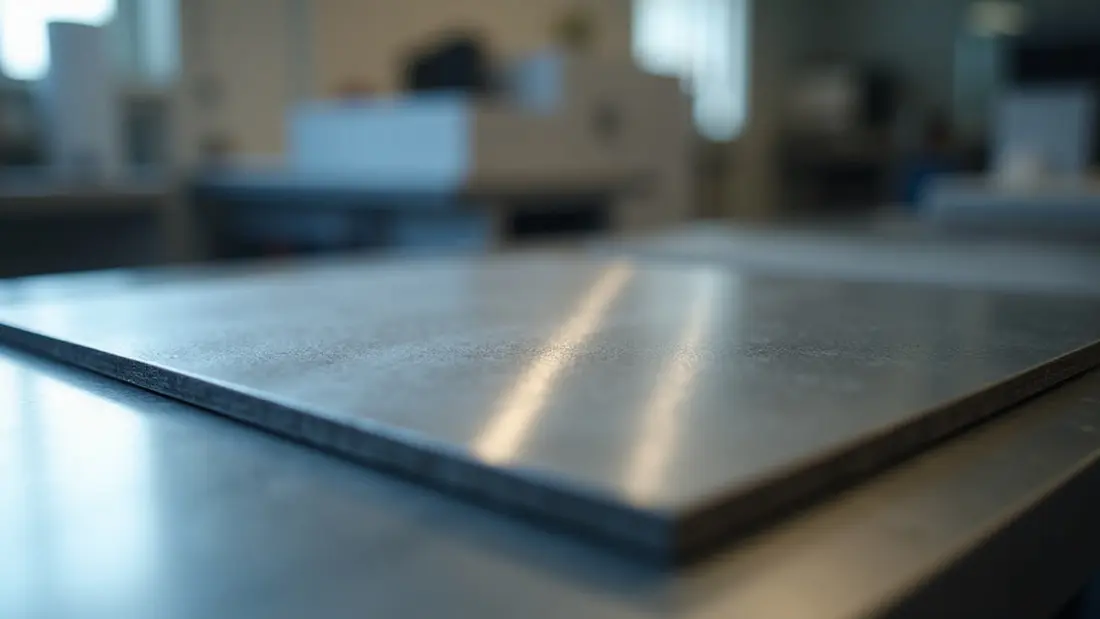
Almost everyone who calls us about metal etching is describing a result, not a process. They want text that will not rub off a control panel, a serial number that survives a solvent wipe, a dedication plaque that still reads in twenty years, or badges that look like something other than a laminated card. Those are four different jobs, and in the trade they are done by four different processes that all get called "etching" in conversation. Picking the wrong one is how you end up with a mark that ghosts out after a season on a rooftop, or a plate that costs three times what it needed to. This is the sorting we do before anything gets clamped down.
Four ways a mark gets into metal
Chemical etching uses a mask and an acid bath to eat a shallow recess into the metal, usually a few thousandths of an inch deep, and it is the traditional method behind old equipment nameplates and photo-etched brass. It is beautiful and it is a wet process with tooling, which makes it expensive at small quantities and unbeatable at thousands of identical parts. Laser engraving removes material with heat — it vaporizes a groove you can feel with a fingernail, and on bare aluminum that groove reads as a lighter, frosted line. Laser annealing does the opposite: on stainless steel the beam heats the surface without cutting it, growing an oxide layer that reads deep black while the surface stays smooth and unbroken, which is why medical and food-contact parts are marked that way. Rotary engraving is a spinning cutter physically plowing a channel, which is still the right answer for thick plate, for deep grooves you intend to paint-fill, and for beveled letters on brass.
For the runs most Southern California businesses actually order — ten of something, a hundred of something, a one-off panel — the laser processes win on cost, because there is no mask, no bath and no tooling to pay for before the first part exists. The whole setup is a file. That is what our engraving and etching work is built around, and it is why a single prototype plate and a batch of two hundred cost roughly the same per unit rather than differing by an order of magnitude.
Anodized aluminum is the workhorse, and here is why
If you have seen a matte black plate with crisp silver-white lettering on a piece of equipment, that was almost certainly laser-marked anodized aluminum, and it is the material we reach for most — see laser engraving on aluminum and stainless for what the fiber laser does with each alloy. Anodizing grows a hard porous oxide layer on the aluminum and dyes it — black, red, blue, gold. The laser ablates the dye out of the pores without cutting into the aluminum underneath, so the mark is the bare bright substrate showing through. There is no ink, no paint and no coating on top to chip, which means the contrast cannot fade the way printed contrast fades, and the surface stays flat and cleanable.
Two things to know before you specify it. The mark is fixed at whatever color the substrate is, so you are choosing between dye colors for the background, not for the text. And the contrast depends entirely on the anodize being real anodize — powder-coated aluminum sold as "black aluminum" will burn rather than ablate and comes out muddy brown. If you are sending us stock rather than buying it through us, tell us which it is.
Bare aluminum, stainless and brass
Mill-finish and brushed aluminum take an engraved mark that reads as a light frosted grey against the brighter surrounding metal. It is legible but it is a lower-contrast look than anodized, and outdoors it collects dirt in the grooves and gradually reads darker — which some people like on architectural work and nobody likes on a safety label. Deep-engraving and paint-filling is the fix when contrast has to be absolute.
Stainless is the material for anything that gets scrubbed, sanitized or rained on directly, and annealed marking is the reason: nothing is removed, so there is no recess for corrosion to start in and no groove for grime to sit in. Brass and copper engrave cleanly and are what most people still want for dedication plaques, donor walls and door plates, usually with the recess filled black so the letters read against the polish. Brass will patina in coastal air unless it is lacquered, and the lacquer is the part that eventually fails, not the engraving — plan on refinishing rather than replacing.
Where composite panels fit — and where they do not
Dibond aluminum from $37.42 is two thin aluminum skins bonded to a polyethylene core, and it is the flattest, most weather-stable rigid panel we stock for exterior signage. It is also the one material in this article you should not try to engrave deeply. Cut past the aluminum skin, which is a fraction of a millimeter thick, and you are into black plastic core — fine as a deliberate effect, ugly as a surprise. Dibond is for printed graphics and for shape cutting, not for etched text.
That cutting is worth planning together with the marking. Our metal laser cutting handles profiles, letter shapes, mounting holes and slots, and when a part is both cut and marked it should be done from one file in one setup — otherwise you are aligning an engraving to holes somebody else drilled, and small registration errors show up immediately on a plate with a border. Send the outline and the artwork as one vector drawing, on separate layers, and the part comes out square to itself.
Badges, tags and anything that gets a number
Serialized work is where laser marking stops competing with printing and simply wins. Every plate can carry a different number, name or code at no extra setup, because the variable is in the file rather than in a plate or a screen. Asset tags, valve tags, panel legends, equipment nameplates and staff credentials all run the same way. Our employee ID badges start at $80.02 for a run of 25 — $3.20 each — and for shops, kitchens, contractors and clinics that want something more durable than a printed card, a marked metal badge is the version that survives being dropped in a parking lot.
One planning note that saves money: give us the whole list at once. A hundred badges in one file is one job. The same hundred ordered as five batches of twenty over six months is five jobs, and the per-piece cost goes up every time.
What Southern California actually does to the mark
The two climates we produce for are not the same. Along the coast — Santa Monica to Long Beach and anything in the marine layer — the enemy is salt, which attacks any recess and any coating edge, so annealed stainless and anodized aluminum hold up far better than engraved-and-filled bare metal. Inland, across the San Fernando Valley and out toward the Inland Empire, the enemy is UV and heat: printed and painted contrast chalks, adhesive labels cook off a hot surface in a couple of summers, and a plate mounted on a south-facing wall can run well above ambient all afternoon. An ablated or annealed mark has nothing in it to bleach, which is the whole argument for etching over printing on anything that has to stay legible for years outdoors.
Mounting matters as much as the mark. Dissimilar metals in contact plus moisture equals galvanic corrosion, so aluminum plates want stainless or nylon hardware and a spacer, not steel screws driven straight through.
Getting the file right the first time
Vector artwork — AI, PDF, DXF, SVG — with text converted to outlines and everything at final size. Raster logos can be marked, but they are marked as a halftone, and a JPEG pulled off a website will look like one. Keep stroke weights above roughly 0.01 inch and capital heights above about 0.08 inch or fine serifs will close up. Gradients, drop shadows and transparency do not exist in this process; the beam is on or off, so design in solid shapes. Leave at least an eighth of an inch of clear margin around the perimeter for the fixture, and mark mounting hole positions in the file rather than describing them in an email.
What moves the price
Marking time scales with how much area gets covered, not with how many lines of text there are — a solid filled logo takes far longer than the same logo as an outline, and a plate that is 80% engraved background costs more than one with dark text on bare metal. After that it is material, part count and whether the job needs a custom fixture. Straightforward wins: put the text on the metal rather than the metal around the text, keep every plate in a run the same size and thickness, and combine cutting and marking into one part.
The sign that is cut, marked and lives on a sidewalk
Not everything is a small plate. An aluminum sidewalk sign from $55 is the case where the panel, the frame and the graphics all have to survive being folded, dragged and left in the sun six days a week, and it is worth deciding up front which parts of it are printed and which are permanent. Printed inserts are cheaper and swap out when the message changes; marked or cut metal is for the part that never changes — the name, the logo, the address. Businesses along Lankershim and San Fernando Road tend to end up with both on the same unit for exactly that reason.
Angels Print produces metal etching, engraving and laser cutting at our shop at 8511 Lankershim Blvd in Sun Valley, for businesses across the San Fernando Valley and greater Los Angeles — equipment and control panel plates, asset and valve tags, plaques, badges, and cut aluminum for signage. If you have a drawing ready, configure and order online; if you are still deciding between anodized, stainless or a printed panel, call us at (818) 806-9006 or bring the part by the shop and we will mark a test coupon in the material you are considering before you commit to a run.