

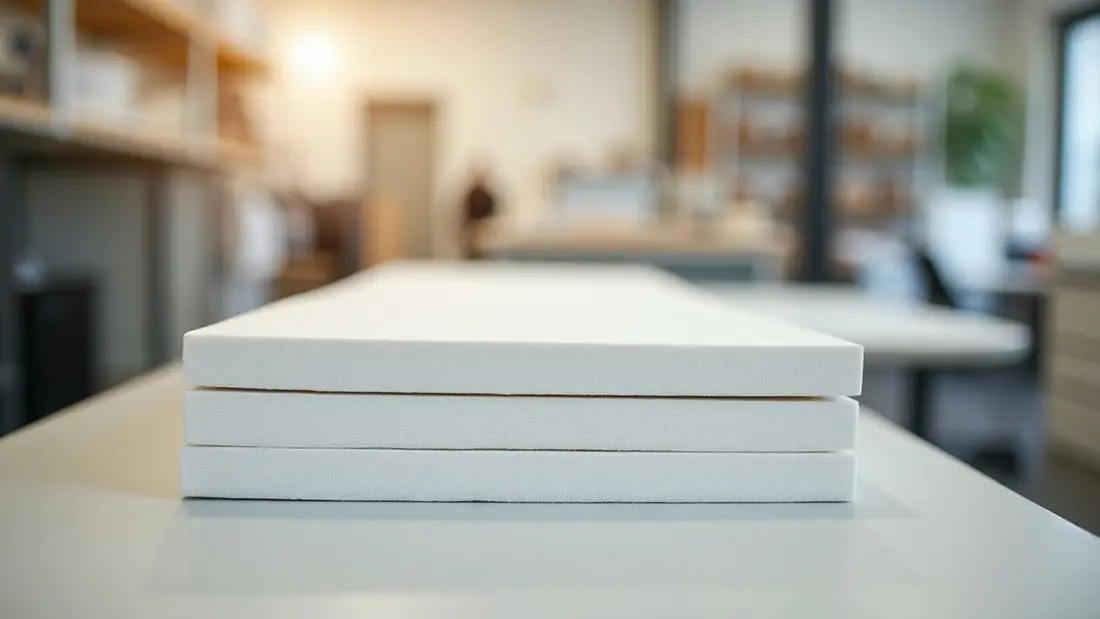
Foam board is the product people ask for by a dozen different names — foamcore, presentation board, mounted print, poster board, that white stuff. What they usually want is the same thing: a large flat graphic that stands up on an easel or hangs on a wall without curling, costs very little, and can be carried in one hand. Foam board does that better than anything else we print. It is also the material customers destroy most often, because it looks like a sign and behaves like a piece of furniture-grade paper. Our foam board starts at $28.30, and most of the decisions that determine whether you are happy with it happen before we hit print.
What it actually is
A sheet of foam board is three layers: a core of extruded polystyrene foam sandwiched between two sheets of clay-coated paper. The paper gives it a smooth, bright, printable face and all of its rigidity in the plane of the sheet; the foam gives it thickness and almost no weight. A 24×36 panel at 3/16 inch weighs well under a pound. That combination — big, flat, stiff, light — is why it dominates presentations, real estate displays and event graphics, and why nobody uses it for anything that has to survive weather.
The paper skin is also the whole story on durability. Everything that goes wrong with foam board is the skin denting, delaminating from the foam, or absorbing moisture. Punch a corner into a doorframe and you get a permanent crease you cannot press out, because the foam under it is crushed and does not spring back.
Thickness: 3/16 or 1/2 inch
The default is 3/16 inch, and for the overwhelming majority of jobs it is correct. It sits in an easel, tacks to a wall, slides into a portfolio case, and holds a 24×36 graphic flat with no visible sag. Below about 30 inches on the long side it is effectively rigid.
Half-inch board is a different animal. Use it when the panel is large — think 36×48 and up — when it has to stand unsupported for a full day, or when the edge is part of the design. A half-inch edge reads as a deliberate white border when the board is hung on standoffs or leaned on a shelf; a 3/16 edge reads as a poster somebody stiffened. Half inch also survives handling by a crowd noticeably better, which matters if the board is going to a trade show where every visitor picks it up. It costs more and it is still not weatherproof.
Printed direct, or a print mounted to the board
There are two ways to get an image onto foam board and they are not interchangeable. Direct printing puts UV ink onto the board's paper face — one piece, no lamination, no edge to lift, and the ink cures instantly. It is the cleaner construction and it is what most orders should be.
Mounting means printing on photo paper or a vinyl and adhering that to the board. You do it when you need a specific paper surface — a true photographic finish, a heavy matte art stock — or when you want a laminate on top for scuff resistance on a board that will be handled for weeks. The tradeoff is that a mounted print has an edge, and edges are where things eventually peel, especially if the board flexes. Tell us which you want when you order, because it changes the substrate we start from.
Size, bleed and how the edge gets cut
Foam board is cut with a blade, not a die. That gives a clean square edge on straight cuts and lets us cut simple shapes, but it is not a contour-cutting process for fine detail — the foam core will not hold a tight interior radius or a narrow tab. If your design needs a silhouette with thin arms or delicate notches, foam board is the wrong material and we will say so.
Build the file at final size with an eighth-inch bleed on all sides, and keep anything you care about — text, logos, faces — at least a quarter inch inside the trim. The blade wanders slightly more on a foam sandwich than it does on paper, and a border designed to be exactly even on all four sides will show the variance. If you want a border, make it wide enough that a sixteenth of an inch does not read as a mistake. 150 dpi at final size is plenty for something viewed from three feet; 300 dpi is fine but it does not buy you anything on a panel nobody puts their nose against.
Where foam board fails, specifically in this climate
Foam board is an interior product. Not "interior recommended" — interior. Three things kill it here, and all three are ordinary Los Angeles conditions.
Heat: a board left in a closed car in the Valley in August is sitting in an oven. The foam core softens and the panel takes on a permanent bow. Move boards in the cabin, not the trunk, and do not stage them against a sun-facing window while you set up.
Moisture: the paper skin absorbs it, one side before the other, and the board cups toward the drier face. Overnight fog on a patio, a sprinkler at 6 a.m., a caterer setting a sweating ice bucket next to an easel — any of those will warp a board that was flat when you unwrapped it. There is no fixing a cupped panel; you can weight it flat for a day and it will slowly go back.
Wind: a light rigid panel is a sail. An easel-mounted foam board outdoors goes over the first time a gust comes down the street, and the corner it lands on is done. If the graphic has to live outside at all — a sidewalk, a curb, a parking lot — that is not a foam board job. A weighted A-frame sidewalk sign from $94.99 is built for it, with swappable inserts so the message can change daily. Planning messages across a building frontage or several locations is what our outdoor advertising and signs work covers.
Mounting it without wrecking it
On a wall, the safest attachments are the ones that grip the edge or spread the load. Removable adhesive strips work on a smooth painted wall if you use enough of them — four minimum on a 24×36, one near each corner, and press through the board rather than into a single point. Do not hang a board from a hole punched in the top; the foam tears out under its own weight over a few weeks.
For anything semi-permanent, standoffs through drilled holes are the right answer, and that is also the point where you should ask whether foam board is still the material. Drilled foam board holds a standoff fine but the hole edges compress over time.
On an easel, the board needs a lip to sit on and something behind it. A tabletop easel holds up to roughly 20×30 comfortably; past that you want a floor easel with a wide base, and past 36×48 you want the board leaning against something solid, because a half-inch panel that size has real leverage.
The jobs it is genuinely best at
Real estate open houses — floor plans, comps, a large exterior shot on the sidewalk-adjacent side of the front door, inside the doorway. Trade shows and conferences — product boards, before-and-afters, spec charts you can carry to the booth in a portfolio. Weddings and events — seating charts, welcome boards, menu displays, all of which live indoors for six hours and then go home with somebody. Offices and clinics — process diagrams, org charts, temporary wayfinding during a build-out. Photography and portfolio work — mounted prints for a review or a wall display. Anything, in short, that is flat, indoor, and either temporary or handled.
When to spend more instead
If the graphic is going in a lobby and needs to still look right in three years, foam board is a false economy. Acrylic business signs start at $46.76 and mount on standoffs with visible depth — that is the logo-on-the-wall product foam board only imitates, and acrylic standoff signs from $37.50 do the same job at room-plate size. For a full photographic panel with the image behind or on acrylic, acrylic printing from $90 gives you something you can wipe down, that does not dent, and that reads as an installation rather than a display. Permanent identification at an entrance or reception desk sits under signage and front signs.
The honest rule: if the panel will be looked at more than a few dozen times, or touched by anyone other than you, or asked to survive a move, price the rigid alternative before you default to foam. If it is going up Friday and coming down Sunday, foam board is the correct answer and nothing else comes close on cost.
We print foam board panels, mounted prints, acrylic signs and sidewalk A-frames at our shop at 8511 Lankershim Blvd in Sun Valley, for agents, event planners, clinics, studios and exhibitors across the San Fernando Valley and greater Los Angeles. If your artwork is built at final size, pick your dimensions and quantity and order online. If you are not sure whether you need 3/16 or half inch, whether the graphic should be printed direct or mounted, or whether the board is going somewhere it will not survive, call us at (818) 806-9006 or come by the shop with the dimensions and we will work it out before you pay for it.