

August 28, 2026
Laminated Business Cards in Los Angeles: Film, Finish and the Edge Nobody Looks At
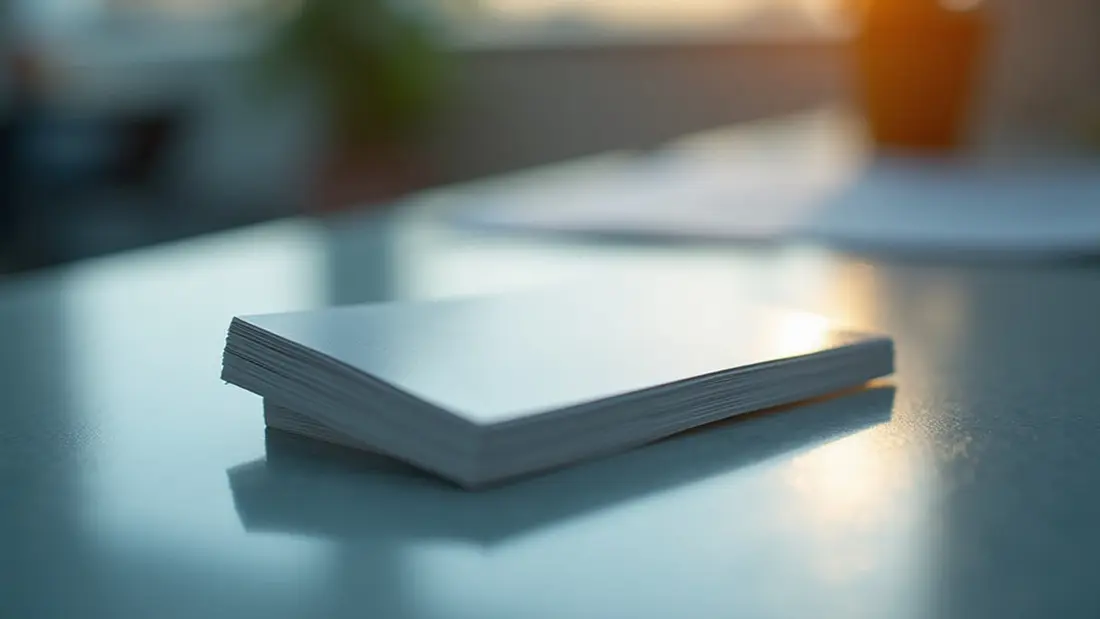
Pull a business card out of a wallet that has been carried for six months and you can usually tell what it was printed on without reading a word. An uncoated card comes out soft at the corners, grey along the edges, with a curl from the shape of a back pocket. A laminated card comes out looking like it did the day it was handed over. That difference is the entire reason laminated cards exist, and it is why we keep the stock on hand at the shop on Lankershim. It is also a product where people pay for the wrong finish, because gloss, matte and soft touch are sold as three cosmetic options when they actually behave in three completely different ways.
What lamination actually is
Lamination is not a coating. A coating — aqueous, UV, varnish — is a liquid applied to the printed sheet and cured. Lamination is a thin plastic film, usually polypropylene, bonded to the printed sheet with heat and pressure. It sits on top of the ink as a separate physical layer, typically somewhere between one and three thousandths of an inch thick per side, and it is applied before the cards are cut.
That distinction explains everything the product does. Because it is a film and not a liquid, it does not soak in, it does not dull the ink, and it does not wear off. It also adds real thickness and real stiffness: a laminated card has a harder snap than the same stock uncoated, and the corners survive being shoved into a card slot. Our laminated business cards start at $33.48, and the default run is 50 pieces at $0.67 each.
Compare that to classic business cards, which start at $25.70 — 50 pieces at $0.51 each. The gap is sixteen cents a card. That is the honest number to make the decision on. If your cards live in a holder on a counter and get replaced every time your title changes, sixteen cents is not worth spending. If they go into contractors' trucks, gym bags, tool belts and glove boxes and you need them legible a year later, it is not a close call.
Gloss, matte and soft touch behave differently
Gloss laminate is the most protective and the most reflective. Colors gain a little depth under it — a deep navy or a saturated red looks richer through gloss film than it does raw. It wipes clean, it resists moisture, and it is the finish that survives the roughest handling. Its problem is fingerprints. On a solid dark background, gloss holds every print from every thumb, and under the fluorescent light of a warehouse or a shop counter that reads as smudged rather than premium.
Matte laminate kills the reflection. Text is easier to read at an angle, photographs of the card look better, and the whole thing feels more deliberate. The trade-off is burnishing: matte film can pick up a shiny scuff where it rubs against something hard, and on a black card those scuff marks show as glossy streaks. It is still far tougher than an uncoated card, but it is not invisible wear the way gloss is.
Soft touch — sometimes called suede or velvet — is a matte film with a texture that feels like chalk or peach skin. People notice it in the hand, which is the point, and it is the finish that makes someone look at the card twice before putting it away. It is also the most delicate of the three: oils from skin darken it over time, and it marks. It belongs to designers, photographers, salons, real estate agents, anyone whose card is handed across a table rather than pulled off a job site clipboard.
The thing nobody checks: writing on it
You cannot write on a laminated card with a ballpoint pen. Ink beads on the film and wipes off with a thumb. Permanent marker mostly holds; anything else does not.
This matters more than it sounds like it should. A large number of the cards we print get handed over with something written on the back — a quote, an appointment time, an extension, a price. If that is how yours will be used, laminating both sides removes the feature you actually rely on. The fix is single-sided lamination: film on the printed front, bare stock on the back. You keep the protection and the snap where it shows and you keep a writable surface. Tell us before we print, not after.
The edge, and why dark cards show a white line
Laminated cards are cut after the film is applied, which means the blade goes through film, paper core, film. The film does not wrap around the edge — it is trimmed flush with it. So the paper core is exposed along all four sides, and on a card printed with a solid dark color, that exposed core is white.
You will see it as a fine light line around the perimeter. On a white or light card nobody notices. On a black matte card it is visible, and it is not a defect — it is how a laminated paper card is made. If a perfectly dark edge is important to the design, the answer is a different construction, not a different laminate.
That is one of the cases where plastic makes more sense. Our clear plastic business cards start at $92.60, with a default run of 50 at $1.85 each. There is no paper core to expose, because there is no paper — the card is a plastic substrate printed directly, and it is genuinely waterproof rather than water-resistant. It also does something laminated paper cannot: you can leave areas unprinted and they stay transparent, so a logo can float with the table showing through behind it. At nearly three times the per-piece cost of a laminated card, it is a deliberate choice for a small run you hand out selectively, not a box you leave at a front desk.
Shape, once flat is not enough
Lamination changes how a card feels. It does not change its outline. If you want the card itself to be the memorable object, that is a die cut — rounded corners, a shaped edge, a cut that follows a logo. Die cut business cards start at $129.14 for a default run of 100 at $1.29 each.
Rounded corners are worth mentioning on their own, because they solve a real problem rather than a decorative one. Square corners are where a card starts to fray, and on a laminated card they are also where the film is most likely to lift after months of abrasion. A radius on the corner removes the failure point.
Keep custom outlines chunky. Narrow spikes and thin protrusions in card stock bend and tear regardless of what film is on them, and a die shifts slightly across a run, so a hairline border traced two millimetres from a shaped edge will look centred on some cards and off on others.
Files we can print without a phone call
Build at 3.5 × 2 inches with an eighth of an inch of bleed on every side, and keep all text and logos at least an eighth of an inch inside the trim line. Vector art with fonts converted to outlines is best; raster art should be 300 dpi at final size, not a web logo scaled up.
Work in CMYK and expect the screen to lie to you about saturated blues and greens. Gloss laminate will bring some of that depth back; matte will take a little more away. If the color is critical — a brand color you have matched everywhere else — say so when you order rather than assuming the file will land on its own. Short runs go through digital printing, which keeps color consistent piece to piece within a run, and the whole range of card work sits under our business card printing service if you want to see the stocks and formats side by side.
One more file-level habit: avoid large flat areas of a single dark ink on a matte laminated card if the card will be handled hard. It is the combination — dark solid plus matte film plus abrasion — that makes scuffs obvious. Add texture, a pattern, a photograph, or move to gloss.
Who in Los Angeles actually needs the film
Contractors, electricians, plumbers, mobile mechanics and anyone whose card ends up in a work vehicle in the Valley in August, where heat and humidity turn an uncoated card wavy. Restaurants and food trucks, where cards live near grease. Anyone at trade shows, where a card is handled by a dozen people in an afternoon and needs to survive the flight home in a bag. Salons, studios and agencies who want soft touch because the card is part of the pitch.
Everyone else can print classic and spend the difference on more cards. There is no prize for over-specifying a business card, and a beautifully laminated card with an out-of-date phone number on it is worth exactly nothing.
Angels Print prints laminated, classic, clear plastic and die cut business cards at our shop at 8511 Lankershim Blvd in Sun Valley, for trades, restaurants, studios and offices across the San Fernando Valley and greater Los Angeles. If your file is ready, pick your stock, finish and quantity and order online. If you are deciding between gloss and soft touch, wondering whether to leave the back writable, or unsure how a dark design will look with a laminated edge, call us at (818) 806-9006 or bring the file to the shop and we will look at it together before you commit to a run.