

August 30, 2026
Laminated Posters in Los Angeles: Film, Curl, Mounting and When Paper Is the Wrong Substrate
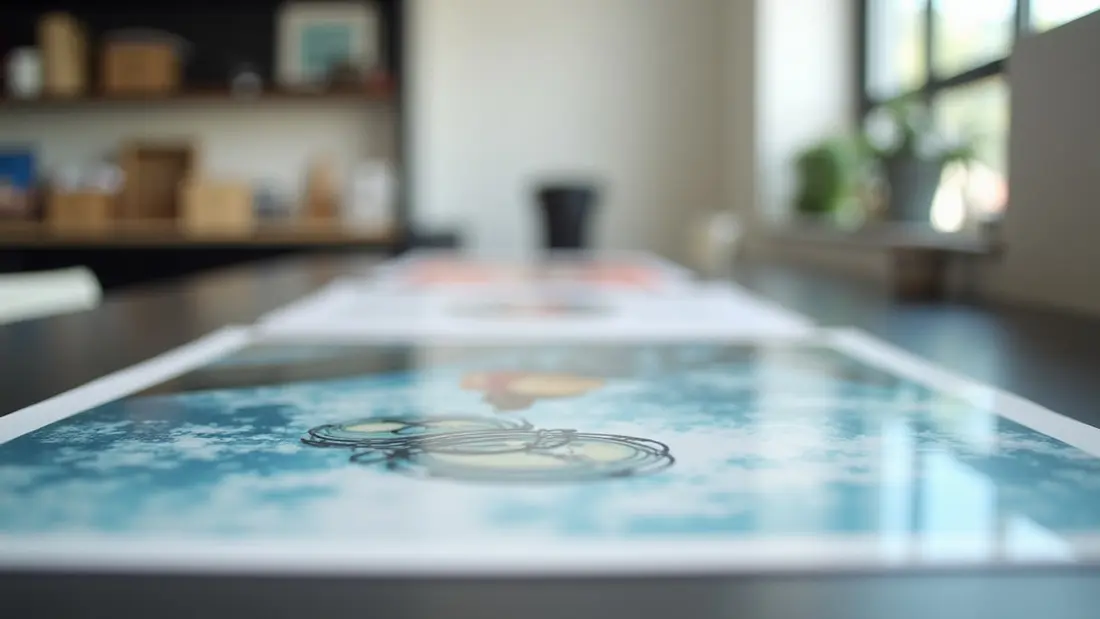
A poster gets taped to a wall and looked at. A laminated poster gets taped to a wall, bumped by a shoulder, wiped down with a rag, rolled up, carried to the next location and put back on a wall. That is the whole difference, and it is why people search for the laminated version specifically: they already had a poster fail. We print these at the shop on Lankershim, and the failures we see are consistent enough to list — scuffed ink at hand height, a wavy edge in a humid room, a print that curled into a tube overnight, and a laminated poster taped outside that lasted three weeks in the sun. Each of those is a different decision made wrong upfront.
What the film is actually doing
A laminate is a clear plastic film — polypropylene or polyester — bonded to the printed sheet with heat and pressure. It is not a spray, not a varnish, not a UV coating applied in the press. It is a separate physical layer with its own thickness sitting on top of the ink, and on a poster it does four things: it stops abrasion from rubbing the ink off at touch height, it blocks moisture and grease from reaching the paper, it stiffens the sheet so it hangs flatter, and it makes the surface wipeable.
Our laminated posters start at $44.35. That is more than a bare poster costs, and the way to justify it is not "it looks nicer" — it is how many times the poster gets handled and how long it has to stay up. A menu board behind a counter, a price list in a workshop, a safety diagram in a warehouse, a gym class schedule, a rotating window promo that comes down and goes back up — all of those are handled prints. A poster for a one-night event is not, and it should not be laminated.
Gloss, matte and satin
Gloss film maximises contrast and saturation. Blacks go deeper, photographs get sharper, and it wipes clean with one pass of a cloth. It also mirrors every light source in the room. That is the single most common regret on a large laminated poster: at 24 by 36 inches, a gloss surface under a row of ceiling lights reflects those lights straight back at the person trying to read it, and half the poster becomes a bright bar.
Matte film scatters light. It reads calmly under direct lighting, hides fingerprints and handling marks, and photographs without hotspots — which matters if the poster is behind a counter that gets posted to Instagram. The trade-off is real: dark tones sit flatter, and a rich black on matte is never as deep as the same black on gloss. Satin sits between them and is the safe default when you do not know the lighting.
The test is not which looks better on a sample. It is where the poster hangs. Overhead fluorescents or a window opposite the wall means matte or satin. A dim interior, or a poster meant to look like a photographic print, means gloss earns its reflections.
Curl, and why laminating one side is a trap
Paper responds to humidity by expanding. Plastic film does not. Bond film to one side of a poster only and you have built a bimetallic strip: as the room's humidity changes, the paper side moves and the film side does not, and the sheet curls toward the laminate. In a dry room a single-sided laminated poster will roll itself into a tube on the wall, usually starting at the bottom corners.
Two-sided lamination — film on both faces — balances that and produces a sheet that stays flat. It is the right build for anything that hangs unframed, anything that gets rolled and re-hung, and anything going into a room with swinging humidity. Single-sided is fine when the back is permanently mounted to a board or held in a frame under glass, because the mount is doing the flattening.
The other half of the curl problem is how the poster travels. A laminated sheet rolled tightly and left rolled for a week takes a set. If a poster is shipped or carried rolled, unroll it and let it lie flat under weight before you judge it.
Where laminated paper stops working
A laminated poster is still paper. The film resists moisture; it does not make the print waterproof, because the cut edges are open paper unless the film is sealed past the trim, and a taped-up sheet has no structure of its own. Two situations expose that immediately.
The first is outdoors. Direct Los Angeles sun does two things at once — it fades inks, and it heats the film enough to soften the adhesive bond. A laminated poster in a west-facing window will hold up longer than a bare one, but it is measured in weeks and months, not seasons. If the print faces the street permanently, it should be a substrate built for it, not paper with film on it. That is the conversation to have before you print, and it is why our outdoor advertising and signs work starts with the exposure, not with the size.
The second is anywhere the poster needs to stand up by itself. A laminated sheet has no rigidity that survives wind or a doorway. If what you actually need is a sign on the sidewalk pulling people in from the street, an A-frame sidewalk sign starts at $94.99 and holds itself upright with weather-facing panels — a laminated poster taped to a stand is a worse version of the same idea at a similar cost.
When to go rigid instead
Inside the building, the upgrade path from laminated paper is a rigid panel. Acrylic business signs start at $46.76 — within a few dollars of a laminated poster — and they are a solid sheet rather than a laminated one. They mount with standoffs or tape, they do not curl, they do not dent when a cart hits them, and they read as permanent rather than temporary. For lobby signage, hours, department names and anything that is not going to change for a year, that is the better buy at nearly the same money.
For image-led work — a photograph in a restaurant, a portfolio piece in a studio, a menu with food photography — acrylic printing starts at $90 and gives you depth and edge glow that laminated paper cannot imitate. It costs roughly double a laminated poster, so the honest split is: content that changes, laminate it; content that stays, print it on a panel. If you are working out which pieces in a space belong to which category, that is what our signage and front signs work covers.
Building the file
Set up at final size with an eighth of an inch of bleed all round and keep text and logos at least a quarter inch inside the trim — posters get trimmed as a stack, and a thin border two millimetres from the cut will look centred on some sheets and off on others. Build in CMYK at 150 to 300 dpi at final size; large-format viewing distance is forgiving, but upscaled phone screenshots are not.
Two things specific to lamination. Colour shifts under film: gloss deepens dark tones noticeably and matte lifts them, so the same file laminated two ways does not look like the same poster. Expect a saturated screen blue to land darker and duller than your monitor promises. And nobody writes on gloss laminate with a ballpoint — if the poster has a sign-up grid, a date, a price that gets updated in marker or a blank to fill in, use matte or a write-on film, and tell us before we build the job.
The Los Angeles part
Two local realities. The first is heat in transport and storage. A tube of laminated posters left in a car through a Valley summer gets hot enough to soften adhesive, and laminated sheets stored under pressure while hot can bond to each other or take a permanent curl. Store them flat, indoors, out of the sun.
The second is that a lot of laminated posters here go into kitchens, gyms, car washes, salons and workshops — steam, oil, sanitiser, sweat. All four attack the paper through an open cut edge. In those rooms, laminate both sides, keep the poster off the wall directly behind a sink or a fryer, and accept that it is a consumable that gets replaced rather than a permanent fixture.
Angels Print prints laminated posters, A-frame sidewalk signs and acrylic panels at our shop at 8511 Lankershim Blvd in Sun Valley, for restaurants, gyms, clinics, contractors and retailers across the San Fernando Valley and greater Los Angeles. If your artwork is ready, pick your size, finish and quantity and order online. If you are not sure whether you want gloss or matte for your lighting, whether the poster needs film on both sides, or whether the job is really a poster at all rather than a rigid sign, call us at (818) 806-9006 or bring the file to the shop and we will work it out before you commit to a run.