

August 30, 2026
Painted Edge Cards in Los Angeles: Stock Thickness, Edge Color and What Goes Wrong
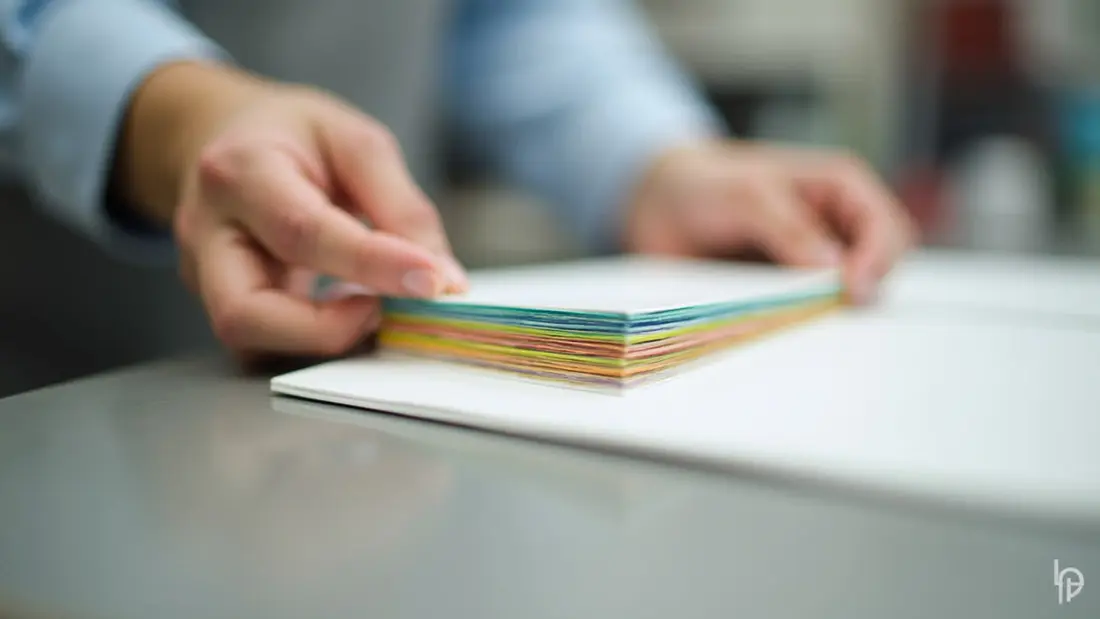
A painted edge card is the only business card that has a third printed surface. Front, back, and a colored band running around the perimeter that you only see when the card is held at an angle or fanned in a stack. It is a design decision made on a surface roughly a thirtieth of an inch tall, and it is the surface people ask us the fewest questions about before ordering. We print these at the shop on Lankershim, and nearly every disappointment traces back to one of three things: the stock was thinner than the customer pictured, the edge color fought the artwork instead of finishing it, or the file was built as if the edge did not exist.
What the product actually is
Start with the stock, because painted edge cards are a thickness product first and a color product second. Ordinary business card stock is around 14 to 16 pt — thin enough that a painted edge would be a hairline you would have to hunt for. Painted edge cards are built from heavy board, commonly in the 32 pt range and up, either as a single thick sheet or as two or three sheets bonded together into one card. That bonded construction is where the term duplex or triplex comes from, and it is also how the trade builds a card with a colored core, where the visible stripe is a sheet of colored paper sandwiched between two printed faces rather than paint at all.
On a true painted edge, the cards are printed, cut, stacked, and the exposed edge of the stack is coated with pigment and cured. The result is a hard, saturated band that wraps the full perimeter. Because the color is applied to the cut edge, the edge is only as clean as the cut — which is why this product lives on thick stock cut carefully, and why it is not something you can add to a card you already had printed somewhere else.
Our painted edge cards start at $91.32, with a default run of 100 pieces at $0.91 each. Compare that honestly against a card meant for volume handouts: our classic business cards start at $25.70 for 50 at $0.51 each. You are paying roughly double per card for weight and an edge. Whether that is worth it depends entirely on what the card is for, which is the next section.
Who this card is actually for
Painted edge cards are a low-volume, high-contact object. They work when the card is handed over deliberately, in a context where the person receiving it is already deciding whether you are expensive or careful — an architect, a designer, a photographer, a stylist, a broker, an attorney, a tattoo artist, a restaurant that wants its reservation card to feel like a reservation card. The card is heavy enough that people notice it in the hand before they read it. That weight is doing the work.
They are the wrong buy when the card is a contact-details commodity. If you go through 500 cards a month at trade shows and networking mixers, most of those cards are photographed and binned the same evening, and paying a dollar apiece for an edge nobody looks at twice is money spent on an audience that is not paying attention. Plenty of our customers order both: a heavy painted edge card for the meetings that matter and a cheap classic card for the pile. Running both from the same artwork through our business card printing keeps the brand consistent across the two.
Choosing the edge color
Three approaches work, and one does not.
Match the artwork. Pull the edge color from a dominant color already in the design — the brand red, the deep navy of the back panel. The card reads as one solid object rather than a card with a stripe. This is the safest choice and the one most people should make.
Contrast deliberately. A black card with a bright edge, or a white card with a saturated edge, turns the perimeter into the loudest thing about the card. It photographs well, it fans well in a stack on a desk, and it is a real design statement. It also fails hard if the contrast color is not otherwise part of your identity — then it just looks like a stripe someone chose at the last minute.
Neutral. Black, white or a muted grey edge on a busy card lets the artwork stay the subject and adds only weight and finish.
What does not work is picking an edge color from a screen and expecting a pigment match. Edge color is applied pigment on a paper edge, not process ink on a coated face, and it will not land identically to the same color printed on the front of the card. If you have a brand color that has to be right, tell us before the run and bring the reference — do not assume the front panel and the edge will read as the same color just because they came from the same hex value.
What the thickness does to your design
Two consequences people meet after the fact.
The first is that a thick card has a visible side. A logo or type placed hard against the trim on the front now sits directly against a colored band, and the band changes how that edge reads. Keep text and logos at least an eighth of an inch inside the trim — the usual rule, but it matters more here, because the edge draws the eye toward the perimeter rather than away from it.
The second is that a full-bleed dark background on the face and a differently colored edge produces a hard color junction at the corner of the card. That junction can look intentional and expensive, or it can look like a printing mistake, depending on whether the two colors were chosen together. Look at the two colors side by side before you commit, not on a monitor at 20 percent zoom.
Standard file rules otherwise: final size, an eighth of an inch of bleed all round, CMYK at 300 dpi at final size, or vector with fonts outlined. Short runs go through our digital printing process, so color holds consistent piece to piece within a run — but a saturated screen color will land duller on the card than your monitor promises, and that gap widens on heavy uncoated board, which absorbs more ink than a coated sheet.
Where painted edges go wrong
Corners. The edge color has to travel around four sharp turns, and corners are where handling concentrates — a card carried loose in a pocket wears at the corner first, and wear on a colored edge is visible in a way that wear on a plain white edge is not. If your card is going to live in a jeans pocket rather than a card case, that is worth knowing before you order.
Rounded corners help, and they are a common pairing with painted edges for exactly this reason. But if what you want is a genuine custom silhouette rather than a softened corner, understand that thick bonded stock is not the easy substrate for it. Die cut business cards start at $129.14 for 100 at $1.29 each and are the right product when the shape is the idea. Combining a complex die with a painted edge is a conversation to have with us first, not an assumption to make in the file — every interior curve is more edge to cover, and the cut quality on the inside of a tight notch is where painted edges look their worst.
The other common miss is expecting waterproofing. The edge is pigment on paper, not a seal. A painted edge card is a paper card and it behaves like one when it gets wet. If the requirement is genuine water resistance and a card that survives a bar, a job site or a gym bag, clear plastic business cards start at $92.60 for 50 at $1.85 each — a solid plastic substrate rather than paper, waterproof by construction. Different card, different reason to buy it.
The Los Angeles part
Two local habits worth planning around. First, heavy bonded stock and heat do not mix well. A box of cards left in a car through a Valley summer sits under its own weight while warm, and bonded board can take a permanent curl or, on the worst days, show stress at the bond line. Store the box flat and indoors — the same rule as any print, but a 32 pt card punishes you faster than a 14 pt one.
Second, this is a card people photograph. Real estate agents, designers, salon and studio owners here put their cards on Instagram, and painted edge cards photograph at an angle specifically so the edge shows. If that is part of the plan, choose the edge color for how it looks in a fanned stack under a phone camera, not just for how it looks on one card lying flat. Those are different pictures and they favor different color choices.
Angels Print prints painted edge, classic, die cut and clear plastic business cards at our shop at 8511 Lankershim Blvd in Sun Valley, for studios, agencies, brokers and independent professionals across the San Fernando Valley and greater Los Angeles. If your artwork is ready, pick your size and quantity and order online. If you are weighing an edge color against your brand palette, wondering whether a die cut will survive a painted edge, or trying to decide how many heavy cards you actually need alongside a cheaper everyday run, call us at (818) 806-9006 or bring the file to the shop and we will work through it before you commit to a run.