

August 30, 2026
Custom Paper Cups in Los Angeles: Sizes, Linings, Artwork and What Goes Wrong
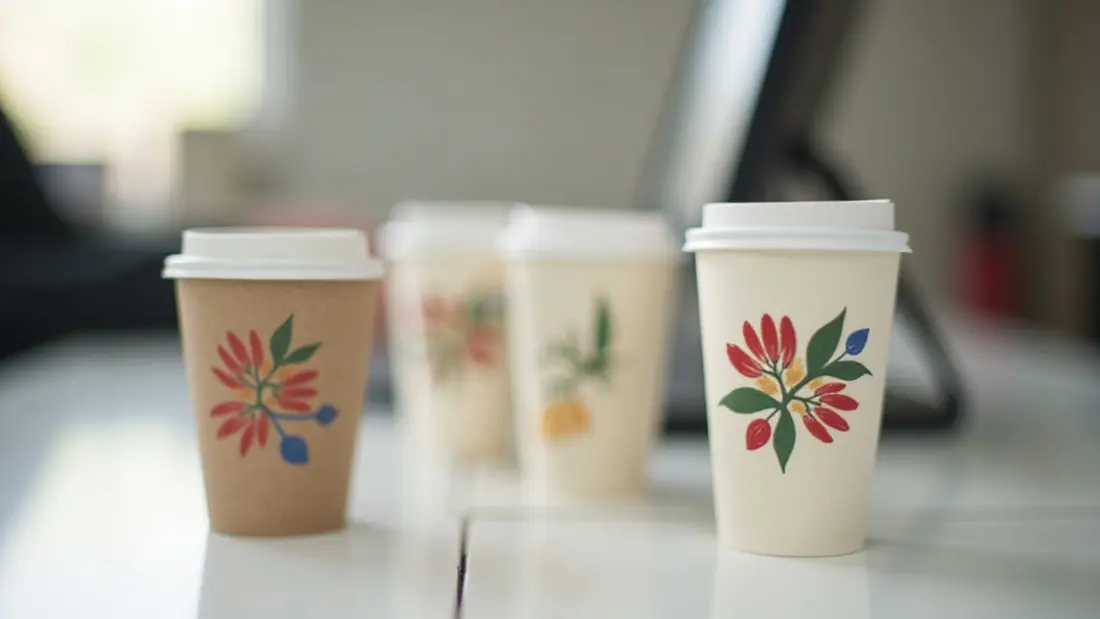
A paper cup is the only piece of print your customer holds for twenty minutes straight, carries down the street, and photographs without being asked. It is also one of the easiest products to order badly, because a cup is not a flat sheet — it is a cone that has been printed flat and then rolled, and almost everything that surprises people about the finished result comes from that one fact. We print custom cups at the shop on Lankershim for cafés, juice bars, taco spots, breweries with taprooms and offices that got tired of anonymous white cups, and the same four questions come up every time.
Our paper cups start at $96.25, with a default run of 50 pieces at $1.93 each. That per-cup number is a small-run number and it does what small runs do: it lets you test artwork on a real cup before you commit to a pallet of them.
Hot cup or cold cup — they are not interchangeable
This is the first fork and people trip over it constantly. A hot cup and a cold cup are built differently, and using one for the other job fails in a visible way.
A hot cup is a single-wall paperboard cone with a lining on the inside, a rolled rim at the top so a lid can snap on, and enough board weight to stay rigid when the contents are near boiling. A double-wall hot cup adds a second layer of board around the outside — an air gap that keeps the customer's hand off the hot surface and removes the need for a sleeve. If you serve drip coffee, tea or anything that goes out at serving temperature, that is your product, and the decision between single wall plus sleeve and double wall is mostly about whether you want to print two items or one.
A cold cup has a different problem: condensation. A cup of iced coffee sweats, and that moisture sits against the outside of the board for as long as the drink lasts. Cold cups are built with that in mind and are usually straighter-sided with a heavier lip. Putting a hot drink in a cold cup gives you a soft, floppy cup and a burnt hand; putting an iced drink in a light single-wall hot cup gives you a cup that goes soggy on the counter and a ring on the table. Tell us the drink and the serving temperature before anything else, and the rest of the spec follows from it.
The lining, and the compostable question
Every cup that holds liquid has a barrier on the inside — bare paperboard would go to pulp in a minute. The standard barrier is a thin polyethylene film. It works, it is cheap, it is what most cups in Los Angeles are, and it is why a conventional cup is not recyclable in most curbside streams: the paper and the plastic cannot be separated at the sorting facility.
The alternative is a plant-based PLA lining, which is what people mean when they say compostable cup. Worth knowing before you specify it: PLA needs an industrial composting facility to actually break down, not a backyard pile and not a landfill. If your city or your hauler collects commercial organics and your customers put the cup in the right bin, it does something. If the cup goes in a regular trash can on Riverside Drive, it behaves like any other cup. We are not going to tell you it does not matter — for a lot of businesses the material is a real part of what they are selling, and a customer who chose you for that reason will read the cup. Just choose it knowing what it buys you, and do not print a claim on the cup that the waste stream in your neighbourhood cannot back up.
Sizes, and the mistake of ordering all of them
Cups are sized by fluid ounces, and the common hot sizes run 8, 12 and 16 oz, with cold cups going larger. The temptation, once you are paying for custom print, is to do the whole ladder at once. Do not, at least not on the first order.
There is a practical reason. Cup artwork is not scalable between sizes — an 8 oz and a 16 oz are different cones with different wrap shapes, so each size is a separate print setup, not a resize of the same file. Ordering three sizes at once means three setups before you have seen a single cup in a customer's hand. Pick the size you sell most of, order that, live with it for a couple of weeks, then extend the artwork to the rest of the ladder once you know the design survives contact with reality.
One more thing worth checking against your own counter: lids. Lid diameter follows the cup's rim, and different sizes often share a rim. If two of your sizes take the same lid, that is one less SKU behind the counter and one less thing to run out of on a Saturday.
Artwork: the flat file is not what you will see
Here is the part that costs people a reprint. Your cup design is printed on a flat, curved-edge blank — a shape like a fan — which is then rolled into a cone and seamed. Three consequences:
Straight lines do not stay straight. A horizontal band drawn straight across the flat artwork will look like it is climbing or sagging on the finished cup. Anything meant to sit level around the cup has to be built on the curve of the dieline, not on a horizontal guide.
There is a seam. The two ends of the blank overlap where the cup is glued. Type that runs across the seam gets interrupted, and a fine detail landing there can be partially hidden. Put your logo away from the seam, and if you have a repeating pattern, choose one that tolerates an interruption.
The top and bottom are not printable to the edge. The rolled rim at the top and the tucked base both eat into the printable area. Artwork that goes right to the top edge of the flat file will simply disappear into the roll. Leave those margins alone and let the design breathe inside them.
Build in CMYK, supply vector where you can with fonts outlined, and if you are giving us a photographic element, give it to us at full size and 300 dpi. And be a little careful with heavy solid coverage: a full-bleed dark cup looks fantastic and is also the least forgiving thing you can print, because every scuff from the stack and every handling mark shows on it. A lighter ground with strong artwork on it holds up better over a week on a shelf.
What goes with the cup
Cups rarely travel alone. If you are pouring drinks, you are probably also handing over something to carry them in and something to close a bag with, and that is where the branding either continues or falls apart.
Custom shopping bags start at $230 for 50 pieces at $4.60 each — the same artwork on a bag turns a takeout order into something that walks down the block advertising you. For sealing bags, marking orders, labelling a cold case or covering a plain cup you already have in stock, die cut stickers start at $92.25 for 100 at $0.92 each, which is the cheapest branding per impression on this list by a wide margin. If you want something customers keep rather than throw out, custom sticker packs start at $170.13 for 25 packs at $6.81 each — a pack that goes in the bag with an order and ends up on a laptop lid.
Anything you want to add to the sticker side of this, our sticker and label printing page covers the materials and cuts. Short-run printed items generally go through our digital printing process, which is what makes a fifty-piece test run of anything worth doing at all.
Sizing the run
Do the arithmetic before you decide the quantity, because cups are a consumable and the maths is unusually clean. Count the drinks you sell in a normal week, multiply by four, and that is roughly a month of cups. A shop doing 200 drinks a week burns 800 cups a month; a small office kitchen might burn 800 in a year. Those two businesses should not be ordering the same quantity, and the second one should not be buying a year of stock in one go if the logo might change.
Storage matters in this city too. Cups arrive sleeved in tubes and stack fine, but a stockroom that gets hot in a Valley summer is not kind to a lined cup left under weight for months, and cardboard sitting on a concrete floor in a back room picks up damp from below. Keep them off the floor, out of the sun, and buy a quantity you will actually get through.
Angels Print prints custom paper cups, shopping bags, sticker packs and die cut stickers at our shop at 8511 Lankershim Blvd in Sun Valley, for cafés, restaurants, taprooms and offices across the San Fernando Valley and greater Los Angeles. If your artwork is ready, pick your size and quantity and order online. If you are not sure whether you need a hot or cold build, how your design will sit on the cone, or which size to commit to first, call us at (818) 806-9006 or bring your file to the shop and we will lay it out on the dieline with you before you order a run.