

August 29, 2026
Magnetic Business Cards in Los Angeles: Where They Stick, What They Cost, and When to Use One
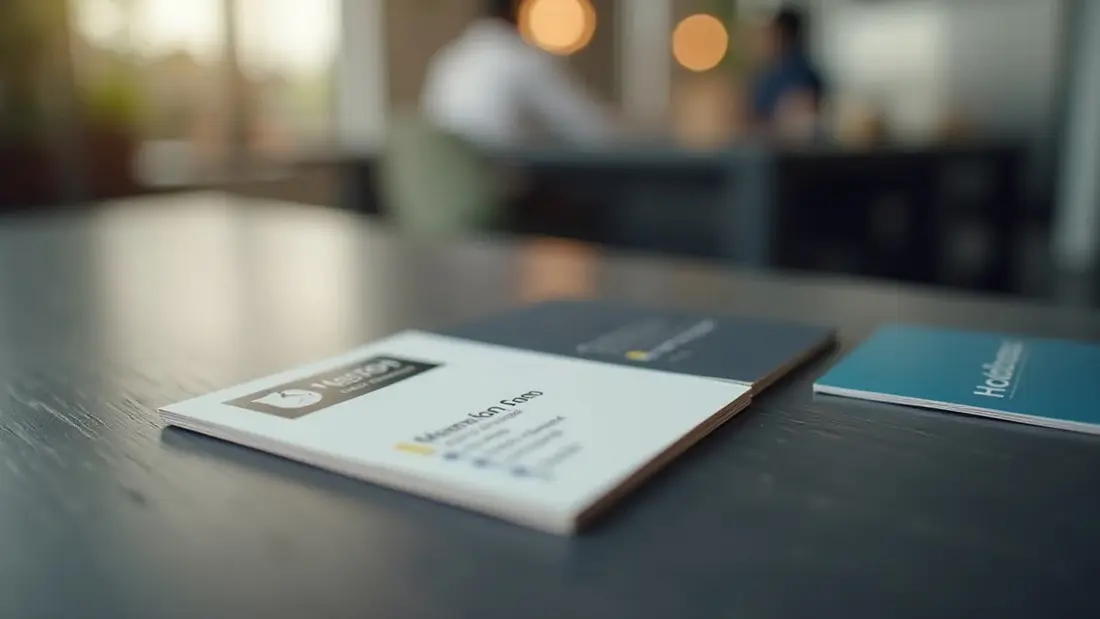
A business card gets handed over, glanced at, and put somewhere. The whole question is where. A paper card goes into a wallet, then into a drawer, then into a trash bag during a move. A magnetic card goes onto the side of a refrigerator, a filing cabinet or a toolbox, and it stays there until somebody needs a plumber. That is the entire pitch, and it is a good one — but it only works if you understand what the product is, where it will and will not stick, and why it does not replace the cards you hand out at a mixer. We print these at the shop on Lankershim for contractors, property managers, dentists, towing companies, food trucks and real estate agents across the San Fernando Valley, and the same three or four questions come up every time.
What a magnetic business card actually is
It is not a paper card with a magnet glued to the back. It is a sheet of flexible magnetic material — ferrite powder in a rubber or vinyl binder — with a printable white face laminated to one side, cut to the standard 3.5 × 2 inch card format. The magnetism runs through the whole sheet rather than sitting in a strip, which is why every piece holds no matter where you cut it. The back is brown or grey and slightly matte, and it is magnetized in narrow parallel bands, which is why two of them grip hard in one orientation and slide apart in the other.
Our magnetic business cards start at $91.25, and the default run is 100 pieces at $0.91 each. Hold onto that per-piece number, because every decision below comes back to it. Ninety-one cents is a lot for a card you hand to someone at a networking breakfast who will never call you. It is very little for a card that sits in a customer's kitchen for four years and gets read on the day their water heater fails.
Where it will actually stick
This is the part people find out after the box arrives. A large share of refrigerators sold in the last fifteen years — the brushed stainless doors in every remodeled kitchen in Los Angeles — are austenitic stainless, which is not magnetic. Your card slides straight off the front of the fridge. It usually still holds on the side panel, which is often plain painted steel, and on the freezer door of some models, but the big flat face everybody pictures is dead.
No printing choice fixes that, and neither does a thicker magnet. What fixes it is planning for the other surfaces. Steel filing cabinets, metal door frames, HVAC units, breaker panels, tool chests, whiteboards, server racks, the inside of a garage door, the dashboard-adjacent metal of a work van — that is where a lot of contractor magnets actually live, and several of those are better placements than a fridge anyway. A card on the side of an electrical panel is sitting exactly where the next person to open that panel will look.
One practical note about storage. Magnetic sheet has memory. Kept flat in the box it stays flat. Left rolled, or in a car in the Valley in August, it takes a curl that never fully relaxes, and a curled card only touches the metal along part of its surface, so the hold drops off sharply. Keep the box flat and out of direct sun.
It is not a card, and that changes how you use it
A magnetic card will not slot into a cardholder, will not sit in a wallet without deforming, and is thicker and heavier than anyone expects when they reach for it in a stack. As a precaution we tell people not to carry one pressed against a magnetic-stripe card or a hotel key. Practically, though, the point is simpler: this is not the card you carry fifty of in your jacket pocket.
The right setup for most businesses is two cards, not one. Classic business cards start at $25.70 for 50 pieces at $0.51 each — that is the handshake card, the one you give out freely and do not think about. The magnetic card is the leave-behind: one goes on the fridge or the panel at the end of a service call, one goes in the invoice folder, one goes to the office manager who decides who gets called next time. Different job, different budget line. At fifty-one cents versus ninety-one cents you can afford both, and the split keeps you from burning dollar-a-piece magnets on people who will never be customers.
Designing something readable from six feet
A paper card is read at arm's length by someone who just met you. A magnetic card is read from across a kitchen or a garage by someone who is not looking for it and does not remember your name. That is a different layout problem.
One message. What you do, in two or three words, and how to reach you. The phone number should be the largest element on the card — larger than the logo — set in a typeface with open counters, because a tightly condensed geometric sans turns 3, 8 and 6 into the same blob from ten feet away. Include the area code. Nobody in Los Angeles assumes 818.
Leave a blank strip if you can. A card where somebody can write an account number, a serial number or the date of the last service in ballpoint gets kept for a reason beyond your logo — but that only works on a matte or satin finish, because ink beads and smears on high gloss. Gloss looks richer under kitchen fluorescents; matte is more useful. Decide which one you actually need rather than defaulting to gloss because it looks better on screen.
If you want a QR code, keep it at least three quarters of an inch square with quiet space around it, and scan a printed proof with a real phone before committing to the full run. An elegantly small code that does not scan is worse than no code at all.
Files we can print without a conversation
Build at 3.5 × 2 inches with an eighth of an inch of bleed on every edge, and keep all text and logos at least an eighth of an inch inside the trim. Rounded corners are standard on magnetic stock — square corners are the first thing to lift and catch — and corners are cut with a rule die that shifts slightly across a run, so a thin border two millimetres from the edge will look centred on some cards and crooked on others. Do not design a frame around a magnet.
Raster art at 300 dpi at final size, not a 72 dpi web logo scaled up. Vector is better, with fonts converted to outlines. Build in CMYK and expect a saturated screen blue or a neon green to come out duller than your monitor suggests. Runs at this size go through digital printing, so colour holds consistent piece to piece within a run — but it is still ink on a white vinyl face, not backlit pixels. Note that magnetic stock prints on one side only; the back is the magnet. If you have content for a second side, it belongs on the paper card that goes with it.
When another card is the better answer
If what you want is a card people notice in the hand rather than one that sticks to metal, the magnet is the wrong tool. Clear plastic business cards start at $92.60 for 50 pieces at $1.85 each and do a completely different job — they get looked at twice, held up to the light, and kept because they feel like an object. Die cut business cards start at $129.14 for 100 at $1.29 each and give you a shape outside the rectangle. Neither one sticks to anything, and that is fine: a card in an architect's portfolio and a card on a property manager's filing cabinet are not competing for the same slot.
Magnets are also the wrong format for anything with an expiry on it. A magnetic card carrying a promotion that ends in three weeks is a dollar-a-piece object that becomes garbage on a fixed date. Put the offer on a postcard and put the phone number on the magnet. If you are working out which combination of stocks makes sense for how your business actually gets called, our business card printing page lays out the options side by side.
Angels Print prints magnetic business cards, classic, clear plastic and die cut cards at our shop at 8511 Lankershim Blvd in Sun Valley, for trades, clinics, restaurants and agencies across the Valley and greater Los Angeles. If your artwork is ready, pick your quantity and order online. If you are not sure whether your customers' fridges will hold one, how to split a run between magnets and paper, or whether your file will survive the die, call us at (818) 806-9006 or bring it by the shop and we will sort it out before you print a hundred of them.