

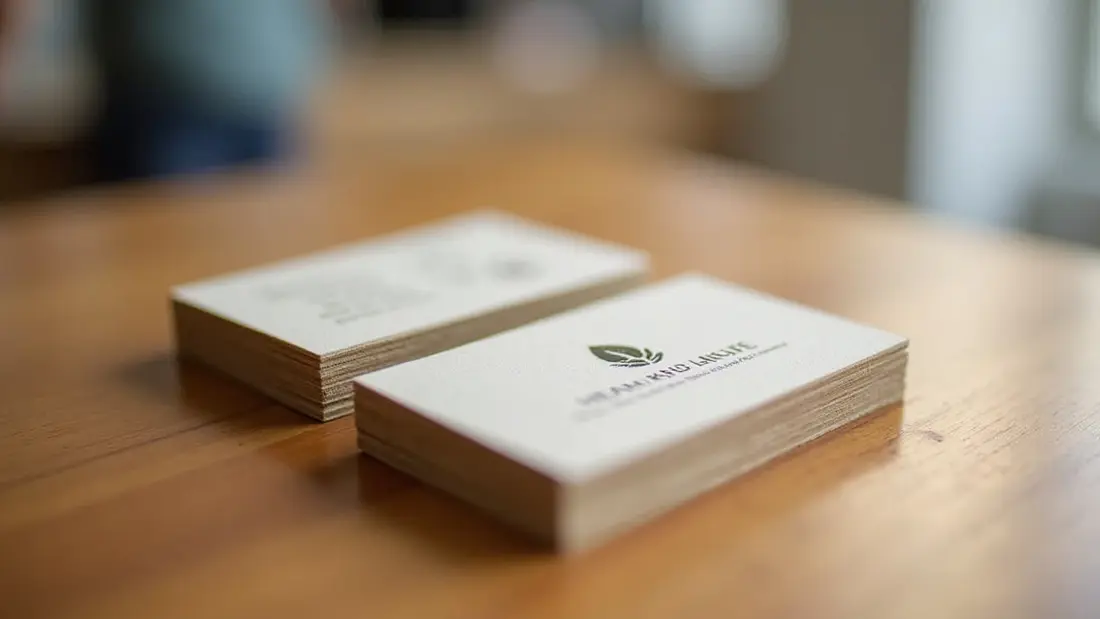
Every few weeks somebody comes into the shop on Lankershim holding a card they were handed at an event, and the question is never about the design. It is about the paper. It felt different — rougher, warmer, heavier than it looked — and they want to know what it was and whether we can print it. Often the answer is hemp. It is one of a very small number of stocks where the material announces itself before anybody reads a word, and in a city where the average person collects four cards a week and remembers none of them, that is the entire argument for the product. It is also a stock that will quietly ruin certain kinds of artwork, so it is worth knowing what you are buying.
What hemp paper actually is
The fiber comes from the stalk of industrial hemp — the long bast fiber under the outer skin, not the leaf and not the flower. It is pulped the same way wood or cotton is pulped. Almost everything sold as hemp paper is a blend, typically hemp fiber with post-consumer recycled pulp or cotton, because pure hemp sheet is difficult to source and priced accordingly. That blend is not a compromise anybody is hiding; it is how the stock gets its consistency and its price.
Two things it is not. It is not seed paper — the plantable stuff embedded with wildflower seeds is a completely different product and it looks and prints nothing alike. And it has no relationship to anything you smoke; the card is paper, made from a stalk, the same way linen paper is made from flax. We mention this because roughly half the people who ask about it are picturing one of those two things.
What it feels like in the hand
Uncoated, with visible tooth. Warm off-white to light cream rather than bright white, usually with faint fiber flecks scattered through the sheet — no two cards are identical under a loupe, which is either the whole appeal or a defect, depending on your brand. There is no gloss, no satin, no coating of any kind, because a coating would seal the texture and you would have paid extra for a card that feels like every other card.
Hemp business cards start at $63.03, and the default run is 100 pieces at $0.63 each. That per-piece number matters more than the starting price, and it is the number to put next to the alternative.
The price, next to a standard card
Our classic business cards start at $25.70 for a default run of 50 at $0.51 each. So the difference between a standard coated card and hemp is twelve cents a piece — about twelve dollars on a hundred cards.
We spell that out because people brace for a luxury markup and then talk themselves out of the stock before they have seen it. Hemp is not a premium tier with a premium multiplier attached. It is a paper change, priced like a paper change. If you hand out a hundred cards a quarter, the decision costs you the price of lunch, and it is the only element of a business card that a recipient registers physically rather than visually.
What the stock does to your ink
This is where hemp punishes artwork that was designed for coated paper, and it is worth being blunt about it.
Uncoated sheet is absorbent. Ink soaks in slightly rather than sitting on the surface, so halftone dots spread — the trade term is dot gain — and everything prints a touch darker and softer than it looks on screen or on a coated proof. Saturated colors lose their edge. A bright cyan-leaning blue, a neon green, an electric orange: all of them come back duller and slightly muddier than your monitor promised. Deep greens, browns, rusts, navy, black and anything earthy print beautifully, because the warm paper is working with them rather than against them.
Fine detail is the second casualty. Hairline rules thicken. Small reversed type — white text sitting in a dark box — fills in at the counters, so an 6pt light-weight sans knocked out of a solid black bar turns into a smudge with letter-shaped hints in it. If you need reversed type on this stock, go up in size and up in weight, and keep it out of the 5–7pt range entirely.
The third thing is the one people forget: there is no white ink. Anything white in your file is not printed, it is bare paper — and bare paper here is cream. A logo built with a white knockout inside it will show warm cream inside it. A product photo with a clean white background will have a cream background. That is fine if you designed for it and jarring if you did not.
Design that suits the stock
Light ink coverage. Hemp is at its best with type, a mark, a rule and a lot of untouched paper, because untouched paper is the thing you are paying for. Flooding the card edge to edge with a dark solid does two things at once: it hides the texture you bought, and it exposes mottling, because absorbent uncoated sheet does not lay down large solids as evenly as coated stock. If your design is a full-bleed black card with silver type, hemp is not your stock.
One practical advantage nobody mentions until they use it: you can write on it. Ballpoint and pencil take cleanly on uncoated paper, where they bead and smear on gloss. For a consultant, a stylist, a mechanic or anybody who writes an appointment time or a quote on the back of the card, that is a real function, not a nicety. Leave a clear area on the reverse for it.
Short runs go through our digital printing process, which keeps color consistent piece to piece across a run — but consistent is not the same as matching your screen. Build in CMYK, expect the shift described above, and do not judge the stock from a photograph of it. Come by the shop and handle a printed sample before you commit to a design that depends on a specific color.
When hemp is the wrong answer
Photography-driven cards. If your card is a portfolio piece — a real estate agent's property shot, a photographer's image, a food brand's hero plate — the softness and the warm base will cost you the thing the card exists to show. Print those on coated stock.
Cards that live in a wallet for two years. Uncoated paper takes on skin oils and pocket dirt over time. A hemp card looks superb for the first month in someone's card case and tired after a long stay in a back pocket. If longevity is the point, clear plastic business cards go the opposite direction entirely — $92.60 for a default run of 50 at $1.85 each, waterproof, tear-proof, and impossible to confuse with anyone else's card, at three times the per-piece cost.
And if what you actually want is for the card to be noticed rather than to feel natural, shape does that job harder than texture does. Die cut business cards start at $129.14, default run 100 at $1.29 each, cut to a rounded, arched or custom outline. Texture is discovered when the card is touched; a silhouette is seen across a table.
The cannabis and wellness question
A large share of the hemp cards we print in Los Angeles go to dispensaries, cultivators, CBD and skincare brands, yoga studios, herbalists and sustainability-forward agencies — the material reads as a statement of category before the copy does. Two notes on that.
First, the stock has nothing to do with regulatory compliance. Licensed cannabis businesses in California operate under advertising and labeling rules that govern what your printed material may say and who it may be shown to; printing it on hemp paper does not touch any of that, and printing it on ordinary card stock does not violate any of it. Bring us copy your compliance advisor has cleared and we will print exactly that.
Second, be careful about how far you push the environmental claim in your own copy. Hemp is a fast-growing annual and blended hemp sheet keeps some volume of virgin wood pulp out of the supply chain, and that is a fair thing to say. "Carbon neutral" and "zero impact" are not, and a specific claim you cannot substantiate is a worse liability than no claim at all. If you want a line on the card, describe the material — tree-free hemp blend, uncoated — and let the paper do the rest.
Setting up the file
Standard 3.5 × 2 inch trim unless you tell us otherwise. Build at final size with an eighth of an inch of bleed on all four edges, and keep type and logos at least an eighth of an inch inside the trim line. Do not design a thin frame around the border — cards shift a fraction across a cut stack, and a 2mm rule that is centered on the top card is visibly off on the bottom one.
Vector art, fonts converted to outlines. Raster elements at 300 dpi at final size, not a web logo scaled up. CMYK, not RGB. Rich black for large areas, plain black for small text. If both sides carry ink, send both as separate pages or separate files and tell us which is the front.
Angels Print prints hemp, classic, clear plastic and die cut cards at our shop at 8511 Lankershim Blvd in Sun Valley, and our business card printing work covers most of the San Fernando Valley and greater Los Angeles. If your file is ready, choose your quantity and order online. If you want to feel the stock before you commit, or you are not sure whether your logo colors will survive an uncoated warm sheet, call us at (818) 806-9006 or bring the file to the shop and we will look at it together before you print a hundred of them.