August 28, 2026
Kiss Cut Stickers in Los Angeles: What Gets Cut, What Doesn't, and Why It Matters
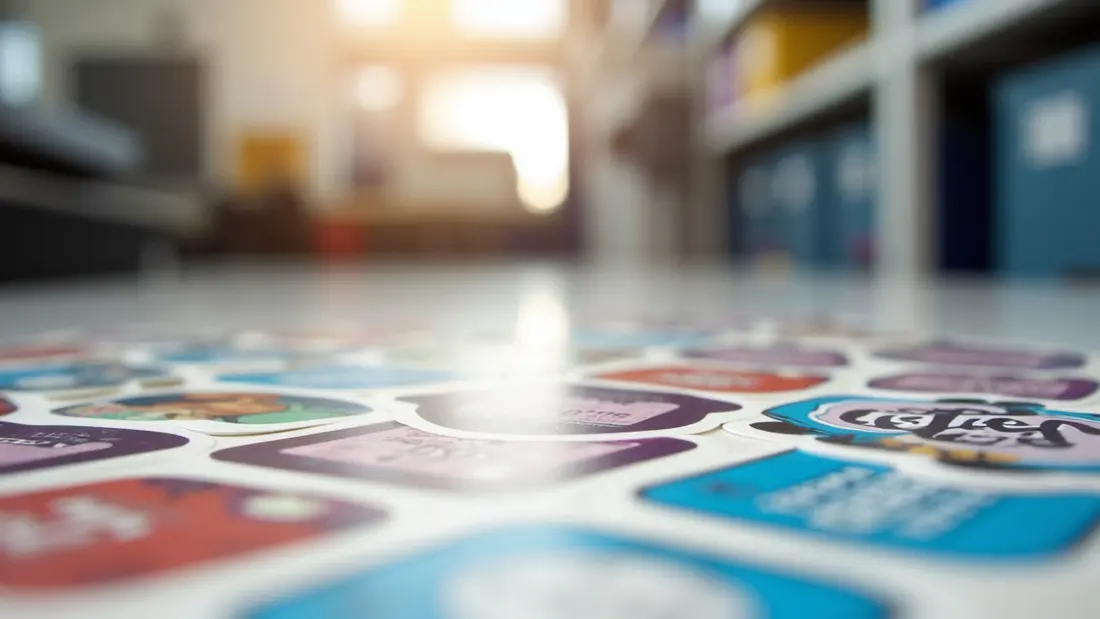
Almost every sticker question that comes into the shop on Lankershim is actually a question about the cut. The printing part is settled — full colour on white vinyl, laminated, done. What people are really deciding is where the blade stops. Kiss cut stops in the vinyl. Die cut goes through everything. That one difference changes how the sticker is handed out, how it survives a tote bag, how it gets packed, and how much of your design is protected.
We print both every week for bands, coffee roasters, tattoo shops, skate brands, churches, dispensaries and a steady run of Etsy sellers working out of apartments in North Hollywood and Van Nuys. Here is what we tell them before they commit to a quantity.
What kiss cut actually means
A printed sticker is two layers: the face material — usually white vinyl with your art printed on it — and the paper or synthetic liner it is stuck to. A kiss cut is a cut that goes through the face and the adhesive and stops at the liner. The liner stays whole. So you end up with your shape sitting on a rectangle or square of backing that is larger than the shape itself.
That border of liner is the entire point. It gives a thumbnail somewhere to start. Anyone who has ever tried to get a bare die cut sticker off its backing with cold hands, or with a manicure, knows the failure mode: you scratch at the edge, you lift a corner of the vinyl, the corner creases, and now the sticker has a fold in it before it has been applied to anything.
Our kiss cut stickers start at $97.25, and the default run is 100 pieces at $0.97 each. Under a dollar is roughly the price of a business card that people actually want, which is the reason this product keeps outselling most of what else we print.
Kiss cut versus die cut, decided properly
Die cut stickers start at $92.25 for 100 at $0.92 each — slightly cheaper, because there is less material per piece and no surrounding liner to trim. They are the right call when the sticker is the object: a single hero sticker sold in a shop, dropped into an order, or handed over at a merch table where it is meant to look like a finished thing with no packaging around it.
Kiss cut wins in four situations, and they come up more often than people expect.
First, mailing. A kiss cut sticker sits on a flat rectangle of liner, which means it can be slipped into an envelope, taped to an invoice, or tucked into a box without the edges catching and peeling on the way. A bare die cut shape in a padded mailer arrives with one leg of the letter R turned up.
Second, delicate outlines. If your logo has thin arms, a script tail, an antenna, a stem — anything narrow — die cutting isolates that thin part and it will bend or tear on its own. Kiss cutting leaves it supported by the liner until the moment of application.
Third, multiples on one sheet. Because the liner stays intact, we can put four, six or twelve separate shapes on a single kiss cut sheet. One piece to hand out, several stickers to peel. This is how most sticker sheets you have seen are made.
Fourth, anything handed to a customer in a hurry — a counter, a booth, a class. Peelability at speed matters more than people think when there is a line behind you.
The sheet is where kiss cut earns its money
Once you understand that the liner survives, sheets become obvious. A single sheet can carry a full logo, a small logo, a slogan, two icons and three tiny fillers, all kiss cut, all peelable independently, on one rectangle that fits in a standard envelope. You are effectively selling or giving away eight stickers with the handling cost of one.
That is what our custom sticker packs are for — $170.13 to start, default run 25 packs at $6.81 each. The per-unit number looks high next to a single sticker until you count what is inside it. A pack is a retail item with a price tag on it, not a giveaway, and it is one of the few printed products a small brand can actually sell at a margin rather than absorb as a marketing cost.
A rule for sheet layout: leave at least an eighth of an inch of clear liner between shapes, and the same from the outer edge of the sheet. Cutting is mechanical and it drifts a little across a run. Shapes crowded against each other look cramped on a good sheet and overlap on a bad one.
Material and finish
White vinyl is the default and it is the right default for the vast majority of jobs. It is waterproof, it survives a dishwasher on a bottle and a rainy month on a laptop lid, and it takes colour cleanly.
Laminate is the layer people forget to ask about. It is a clear film over the print, and it does two jobs: it stops the ink abrading off against keys, zips and other stickers, and it decides the finish. Gloss makes saturated colour pop and beads water. Matte kills glare, photographs beautifully for product listings, and shows fingerprints less. If you sell online and shoot your own product photos, matte is usually the easier surface to light.
Clear vinyl is the other option worth knowing about, and it comes with a caution: it is genuinely transparent, so whatever is behind it shows through your artwork. On a car window or a glass storefront that is the effect you want. On a coloured tote bag it turns your black lettering into mud. Anything with white in the design needs white ink or a white face material — there is no such thing as printing white on clear by leaving the area blank.
More on the material choices lives on our sticker and label printing page, and the short-run colour behaviour is a function of our digital printing process, which keeps a run consistent piece to piece.
Artwork that cuts cleanly
Build the file at final size. Give us the cut line as a separate vector path on its own layer — a stroked path, one colour, clearly labelled. If you do not supply one, we will offset the outline of your artwork for you, but then the offset is our judgment call rather than yours.
Keep an eighth of an inch of bleed past the cut line on every side. Vinyl and blade both move slightly; without bleed a drift of half a millimetre gives you a hairline of white liner along one edge.
Avoid thin borders that run parallel to the cut. A one-millimetre outline around the whole sticker is the single most common way a run comes back looking uneven — it will be perfectly even on some pieces and visibly thicker on one side on others, and the eye catches it immediately.
Round your corners, at least slightly. Sharp points on vinyl lift first and peel first. Even a 2 mm radius meaningfully extends how long a sticker survives on a water bottle.
Raster art should be 300 dpi at final size. Vector is better, with fonts converted to outlines. Build in CMYK and expect a fluorescent screen green or an electric blue to land a shade duller on vinyl than it looks backlit on your monitor.
Where stickers fit with everything else
Stickers are rarely a standalone order. The pattern we see most often from local brands is stickers plus packaging: a die cut on the outside of the box as a seal, a kiss cut sheet inside as a thank-you, and the whole thing carried out of a market stall or a pop-up in a printed bag. Our custom shopping bags start at $230 for 50 at $4.60 each, and a bag with your mark on it walks around Los Angeles all afternoon in a way a sticker on a laptop does not.
The other honest note: a sticker is not a label. If you need something that goes onto a jar in sequence off a roll, applied a hundred times an hour, that is roll label work and it is a different product with a different setup. Kiss cut sheets are for hands, not for machines.
Angels Print prints kiss cut stickers, die cut stickers, sticker packs and shopping bags at our shop at 8511 Lankershim Blvd in Sun Valley, for brands and shops across the San Fernando Valley and greater Los Angeles. If your file is ready with a cut line, pick your size and quantity and order online. If you are weighing sheets against singles, unsure whether your outline is too thin to die cut, or trying to decide between gloss and matte for product photos, call us at (818) 806-9006 or bring the artwork by the shop and we will sort it out before you print a hundred of them.