

September 1, 2026
Rectangle Flags in Los Angeles: Wind, Hardware and Making a Flag Readable From the Street
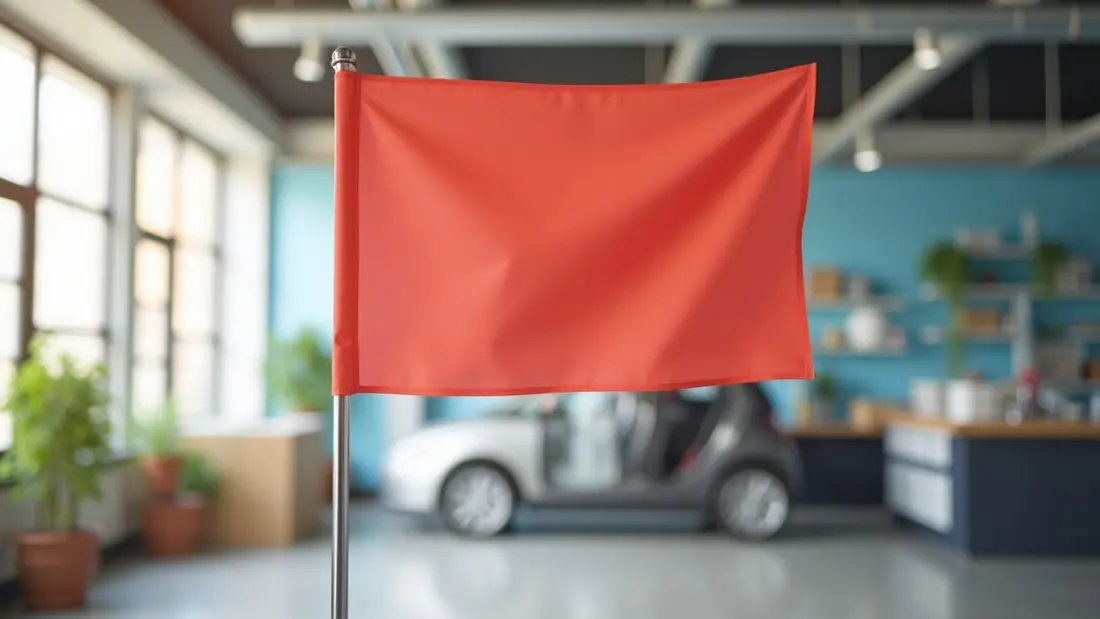
People search for "rectangle flag" when the feather flag outside the shop next door has started to look like everybody else's feather flag. A rectangle reads differently — squarer, more permanent, more like something a bank or a dealership would fly than something a pop-up tent brought for the weekend. That instinct is right. But a rectangle flag is also the harder of the two shapes to get working on a Los Angeles street, because it depends on wind in a way a feather does not, and because most of the disappointing ones we see were sized and mounted as if they were banners. We print flags at the shop on Lankershim for car lots, gyms, churches, schools, dispensaries and event crews across the Valley, and almost every problem traces back to a decision made before the file was ever sent.
What a rectangle flag actually is
It is a printed textile, hemmed on all four sides, finished on one edge to attach to hardware — grommets for a rope-and-pole setup, or a sewn sleeve that slides over a pole or a bracket arm. Ink goes into the fabric rather than sitting on top of it, so the piece stays soft, flies properly and does not crack along a fold the way a coated substrate would. Our rectangle flags start at $195.
This is a different object from a banner even when the dimensions match. A banner is stretched flat and held under tension against a wall or a frame; every square inch is visible all the time, and wind is a load you fight with grommets and bungees. A flag is deliberately loose. It is designed to move, and it is only fully legible during the fraction of the time it happens to be extended. Once you accept that, the rest of the decisions make sense.
The trade against a feather flag, in one sentence
A feather flag has a curved pole running up its leading edge, so it holds its shape and stays readable in dead-still air. A rectangle flag has nothing holding it out, so on a windless morning in Sun Valley it hangs as a vertical stripe of colour and your message is folded up inside it.
In exchange, the rectangle gives you the largest usable flat area of any flag shape and a completely different tone. Institutions fly rectangles. Feathers say promotion; rectangles say premises. If you are marking a location that will be there next year, that is worth something. If you need a message legible to a driver at 3 p.m. on a still Tuesday, a flag of either shape is the wrong tool and you want a fixed sign — that is a conversation for our signage and front signs side.
Wind is the spec, and Los Angeles has two kinds of it
Most of the year the Valley gives you a mild afternoon breeze that arrives around two or three o'clock. That is flag weather: enough to lift and extend the fly end, not enough to punish the stitching. It is also why we tell people to look at their own street at the hour that matters to them before choosing a size. A flag that needs a stiff wind to open is a flag that is closed during your morning rush.
Then there are the Santa Ana events in the autumn and winter, which come down through the passes and hit the north Valley hard. This is what destroys flags, and it never destroys them in the middle. The failure starts at the fly end — the free edge farthest from the pole — where the fabric whips fastest and the hem takes the most abuse, and it walks inward from there as a fraying tear. Two practical responses: tell us the flag is going up on an exposed pole rather than a sheltered wall so we can finish that edge accordingly, and be willing to take it down when a wind advisory is posted. A flag you pull in three times a year lasts several times longer than one that has never come off the pole. Nobody wants to hear that, and it is still the single largest factor in how long the piece survives.
Size interacts with this. Bigger is not automatically better on a flag, because a larger panel catches more air, hangs heavier, needs more wind to lift and puts more strain on both the hem and the hardware. A well-placed smaller flag that opens at 11 a.m. beats a big one that only opens in a storm.
Single-sided and double-sided are two different products
A single-sided flag is printed once. The ink strikes through to the back, so the reverse shows your artwork mirrored and slightly softer — readable as a colour and a logo shape, but with any text running backwards. For a flag mounted flat against a wall on a bracket, or one that people only ever approach from a single direction, that is completely fine and it is the lighter, better-flying option.
A double-sided flag is two printed panels with an opaque layer sewn between them so neither side ghosts through the other. Both faces read correctly. It is heavier, it needs more wind to fly, and it costs more. Choose it when the flag stands free at a driveway entrance with traffic passing in both directions, or on a pole in the middle of a lot where there is no back side. Choose against it when the flag is going on a building face and the back is the wall.
Mounting, and the part we cannot answer for you
Rectangle flags go up three common ways: an in-ground or roof-mounted vertical pole with a halyard, a wall bracket angled out from the building face, or a portable base with an upright pole for events. Each puts different loads through the hem, so tell us which one you are using before we finish the flag.
What we will not do is tell you whether your flag is allowed. Sign and banner rules in Los Angeles depend on your zoning, your specific street, whether anything projects over a public sidewalk, and — if you lease — on what your landlord's agreement says, which is usually stricter than the city. Check with the jurisdiction and your landlord before you commit to a size or a bracket position. A flag that has to come down two weeks after it goes up is a full loss, and it is the kind of loss that gets discovered by a neighbour, not by you.
Designing for a moving surface
Build the artwork the way you would build a highway sign, then simplify it once more. One idea, one logo, high contrast, heavy letterforms. Thin scripts and long phone numbers are wasted on a flag — the surface is curved, moving and only intermittently open, and detail that survives on a proof at your desk disappears at forty feet.
Keep anything critical toward the hoist edge, the side attached to the pole. That edge moves least, stays visible longest and wears slowest. Treat the fly end as decorative, because it is the part that spends the most time folded and the part that will eventually fray. Supply vector art or high-resolution files built at final size; our digital printing team will tell you if a colour is going to land differently on textile than it did on your last vinyl job, which is a normal thing to ask about before a run rather than after.
Indoors, choose something else
Flags are outdoor instruments. Inside a hall or a booth there is no wind, so a rectangle flag hangs shut and does nothing. For indoor visibility at the same kind of price, a 3FT SEG fabric stand starts at $195 and holds a printed fabric panel flat in an aluminium frame — the same textile look, permanently open. For a photo wall or a stage background, a backdrop banner starts at $189.99. And when you just need a message standing next to a table at a job fair, a black stand retractable banner starts at $62.50 and goes back in its case in about a minute.
Many of our customers end up with a pair: a flag outside doing the wayfinding, a retractable or fabric stand inside doing the explaining. They are answering different questions.
Sun, and planning for the second flag
Direct Valley sun is relentless on textile. Every flag fades, and reds and deep blues go first. There is no finish that stops this, only slows it. Two habits help: rotate two flags rather than flying one continuously, and treat the flag as a consumable with a replacement cycle rather than a fixture you buy once. Budget accordingly and you will never be the business with the pink flag that used to be red — which reads, to anyone driving past, as a place that stopped paying attention.
Angels Print prints rectangle flags, fabric stands, backdrop banners and retractable displays at 8511 Lankershim Blvd in Sun Valley, for businesses across the San Fernando Valley and greater Los Angeles. If you know your size, your mounting method and whether you need one side or two, pick your options and order online. If you are still weighing a rectangle against a feather, or you want us to look at artwork before it goes onto a moving surface, call (818) 806-9006 or bring the file to the shop and we will work it through with you.