

September 1, 2026
Retractable Roll Up Banners in Los Angeles: What the Hardware Does, and Where These Fail
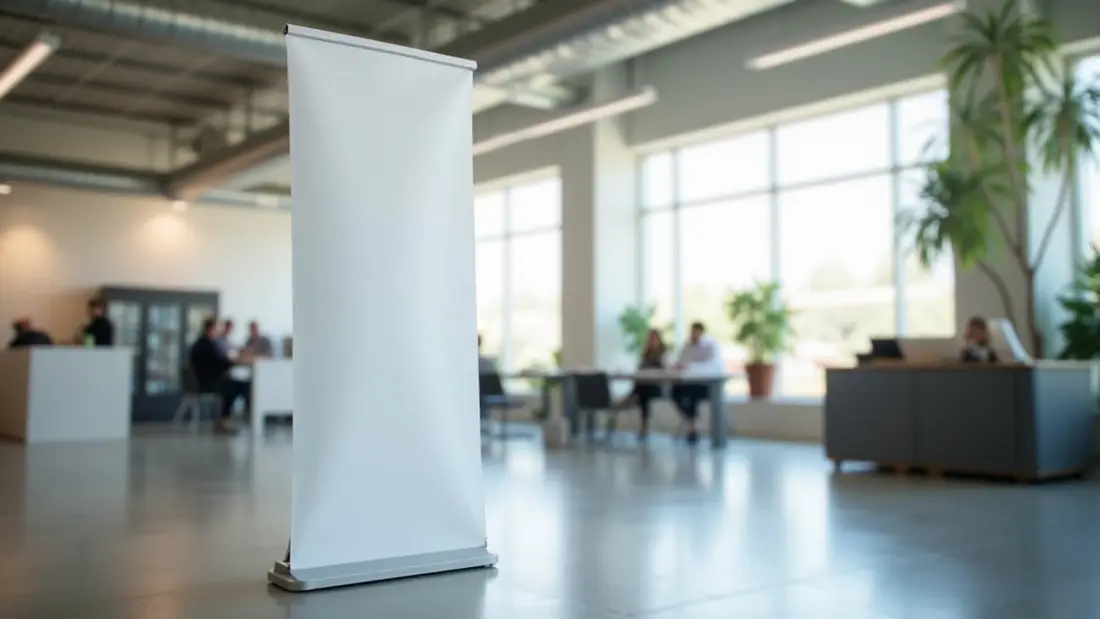
A retractable banner is the only sign most businesses own that has moving parts. That is the whole story of why some of them still look sharp after forty events and others develop a permanent wave down the middle after three. You are not buying a print — you are buying a printed film plus a spring-loaded aluminum cassette, and the cassette is the part nobody asks about. We build these at the shop on Lankershim for trade show crews, clinics, churches, real estate teams, recruiters and restaurant openings across the Valley, and the complaints we hear almost never concern the ink.
What is actually in the box
Inside the base is a roller under spring tension, wound tight, with the bottom edge of the film clamped to it. You pull the top rail up, a support pole in two or three sections drops into a socket at the back of the base, and the pole holds the rail against a spring that is permanently trying to pull it back down. Nothing is locked. The banner stands because two forces are balanced.
That design has consequences. The film is under constant vertical tension while it is up, which is what keeps it flat and why a retractable looks better than a banner hanging from grommets. It is also why a wrinkle, once set into the film, gets pulled through the whole panel instead of relaxing out. And it is why the base has to be heavy: a light base with a tall film is a lever waiting for someone's tote bag.
Our retractable roll up banner starts at $52.50. That is the standard configuration — cassette, telescoping pole, printed film and a carry bag — and for a lot of buyers it is the correct answer with no further thought required. Where it pays to think is when the stand is going to be handled by different people, at a lot of events, on a floor plan you do not control.
Film opacity is the decision that ruins these
Retractable film is not vinyl banner material. It is a thinner, flexible print media that has to wind onto a two-inch roller a few hundred times without cracking, and it has to hang dead flat with no support at the edges. That combination means it is thinner than you expect.
The variable that matters is opacity. A single-layer film with nothing behind it will show whatever is behind the stand — a lit window, a white pipe-and-drape wall, the exit sign, the next exhibitor's blue backdrop bleeding through your white background. Blockout film has a grey or black core layer sandwiched inside, so nothing transmits. It costs more and it weighs more, and it is the difference between a banner that reads as a solid printed panel and one that looks vaguely dirty under trade show lighting.
Ask yourself where the light is coming from. A stand against a solid wall in a lobby is fine on standard film. A stand in front of a storefront window on Lankershim, backlit by afternoon sun, needs blockout or it will glow and go transparent for four hours a day. So does anything double-sided, and anything that will sit in the middle of a room where people walk behind it.
Curl, and how the film gets wrecked
Three failure modes, all avoidable.
The first is storage under tension for months. Film left retracted and untouched for a year takes a memory of the roller — you pull it up and the top eighteen inches want to curve toward you. It usually relaxes after a few hours standing, but not always. If a stand is going to sit in a closet between annual events, that is a reason to buy a better film, not a cheaper one.
The second is heat. A cassette left in a trunk through a Valley August is a metal tube sitting at a temperature well above anything the film was designed for, wound tight. That is exactly the condition that sets a curl permanently. Carry it in the cabin, not the trunk, and do not leave it in a parked car at a hotel while you go to lunch.
The third is retraction speed. The spring will pull the rail down at whatever rate you let it, and if it slams into the base the film buckles at the top edge and creases. Walk it down with your hand, every time. The fastest way to destroy a $52.50 stand is to let go of it once.
Height, base weight and the room you are actually in
Standard retractables land around 79 to 92 inches tall, and the top eight inches are frequently blocked by someone's head from eight feet away. Put nothing you need read — no phone number, no QR code — in the bottom eighteen inches or the top six. The band that actually works at a crowded event is roughly chest to eye level, which is a much smaller design area than the file you were sent.
Base weight is the specification to compare when you are choosing between two stands that look identical online. A heavier extruded base with end caps and a wider footprint will survive being knocked; a light stamped base will not. Our black stand retractable banner starts at $62.50 and is the version we point people toward when the stand lives in a permanent spot — a clinic waiting room, a showroom, a church foyer — because the black anodized hardware disappears against dark flooring and the silver one does not.
One hard rule: these are indoor products. There is no wind rating on a retractable, because there is no mechanism that could give it one. Nothing anchors the base, and the film is a sail with a lever arm of seven feet. A retractable on a sidewalk in Sun Valley in a Santa Ana condition is going over, and the fall usually bends the top rail, which is not repairable. Outdoors you want a different product category entirely — that is a conversation for our signage side of the shop.
When a retractable is the wrong tool
Two situations where people buy retractables and regret it.
The first is a photo wall or a step-and-repeat. Retractables are seven feet tall and about a yard wide, and three of them lined up produce two visible seams and three visible poles. If what you want is a continuous backdrop for photos or a booth back wall, buy a backdrop. Our backdrop banner starts at $189.99 and gives you one uninterrupted printed surface with a frame behind it, which is what the camera needs.
The second is a booth you set up more than a few times a year. A tensioned fabric display holds the fabric flat inside a frame rather than under spring load, so it does not crease, and the graphic is a washable pillowcase that packs into a bag instead of a rigid tube. Our 3FT SEG fabric stand starts at $195. It costs roughly three times a standard retractable and it will outlast four of them if the stand travels every month. If it goes out twice a year, it will not, and the retractable is the smarter purchase.
Building the file
Set the artwork at the full film size including the portion that wraps onto the roller — that bottom strip is inside the cassette and will never be seen, so nothing important goes there. Build in CMYK at 150 dpi at final size, or supply vector with fonts outlined. Large flat areas of a single corporate colour are the most demanding thing you can put on a retractable, because any banding runs the full seven feet where the eye can follow it; if the brand colour has to match an existing piece, tell us and bring the reference. Short runs go through our digital printing process, and if you are ordering several stands that will stand side by side, order them together so they come off the same run rather than weeks apart.
Angels Print prints retractable roll up banners, black stand retractables, SEG fabric stands and backdrop banners at 8511 Lankershim Blvd in Sun Valley, for businesses across the San Fernando Valley and greater Los Angeles. If your file is ready and you know the room, pick your size and order online. If you are still deciding between standard and blockout film, or whether one backdrop beats three retractables for your booth, call us at (818) 806-9006 or bring the floor plan to the shop and we will work it out before anything gets printed.