

September 2, 2026
SEG Backlit Popup Displays in Los Angeles: How the Light Works, What It Costs, and When You Don't Need One
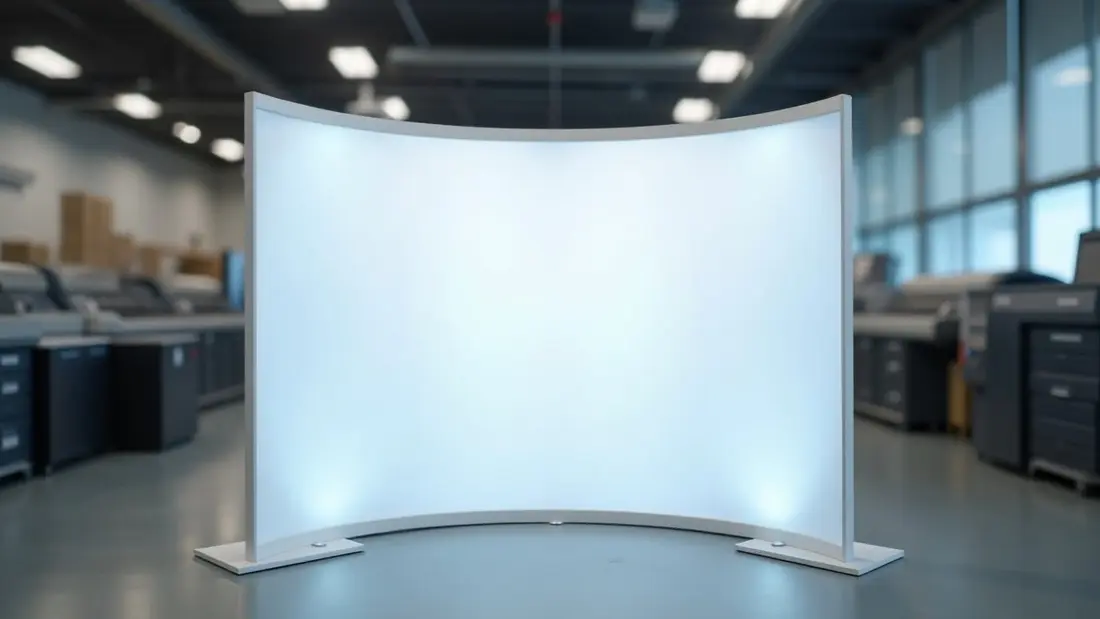
Walk a trade show floor at the LA Convention Center or the Anaheim Convention Center and you can pick out the backlit booths from the far end of the aisle. Everything else on that floor is lit by the same flat ceiling wash, so every graphic is equally grey. A backlit fabric wall is the one surface generating its own light, and the eye goes to it the way it goes to a television in a dim room. That is the entire reason these cost what they cost. We build and print them at the shop on Lankershim for exhibitors, showrooms, restaurants and retail across the San Fernando Valley and greater Los Angeles, and the questions worth answering before you buy are about light, not about printing.
What an SEG display actually is
SEG stands for silicone edge graphic. The print is done on polyester fabric by dye sublimation — the ink turns to gas and dyes the fibre itself, so the colour is in the cloth rather than sitting on top of it. Around the perimeter of that fabric panel, a thin silicone bead is sewn into a hem. The frame is aluminium extrusion with a matching groove cut into its face. You start the bead in one corner and press it in with your thumb all the way around, and the panel goes tight and flat with no visible hardware, no frame overlap, no shadow line at the edge.
That is the whole trick, and it is why SEG replaced Velcro-and-panel popups. The graphic ends exactly where the frame ends. On a backlit unit it matters twice over, because any wrinkle, any slack, any pucker in the fabric shows up as a bright or dark band once you put light behind it. Tension is not a finish detail on a light box. It is the picture.
Where the light comes from, and the hotspot problem
Our SEG backlit popup display starts at $1145.05, with size and options chosen in the configurator. The frame is deeper than a non-lit SEG frame for one reason: the LEDs need distance. Light sources close behind fabric read as a row of bright dots — the hotspot problem — and the fix is either depth, a diffuser layer, or edge-lit LEDs that fire sideways into the cavity and bounce. Cheap backlit walls skip all three and you end up with a graphic that has a visible stripe of glow across the middle and dark corners.
Two practical consequences. First, a backlit frame does not pack down as thin as a standard fabric wall, so budget for a bigger case and a bigger corner of the van. Second, the fabric itself is a different material — a backlit print needs a specific opacity so light passes through without washing out the colour. You cannot take the graphic off your existing non-lit SEG wall, drop it into a lit frame, and expect it to look right. Dark areas that read as rich black under ambient light go muddy grey when lit from behind, and fine reversed-out type loses its edges.
Design the artwork for transmitted light
This is where most files arrive wrong. Artwork for a backlit panel is not artwork for a printed banner with the brightness turned up. Light passing through fabric lifts everything about a stop and a half, so mid-tones go pale and anything already light goes to paper white. We tend to see the best results when the file is built a touch heavier than looks right on your monitor, with real contrast between the message and its background rather than a gentle gradient that will flatten out entirely.
Keep the critical content out of the outer margin. Some of the panel edge disappears into the silicone hem and the frame channel, so a logo sitting an inch from the trim can end up half swallowed. Reversed type — white on a dark field — is the strongest thing you can do on a backlit wall, because the light is doing the work of the ink. Dark type on a bright field is the weakest, because the bright field is glowing and the type is fighting it. And build in CMYK with bleed all around, same as any other job we run through digital printing.
Be honest about whether you need the light
Backlighting earns its price in exactly two situations: a crowded floor where everyone else is under the same flat lighting, or a permanently installed wall in a dim room — a showroom, a lobby, a restaurant back wall — where the display is the light source and it runs every day for years. In both cases the fixture is doing something no printed panel can do.
It does not earn its price at an outdoor event in daylight, at a job fair in a fluorescent-lit gym, or on a table you set up four times a year. Daylight beats any LED array you can carry, and a backlit wall in full sun is just an expensive fabric wall. Be honest about the room before you commit the budget.
If the answer is that you want the tension-fabric look without the light, the 3FT SEG fabric stand starts at $195 and uses the same silicone-edge system on a narrow frame — the format for a doorway, an aisle end, the corner of a booth, or a row of three across a lobby. It packs small, sets up in minutes, and because the graphic is a fabric pillowcase you can order a second skin later and swap the message without buying the frame twice.
The cheaper backdrops, and what they give up
For a photo wall, a step-and-repeat, a stage background or an event backdrop that has to look clean in pictures, the backdrop banner starts at $189.99. That is the honest choice when the wall is scenery rather than signage — it needs to fill the frame behind people and take a camera flash without a hot glare, and it does not need to be lit or read from thirty feet.
For the sign that stands next to the booth rather than behind it — the one carrying the offer, the QR code, the schedule of demos — the black stand retractable banner starts at $62.50. Every exhibitor we work with ends up wanting one or two of these regardless of what the main wall is, because the main wall says who you are and the retractable says what is happening today. Buying a second backlit panel to carry a message that changes every show is a waste; buying a $62.50 retractable for it is not.
Power, venue rules and the things that go wrong on site
A backlit display needs a power drop, and at most convention centres electrical is ordered in advance from the venue or its exclusive contractor, at a price that rises steeply if you order it on the show floor. Find out before you build the booth whether your space includes power, where in the space the drop lands, and whether you are allowed to run your own extension cord across the carpet. A beautiful light box with the cable coming out of the wrong corner and taped down the middle of your booth is a self-inflicted problem.
Two more things. Check the height limit for your booth size — inline booths are usually capped lower than island booths, and a tall backlit wall that violates the cap gets covered or removed by show management, not negotiated. And handle the fabric like laundry, because that is what it is: fold it, do not crush it around the frame poles, and if it arrives creased from the case, most creases relax out once the panel is tensioned. Washing is possible on dye-sublimated polyester, but ask us first about the specific fabric rather than putting it through a hot cycle and finding out.
Setup, and who is doing it
An SEG backlit popup goes together with no tools: the frame sections push-fit, the LEDs clip or slot in, the fabric beads press into the groove. It is genuinely a two-person, twenty-minute job — but it is a two-person job. The last corner of a large panel takes real hand pressure, and one person trying to hold tension and press bead at the same time will fight it. If a single staffer is setting up your booth, spec a smaller frame or the narrower fabric stand instead, and do the run-through once at the shop or in your office before the show rather than in the aisle at seven in the morning.
If the display is going in permanently — a showroom wall, a restaurant, a retail backdrop — it becomes an installed fixture rather than an exhibit, with a mount, a cable route and a switch to think about. That is signage and front signs work, and it is worth walking the wall with us before ordering a size, because the position of the nearest outlet often decides the layout more than the wall dimensions do.
Angels Print prints and builds SEG backlit popup displays, SEG fabric stands, backdrop banners and retractable banners at 8511 Lankershim Blvd in Sun Valley, for exhibitors and businesses across the San Fernando Valley and greater Los Angeles. If you know your booth size and your artwork is ready, pick your options and order online. If you are still deciding whether the light is worth it for your room, what will fit under your venue's height cap, or how your file should be rebuilt for transmitted light, call us at (818) 806-9006 or come by the shop with your artwork and your booth dimensions and we will work it out before anything gets printed.