

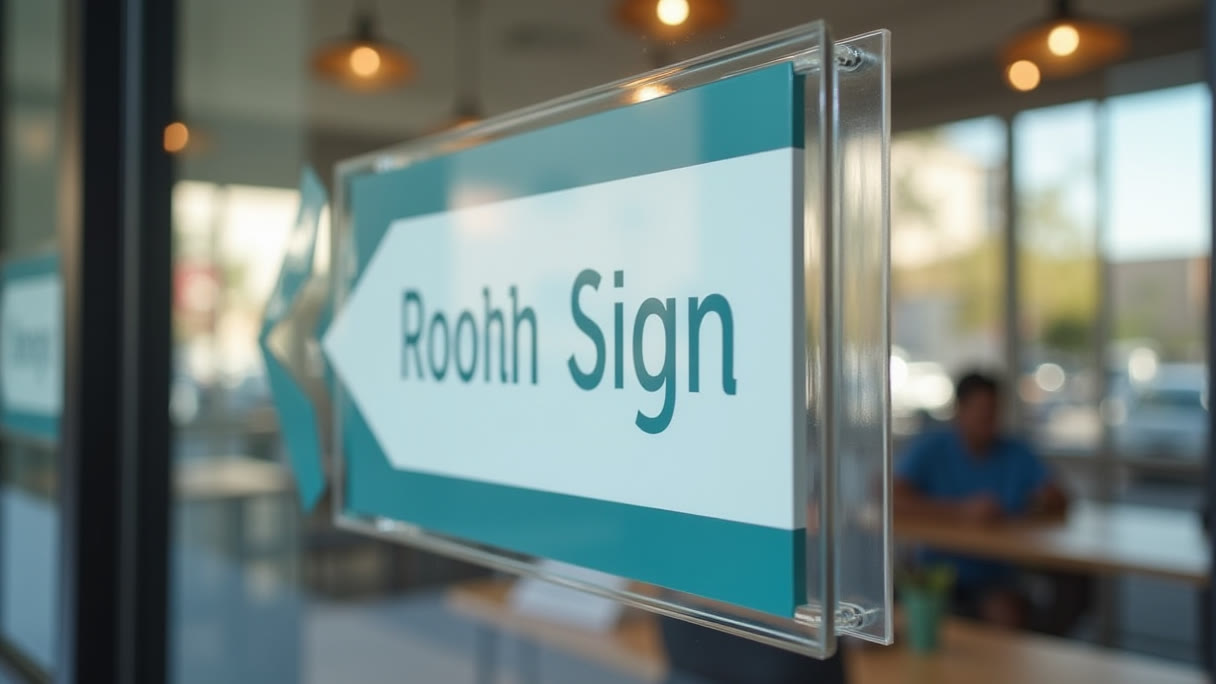
A front sign has two audiences and they need different things. The customer who already knows your name is looking for confirmation — they want to spot you from the lane and slow down in time to turn. The person who has never heard of you is walking past on the sidewalk and has about four seconds to work out what you sell. One panel has to do both, and the decisions that make it work are made before anything is printed.
We print storefront signage at the shop on Lankershim in Sun Valley, a few miles from Burbank, for the shops on Magnolia, the offices off Hollywood Way, the suites around the Media District and the studio-adjacent vendors on Victory. This is the conversation we have with people before the file goes to the press. If you already know what you need, our signage and front signs work covers the panel itself; the Burbank page is the short version.
Your street decides your letter height, not your logo
The standard rule is roughly one inch of capital letter height for every ten feet of reading distance, and it holds up well enough for planning. What changes it is which Burbank street you are on.
On Magnolia Boulevard through Magnolia Park, most of your traffic is on foot or crawling for parking. Read from across the street or from the opposite sidewalk — call it forty to sixty feet — your main line lands somewhere around four to six inches tall, and you have room left for a second line saying what you actually do. On San Fernando Boulevard downtown, same thing: people are walking.
On Hollywood Way, Olive, Victory or Burbank Boulevard, the reader is doing thirty-five to forty in a car with turn decisions to make. Now the useful reading distance is a hundred feet or more, your name wants to be eight to twelve inches tall, and the second line is gone. That is not a design failure, it is arithmetic. Decide which street you are printing for, then cut copy until the letters fit.
The other thing that changes with speed: a driver reads your sign for a fraction of a second while turning their head. Contrast does more for that reader than any typeface choice. Dark type on a light panel, or light type on a genuinely dark panel — not a mid-tone on a mid-tone, which looks fine on your monitor and disappears at noon on a west-facing wall.
Before anything gets printed, two people have to say yes
Permanent signs on a building in Burbank need a sign permit from the city, and the rules differ by zone and by the corridor you are on — Magnolia Park in particular has its own character that the planning counter cares about. Downtown storefronts and the commercial strips are not all treated the same way.
Separately, your landlord almost certainly has a sign criteria sheet for the building, and it will tell you the maximum panel size, whether you may mount to the fascia, and sometimes the exact material everyone in that center uses. Plenty of Burbank strip centers require every tenant panel to match.
We print the panel. We do not pull permits and we cannot tell you what your landlord will approve, so get both answers before you commit to a size. The order we recommend: landlord criteria first, city counter second, final dimensions third, artwork last. People who do it in the other order end up paying for a panel that has to shrink.
While that process runs, a vinyl banner starting at $67 is the honest stopgap. Hemmed and grommeted, hung on the fascia or across the window, it tells the street you are open during the weeks a permanent sign is being approved. It is also what you want for a grand opening, a seasonal promotion, or a move announcement — things a permanent panel should never be asked to say.
Dibond outside, acrylic inside
For an exterior panel, Dibond aluminum starts at $37.42 and is the default for good reasons. It is two thin aluminum skins over a solid polyethylene core, so you get a rigid flat panel at a fraction of the weight of solid metal, it will not warp the way a plastic sheet does in Valley heat, and it stays flat across a wide span. A four-foot panel of Dibond hangs straight; the same span in a thin plastic sheet will oil-can and catch light in waves.
Flat is the whole point on a storefront. Any ripple in a large panel reads as cheapness from across the street before anyone gets close enough to read the type.
Inside — reception walls, suite doors, the panel behind the counter, conference room identification — acrylic business signs start at $46.76. Acrylic reads as permanent in a way a printed sheet does not, and the reason is physical: the thickness of the material gives the edge a visible depth, and the panel throws a real shadow on the wall behind it.
Standoffs are the detail people notice without knowing why
An acrylic standoff sign starts at $37.50 and holds the panel off the wall on machined barrels, usually somewhere between a half inch and an inch.
That gap is doing the work. The panel floats, the wall behind it goes slightly out of focus, and the shadow line separates your sign from the drywall it is mounted to. It is the difference between a lobby sign that looks installed and a lobby sign that looks taped up. In a Burbank office suite where the tenant next door has a flat printed panel, the standoff version reads as a more established business for about the price of a decent lunch.
The barrels also solve a practical problem: they let you mount cleanly into a wall that is not perfectly flat, and they give you a defined pattern of four or six small holes instead of adhesive residue you will have to answer for at move-out.
Mount into what is actually there
Tell us what the wall is before you finalize the sign, because the wall changes the fastener and sometimes the panel size.
Stucco over frame. Common on the older Burbank commercial buildings. You are drilling through stucco into whatever is behind it, and hitting a stud matters more than the anchor brand. Plan your mounting points around framing, not around where the design would prefer them.
Brick and block. Downtown and the older Magnolia storefronts. Drill into the mortar joint rather than the face of the brick where you can — it patches cleanly if you ever move, and the landlord will care about that.
Glass. For window-mounted work the panel usually wants to be smaller than you think, because the transom or mullion divides the visual field whether your artwork acknowledges it or not. Measure the clear glass, not the opening.
Foam or EIFS. Soft exterior insulation looks like stucco and is not. It needs anchors that reach something solid, and a heavy panel hung on foam alone will pull out. If you are not sure which one you have, tap it — it sounds hollow and gives slightly.
Sun exposure is a west-facing problem
A Burbank storefront facing west takes direct afternoon sun for hours in summer, and that is what ages a printed graphic. Reds and magentas shift first, then yellows; deep blues, greens and blacks hold longest. This is worth knowing at the layout stage, because a brand built on a saturated red field and a brand built on dark navy will not age at the same rate in the same spot.
We are not going to put a month count on a panel in a specific location — the north-facing wall in an alcove and the west-facing fascia over the sidewalk are not the same job. Keep the artwork on file so a replacement is a reorder rather than a redesign, and look at your sign in person occasionally. Nobody notices their own sign fading, because they see it every day.
Files
Send vector artwork with fonts outlined, built at final size, with bleed. Build in CMYK. Keep critical copy well inside the panel edge, and leave the outer inch or so free of anything you cannot afford to lose to a frame, a trim or a mounting hole.
Photographic content at full sign size does not need the resolution print people expect — 100 to 150 ppi at final size is fine for anything read from more than a few feet. Logos should be vector regardless. If your only file is a small web JPEG of your logo, say so early; enlarging it is a redraw, not a scale, and that is better handled before the rest of the layout is locked.
If you are ordering more than one piece — an exterior panel, a lobby sign and suite numbers — decide up front which one is the reference for color. Different materials and different finishes will not match perfectly, and picking the primary piece first gives everything else something to be judged against.
Angels Print prints front signs, Dibond panels, acrylic signage and banners at 8511 Lankershim Blvd in Sun Valley, for businesses across Burbank and the San Fernando Valley. If your sizes are settled and your artwork is ready, pick your material and dimensions and order online. If you are still working out how tall the letters need to be for your street, what your landlord's criteria sheet actually allows, or whether a banner should carry you until the permanent sign is approved, call us at (818) 806-9006 or bring the file into the shop and we will work through it with you first.