

September 4, 2026
Updated
Square Business Cards in Los Angeles: What the Format Buys You, What It Costs, and Where It Goes Wrong
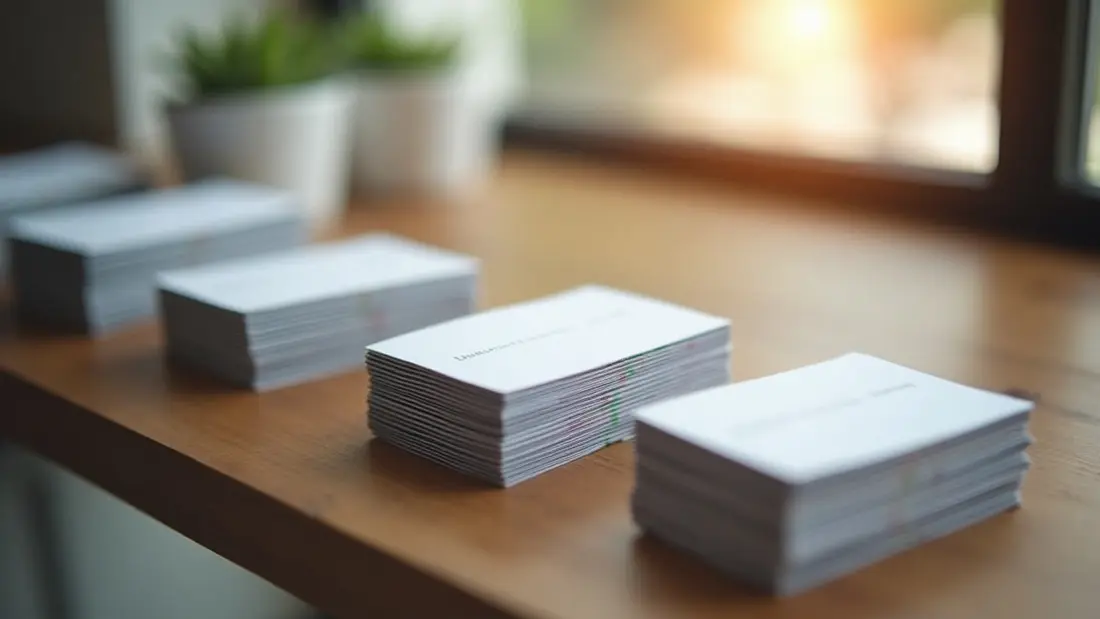
Somebody hands you a stack of twenty cards at an event in Los Angeles and nineteen of them are three and a half by two inches. The twentieth is square, and you look at it for a second longer than the rest. That extra second is the entire product. We print square business cards at the shop on Lankershim for photographers, tattoo artists, architects, coffee roasters, agencies and food trucks across the San Fernando Valley and greater LA, and the format works — but it works because it breaks a standard, and breaking a standard has costs that nobody mentions until the box arrives.
This is what we tell people at the counter before they commit.
What the square actually changes
Our square business cards start at $57.35, with the default run at 50 pieces — $1.15 each. A square card is usually somewhere around two and a half inches on a side; you pick the size and stock in the configurator.
The first thing it changes is orientation. A rectangle forces a decision — landscape or portrait — and half the time the front and back disagree, so the recipient has to rotate the card to read the second side. A square has no such decision. Whatever way it lands on a desk, it is right way up. If your logo is a circle, a monogram, an Instagram-shaped mark or anything built on symmetry, the square is the frame it was already designed for, and you stop cropping it into a slot that fights it.
The second thing it changes is how the card is stored, and this is the part that matters more than the design. A rectangle goes into a wallet card slot and is never seen again. A square does not slide cleanly into that slot, so it ends up somewhere else — pinned to a corkboard, dropped in a desk tray, stuck to a fridge, left face up next to a monitor. That is a worse card for a person who needs your number in a parking lot and a better card for a person who will call you in three weeks. Decide which of those two you are actually selling to before you order.
Which square business card size should you choose?
Our square business card configurator offers 2 x 2, 2.5 x 2.5 and 3 x 3 inches, plus a custom-size option. A 2-inch square suits a compact logo and a short contact line. The 2.5-inch format gives the layout more room, while a 3-inch square can accommodate larger artwork or more spacing. These are finished card dimensions; add the required bleed outside that trim size in your artwork.
Print a paper mockup at 100% before choosing. Check the smallest text, scan any QR code at that size, and try the mockup in the holder or package where the card will live. More area is useful only if the finished card fits its intended use.
The holder problem
Every acrylic counter holder, every card wallet, every leather case and every business card scanner tray in the country is built around three and a half by two inches. Drop a square card into a standard holder and it slouches, shows too much of the back wall, and reads as a mistake rather than a choice.
If your cards live on a counter — a salon reception desk, a café register, a shop-front by the door — buy the holder for the card, not the other way round, and buy it before the print run so you can check the fit. If your cards live in your jacket pocket and get handed over one at a time, the holder question disappears and the square is pure upside. We have watched more than one square run sit in the box for a year because the front-of-house holder could not present them.
What it costs against a plain rectangle
Be clear-eyed about the money. Our classic business cards start at $25.70, also 50 pieces by default, which is $0.51 each. The square is $1.15 each at the same quantity — a little over twice as much per card.
The reason is geometry, not markup. A press sheet yields a certain number of finished pieces, and a square eats more sheet per card than a rectangle does while leaving more waste around the layout, plus the cutting is a different pass. You are paying for area and handling.
That ratio should decide where each format goes. Sixty-four cents a card is nothing when you hand over one card at a considered moment to somebody who is deciding whether to hire you. It is real money when you are dropping a hundred cards in a fishbowl at a trade show, tucking one into every order that leaves the shop, or leaving a stack on a counter where they walk off by the handful. A lot of our customers run both: squares for the meetings, classics for the volume. There is nothing unserious about that — the fishbowl card and the handshake card have different jobs.
Designing for a smaller canvas than you think
A standard card gives you seven square inches. A two-and-a-half-inch square gives you about six and a quarter. It looks bigger because it is unfamiliar, but you have less room, and the room you have is a different shape — no long horizontal line to run a name and a title across.
Cut the content first. Name, what you do in three or four words, one way to reach you, one mark. That is a full square. The second phone number, the street address, the tagline and the three social handles are what turn a square card into a crowded one, and crowded reads worse in a square than in a rectangle because there is no long axis for the eye to travel down.
Use the back properly. Two sides of a square is the same total area as two sides of a rectangle, so the back is not a bonus — it is half your design. A clean, uncluttered back also means somebody can write an appointment time or a quote figure on it, which is one of the quiet reasons cards survive in a pocket.
Centre things on purpose. The square rewards symmetry and punishes near-symmetry. Something that is centred by two millimetres off looks broken on a square in a way it does not on a rectangle, because the eye has four equal sides to compare it against.
A QR code fits a square better than anything else. If you are putting one on the card, this is the format that gives it a clean field without shoving the rest of the layout into a corner. Keep it big enough to scan from a hand's distance and leave the quiet margin around it alone.
Why we talk you out of thin borders
Every card in a run is cut, and cutting has a tolerance — a fraction of a millimetre of drift across a stack is normal on any press anywhere. On a rectangle, a border that lands slightly heavier on one edge is easy to miss. On a square, the viewer is unconsciously comparing four sides of identical length, and a border that is a hair thicker at the bottom than the top is the first thing they see.
So either run the colour off all four edges into the bleed, or keep any frame generous enough that a small drift is invisible. A one-millimetre keyline sitting a millimetre from the trim is the single most common way a square card comes out looking cheap, and it has nothing to do with print quality.
When square is not the format you actually want
Sometimes people come in asking for square when what they want is not a normal card, and there are better ways to get there.
Clear plastic business cards start at $92.60 — 50 pieces at $1.85 each. Transparent stock is a stronger interruption than a shape change, it survives being carried loose in a bag, and it does still fit a wallet slot. If the goal is that the card gets kept, plastic outperforms almost everything.
Die cut business cards start at $129.14, with 100 pieces as the default run at $1.29 each. This is the one to look at if the shape itself is the message — a rounded square, a card cut to the outline of your product, a tab or a notch. Note that the default run here is a hundred, not fifty, which is why the starting figure looks larger while the per-card price sits below the plastic.
And if you are still unsure, the honest answer is often to print a small run of squares alongside your classics and watch which one people put in their pocket and which one they put down on the table.
Files, stock and what to send us
Send vector artwork with the fonts outlined, built at final size with an eighth of an inch of bleed all round, and keep anything that must not be cut well inside the trim. Build in CMYK — a saturated blue or a bright green that glows on your laptop will come back calmer on paper, and that is physics, not an error. Any raster elements should be 300 ppi at the size they actually print, so a logo pulled off a website at 600 pixels wide is not going to hold up.
Stock and finish are chosen in the configurator, and they matter more on a square than you would expect: an unfamiliar shape in a flimsy stock reads as a flyer, while the same shape in something with weight in the hand reads as deliberate. If you are working through the whole set — cards, and whatever else carries the same identity — that is our business card printing work, and the presses behind it are the same digital printing we run everything short-run on.
How many to order
Fifty is a sensible first square run precisely because it is a format you should test in the real world before committing to a thousand. Order fifty, carry them for a month, see whether the holder works, whether people keep them, whether the layout you loved on screen still reads across a table. Then scale the run once you know. Reprinting a corrected design is cheaper than storing nine hundred and fifty cards with a typo and a border that drifted.
Angels Print prints square, classic, clear plastic and die cut business cards at 8511 Lankershim Blvd in Sun Valley, for businesses across the San Fernando Valley and greater Los Angeles. If your artwork is ready, pick your size, stock and quantity and order online. If you are still deciding between a square and a rectangle, or you want to see what your logo looks like at two and a half inches before you print five hundred of them, call us at (818) 806-9006 or bring the file into the shop and we will look at it with you first.