

September 9, 2026
Teardrop Flags in Los Angeles: Wind, Bases, and Why Half of Them Are Face-Down by Friday
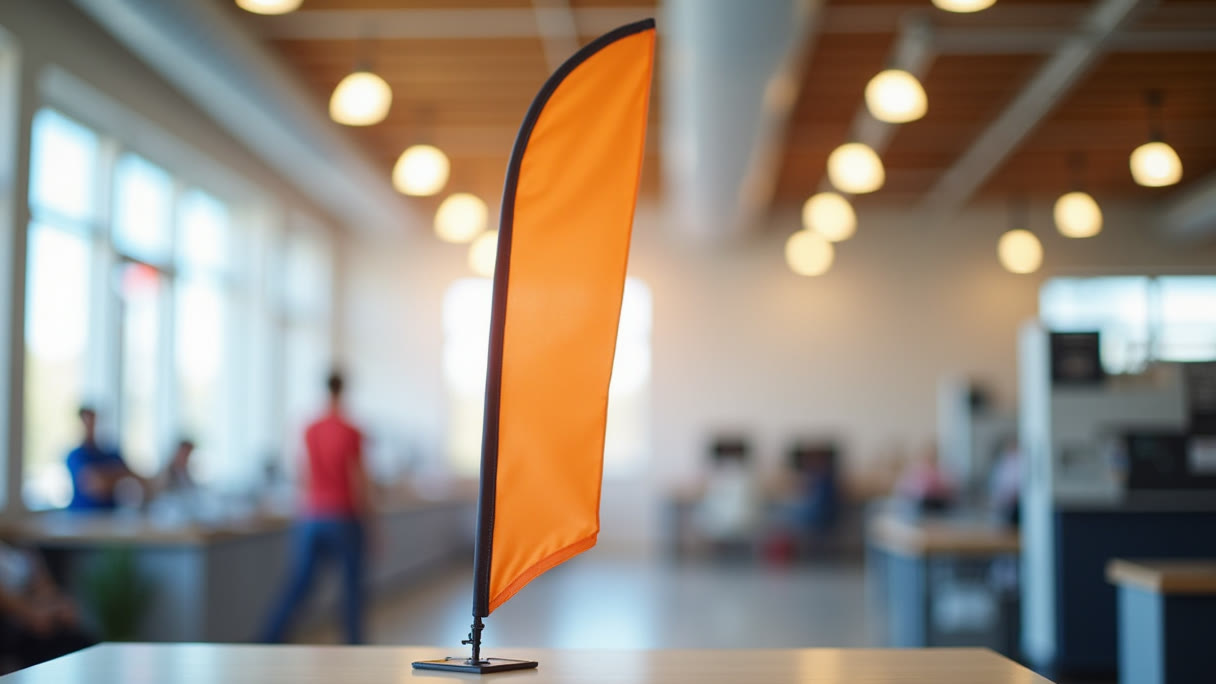
Drive Lankershim from Sun Valley down through North Hollywood and count the teardrops. Phone repair, tax prep, a new taco spot, a dealership with eight of them in a row along the fence, a weekend farmers market, a gym running a January promo. They are everywhere in Los Angeles because they solve a specific problem: your sign is flat on the building, twelve feet up, parallel to a street where nobody is looking up. The teardrop is the thing at eye level that moves.
We print teardrop flags at the shop on Lankershim, and we also see the ones that come back — bent poles, torn sleeves, bases somebody left in a hedge. Almost none of that is a printing problem. It is a base problem, a placement problem, or a wind problem. Here is what we tell people before they order.
What the shape is actually for
A rectangular flag on a pole spends most of its life wrapped around that pole or hanging limp, and either way you cannot read it. A teardrop is sleeved along a curved fiberglass or aluminum pole set so the fabric stays under tension from top to bottom. It holds its shape in dead air and it holds it in wind. That is the whole design: it is legible at 6 a.m. with no breeze and legible at 3 p.m. when the canyon is pushing 20 mph.
The second thing it does is swivel. A properly assembled teardrop rotates on its base so the flag weathervanes into the wind instead of fighting it. When somebody tells us their flag snapped a pole, the first question is whether the swivel was seized or was never free to begin with — a flag that cannot turn takes the full load broadside every gust.
Our teardrop flags start at $155. That figure is for the printed flag with hardware; size, base type and quantity are chosen in the configurator, and the price moves with them.
The base is the decision, not the flag
People spend an hour on the artwork and thirty seconds on the base. Reverse that. The flag is the cheap part to reprint; a flag that goes over in the parking lot costs you a customer's windshield.
Cross base with a weight plate. The default for hard surfaces — sidewalk, showroom floor, asphalt. The X of legs alone is not enough outdoors. You want the center weight on top of it, and on a windy corner you want more weight than feels necessary. Indoors at a trade show, the bare cross base is fine.
Water or sand bag. A ring bag that sits over the cross base. Water is convenient and legal everywhere; sand is heavier per liter and does not evaporate over a summer. If the flag lives outside a storefront permanently, sand.
Ground spike. The best option by a wide margin if you have dirt or grass — a lawn, a landscaped strip, a construction perimeter, a park event. Nothing to trip over, nothing to steal, and it takes wind loads a surface base cannot. Most of the flags we see fail were on a cross base when a spike would have worked.
Wall or vehicle mounts. For a flag bolted to a fence post or a bracket. Fine, but check what the mount is bolted to before you check the flag.
One thing that has nothing to do with us: a flag on the public sidewalk in front of your business is a sidewalk obstruction, and cities across LA County treat that differently from a flag on your own private frontage or parking lot. Check with your city before you plant six of them along the curb, not after somebody complains.
Los Angeles wind is not one condition
A teardrop in a Sun Valley strip mall lives a different life than the same flag in Santa Monica or up a canyon in Sylmar. Three patterns worth planning around.
The daily afternoon build. Most of the Valley is calm in the morning and picks up between two and six. A flag that looks stable when you set it at nine is not evidence of anything. Set it, then go look at it at four.
Santa Ana events. These are not gusts, they are sustained pressure for a day or three, often in the fall. Nothing on a portable base survives an aggressive Santa Ana. The right move is to take the flags down and lay them flat, the same way you would with an A-frame. Plan for that being someone's job.
Building corners and drive aisles. A flag ten feet from a building corner sits in accelerated, turbulent air, and turbulence is worse than steady wind because the swivel never settles. Move it out into open air or tuck it fully against the wall — the corner itself is the worst spot on the property.
If you are running a set of flags outside a location permanently, order a spare flag with the first batch. Sun and abrasion at the pole sleeve are what age these, and a matched spare means you swap one instead of reprinting the set when colors have drifted.
Single-sided, double-sided, and the mirror question
A single-sided teardrop prints one side, and the reverse reads as a mirror image through the fabric — faint, backwards, but visible. For a logo mark and three words, plenty of businesses accept that. For anything with a phone number or a URL, a reversed back side looks like a mistake to every person approaching from the other direction.
Double-sided construction puts two printed panels around a blocker layer, so both sides read correctly and neither shows the other through. It costs more and it catches slightly more wind. Choose it when traffic passes in both directions — a two-way street, a mall walkway, a booth aisle — and skip it when the flag faces a single approach, like a driveway entrance off a one-way flow.
Designing for a shape with no straight edges
The readable area of a teardrop is a curved wedge, not a rectangle, and the bottom of the curve tapers to almost nothing. Whatever you put in the lower third is decoration.
Put the mark and the biggest word in the fat upper section. Set the type large enough to read from across four lanes of traffic — most first drafts we see are about half the size they should be. Keep artwork off the sleeve edge, since that strip disappears around the pole. And commit to high contrast: a light logo on a mid-tone field looks refined on a monitor and vanishes at fifty feet in flat noon sun.
Send vector art with fonts outlined where you can, or raster at a resolution that holds up at final size, and build in CMYK. Dye on fabric renders a little softer than the same file on a coated sheet — that is the material, not an error. The presses and printers behind this are the same digital printing we run everything else on.
What else that money buys
Before you commit to a set of flags, compare them against what they replace.
A black stand retractable banner starts at $62.50 — cheaper than a teardrop, but it is an indoor product. Put one on a sidewalk and the first real gust folds it. Indoors, in a lobby or a booth, it does the job for a fraction of the price.
A 3FT SEG fabric stand starts at $195. Silicone-edge fabric in an aluminum frame, meant for interiors, and it looks considerably more expensive than a flag does. This is the one for a showroom floor or a conference where a teardrop would read as street-level advertising.
A backdrop banner starts at $189.99 and does something a flag cannot — it fills a wall behind people for photographs. Flags mark a location; backdrops mark an occasion. Events usually need both.
And if the real problem is that nobody can find your building from the street, a flag is a patch on a signage problem. Permanent signage and front signs cost more once and stop costing you anything after that.
When a teardrop is the wrong tool
Skip it if the flag would sit in an enclosed courtyard with no sightline to traffic — you are paying for visibility you do not get. Skip it for dense information; nobody reads a service list at 35 mph. Skip it if there is nowhere legal and stable to stand it, because a flag on a bad base is a liability rather than a sign. And if the message changes weekly, a flag is the expensive way to say it — the copy is printed into the fabric, so a new promotion is a new flag.
Where it earns out is the standing case: your name, your category, your logo, up at eye level, in motion, every day the place is open.
Angels Print prints teardrop flags, banners, fabric displays and front signage at 8511 Lankershim Blvd in Sun Valley, for businesses across the San Fernando Valley and greater Los Angeles. If your artwork is ready, pick your size, base and quantity and order online. If you are not sure whether you need a spike or a weighted cross base, whether the back should read correctly, or whether a flag is even the right answer for your frontage, call us at (818) 806-9006 or bring the file into the shop and we will work it out with you before anything gets printed.