

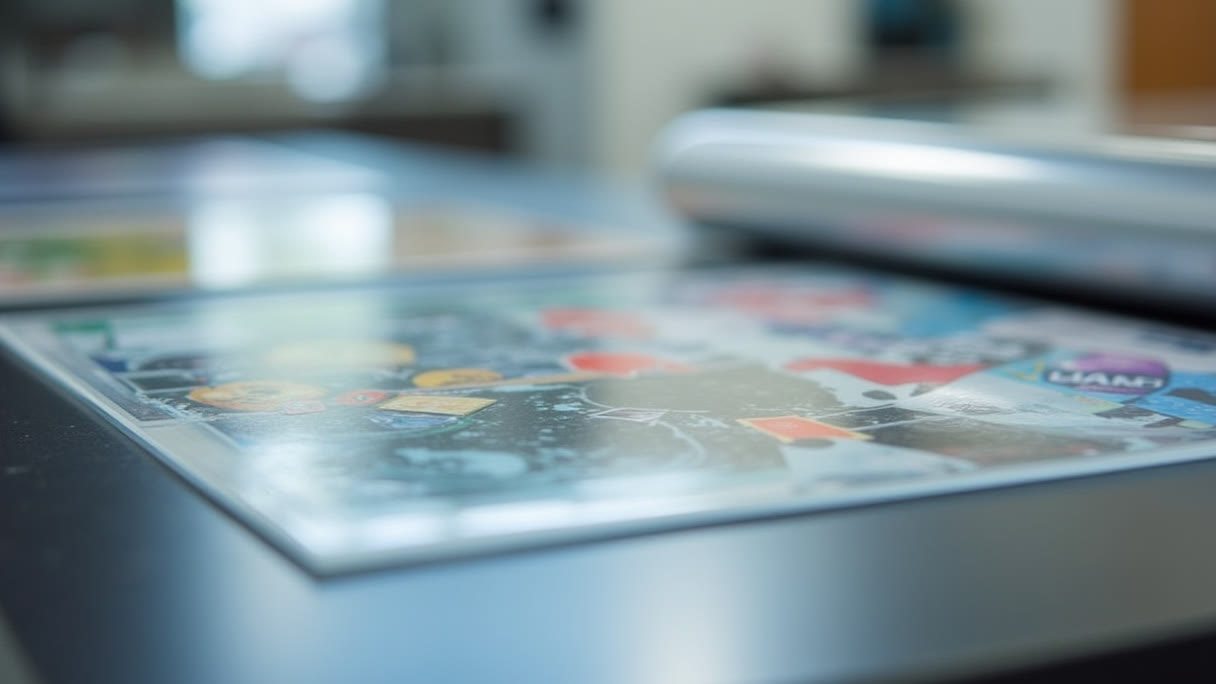
UV printing gets asked for by name more than almost anything else we run, and usually by someone who was told to ask for it rather than told what it is. The short version: the ink is cured by ultraviolet light the instant it lands, so it never soaks in and never has to dry. That one fact decides everything downstream — what you can print on, how the color reads, whether you need a white layer, and whether your job is a rigid panel, a card or a sheet of acrylic.
We run UV printing at the shop on Lankershim in Sun Valley, a few miles down San Fernando Road from Pacoima, and a good share of it goes to businesses off Osborne, Glenoaks and Van Nuys Boulevard — fabricators and machine shops, body and paint shops, warehouse suites, clinics, churches, taquerias and food trucks. If you want the local page with prices on it, that is UV printing in Pacoima. What follows is the conversation we have with people before a file goes on the press.
Cured, not dried, and why that changes the material list
Conventional printing needs the substrate to cooperate. Ink either absorbs into paper fibres or sits in a coating and dries by evaporation, which is why you cannot put a sheet of aluminum through an offset press and expect anything useful. UV ink is a liquid resin that turns solid polymer under a lamp travelling with the print head. Nothing is absorbed. Nothing evaporates.
So the material no longer has to be porous — it only has to be flat, rigid enough to hold still and clean enough to bond to. Aluminum composite, acrylic, PVC, foam board, styrene, wood, glass and coated metals are all fair game. That is the whole reason a print shop can hand you a finished sign panel instead of a printed sheet that somebody else has to mount.
The second consequence is color. On uncoated paper, ink spreads slightly into the fibre and loses a little density — printers plan for it. Cured on top of a non-absorbent surface, the ink keeps the density it was laid down with, which is why a UV-printed panel reads more saturated than the same file on a poster. It also means the ink film has a thickness you can feel with a fingernail, and that thickness is a tool, not a side effect.
The white layer is the decision people forget
On paper, white comes from the paper. On clear acrylic, brushed aluminum, black PVC or anything that is not already white, there is no white — so white has to be printed as its own layer of ink, and where that layer sits changes the job.
Printed under your artwork, white acts as a primer: the colors sit on an opaque base and look the way they do on a proof. Printed over the artwork, on the back of a clear panel, it backs up a piece that is meant to be viewed through the acrylic — the glass-like look people want for a reception sign. That second version, second-surface printing, means the file goes on the press mirrored and the layer order reverses. Tell us which face people will be looking at and we will build the file accordingly. Get it wrong and you have a beautiful sign with your logo running backwards.
White is also a thing to leave out on purpose. On a brushed or mirror-finish panel, knocking white out of part of the design lets the metal itself become an element — the logo prints, the background stays bare aluminum. That only works if your file has a real transparent background, not a white rectangle.
Raised spot UV, and what it needs to work
Because the ink hardens immediately, it can be stacked. Lay a clear varnish down in several passes and you get a raised, glossy shape sitting proud of the sheet — spot UV you can feel, not just see.
On cards this is raised spot UV business cards, from $64.67, with the default run at 50 pieces and $1.29 each. It is a finish that earns its money in a handshake, because the person receiving the card notices it before they read it.
Two things make or break the effect. Contrast. The raised varnish reads by catching light, so it wants a matte or dark surface around it — gloss varnish on a gloss field mostly disappears. Size. Keep the raised elements to a logo, a monogram, a rule, a pattern or a name set large. Thin hairlines and body copy under about eight points fill in and lose their shape, and a whole card covered in varnish reads as laminated rather than as anything deliberate. Supply the spot area as a separate solid-black vector layer at exactly the same size as the artwork, and say in the file name which layer it is.
Picking the panel
Most of what we print flat for Pacoima falls into three jobs, and the material is the answer to how long the piece has to live and where it has to live.
Outdoors, on the building. Dibond aluminum from $37.42 — two skins of aluminum bonded to a polyethylene core. It does not absorb water, does not warp with humidity and stays flat across a wide panel, which is what you want for a front sign, a parking or directional sign, a tenant panel on a warehouse suite or a rate board mounted on a wall. It also takes drilled mounting holes without cracking.
Indoors, permanent. Acrylic printing from $90. The reason it looks like money has nothing to do with the graphic: it is material thickness and the shadow a standoff-mounted panel throws on the wall behind it. Reception walls, suite identification, the panel behind the counter, a menu board that will not be changed monthly.
Indoors, short life. Foam board from $28.3 — light, cheap, stiff, easel-friendly. Right for a trade show table, a presentation, an event, a grand opening, a temporary in-store display. Wrong for outdoors: the core drinks water at the cut edges and the panel will bow the first time it rains on it.
If you are not sure between two of them, the useful question is not which looks better. It is what happens to this panel in six months — is it still on the wall, or was it always going to be recycled after the event?
Sun, and what goes first
Pacoima gets full, unshaded sun on most of its industrial frontage, and UV-cured ink holds up to it considerably better than solvent prints on paper. Better is not forever. Under sustained direct exposure the warm end goes first — reds, magentas, then yellows — while blacks, deep blues and greens hold on longest. A design built on a hot red field ages visibly faster than the same design built on navy, and that is worth knowing while you are still in the layout, not when you are pricing a replacement.
We will not put a month count on a specific panel, because a north-facing wall under an awning and a west-facing panel over a parking lot on Osborne are not the same job. Plan by exposure, keep the artwork on file so a reprint is a reorder and not a redesign, and if the piece is going somewhere brutal, ask us about an overlaminate before we print rather than after.
Files that go straight on the press
Send vector artwork with the fonts outlined, built at final size, with bleed all round. Build in CMYK — an RGB file has to be converted by somebody, and you would rather that somebody be you, looking at your own brand colors, than a conversion happening quietly on our end.
Photographic content at 150 ppi at final size is fine for a panel read from across a room or a parking lot; there is no point sending 300 ppi for a four-foot sign nobody inspects from eighteen inches. Put any white layer and any cut line on their own clearly named layers. Keep critical copy well inside the trim, and if the panel will be mounted with drilled holes or standoffs, tell us where they go so we do not center a hole through your phone number.
Bring a photo of the wall
The single most useful thing you can bring to the shop is a picture of the place the sign is going, with a tape measure or a door in the frame for scale. Half the questions about material, thickness, mounting and size answer themselves once we can see the wall, and the other half stop being guesses. A panel sized from memory is the most common reason a good print ends up in a closet.
Angels Print runs UV printing on acrylic, aluminum composite, foam board and cards at 8511 Lankershim Blvd in Sun Valley, for shops and businesses across Pacoima and the San Fernando Valley. If your file is ready, choose your size and quantity and order online. If you are still deciding between aluminum and acrylic, working out whether your artwork needs a white layer, or holding a phone photo of a blank wall, call us at (818) 806-9006 or bring the file into the shop and we will work it out with you first.