

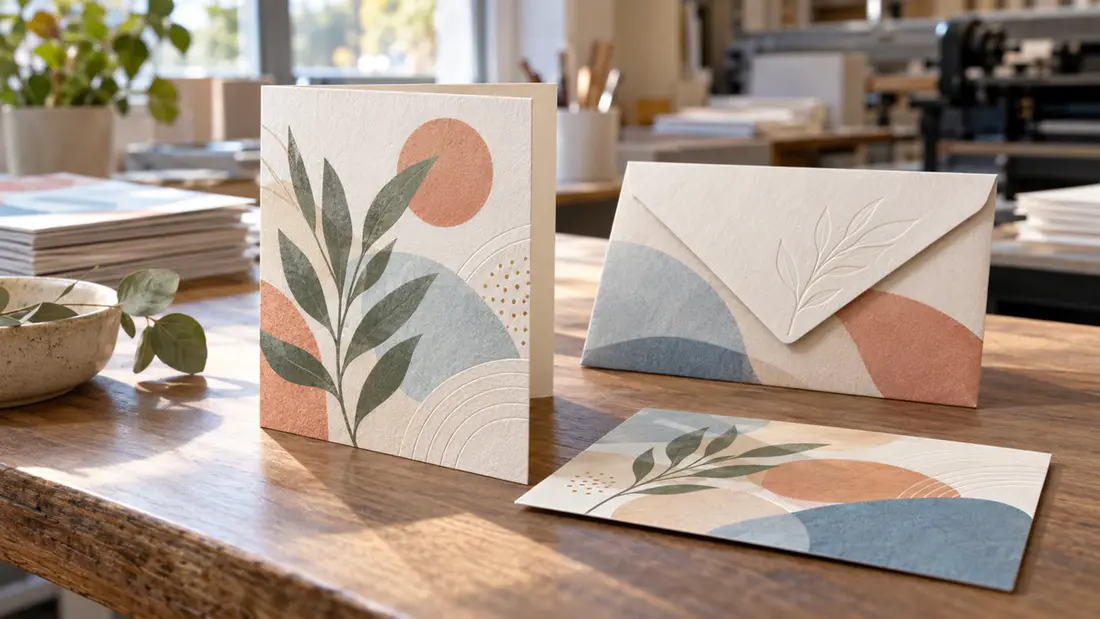
Deciding what to include in donor thank you cards starts with the message. Use a personal greeting, specific thanks for the gift and a brief statement of its impact. Leave space for a signature. Add your nonprofit’s name so the sender is clear; personal details belong inside a folded card with an envelope.
Write your year-end message first. A short acknowledgment can fit a postcard, while a longer personal note needs more room. Reserve handwriting space before the design is finished.
What to include in donor thank you cards?
A personal greeting. Check the donor’s preferred name against your records. “Dear Jordan” feels different from “Dear Supporter,” but an incorrect name is worse than a general greeting. Check household greetings, too. Don’t assume everyone shares a surname.
Specific thanks. Name the support you’re acknowledging: “Thank you for your year-end gift to our food pantry.” Mention a designated program only when your records support it. The amount can stay out. That’s especially useful on an exposed postcard.
A concise impact statement. Explain what the support helps your organization do in one or two sentences. “Your gift helps stock our pantry with groceries for local households” connects the donation to the work. Verify any numerical result first. Your team must also be able to connect that result accurately to the gift.
A signature with a name. Reserve a clear handwriting area, with the signer’s printed name and role beneath it. A program director may be an appropriate choice. Think about who will sign. A printed signature can serve a large mailing; individual staff notes need extra room.
Clear sender identification. Include the nonprofit’s name and a modest logo or return contact, keeping them secondary to the thanks. Give this piece one job. Leave another donation request, response form and tax-receipt language to separate communications.
How much should the thank-you message say?
Try 40–70 words for a postcard and 70–120 words for a folded card as drafting targets. These aren’t printing limits. Type size and artwork affect the fit, as does space reserved for addressing or handwriting.
Here’s an adaptable example: “Dear [Preferred Name], Thank you for your year-end gift to [Organization]. Your support helps [verified program activity], giving [people served] access to [specific benefit]. We’re grateful you chose to support this work. With thanks, [Signature space] [Name and role].” Replace every bracketed field before preparing production artwork.
Read the message aloud. If it sounds like an annual report, shorten the organizational background and make the thanks more specific. A second paragraph should add a relevant detail, such as a verified program update, instead of repeating your mission statement.
Should you choose a folded card or a postcard?
Choose a folded card for an inside writing area or enclosed personal details. Angels Print’s Greeting Cards offer top-fold and side-fold choices, including a finished 7 × 5-inch top-fold card and a finished 5 × 7-inch side-fold card. Outside and Inside printing accommodates a printed message. Outside Only leaves the interior for handwriting.
Check the folding selection. Scored (No fold) and Scored and Folded are separate options, so review your combination in the configurator. Volunteers may need to fold cards as well as sign and assemble them.
Choose Postcards for a brief acknowledgment readable without opening an envelope. Listed sizes include 4 × 6 and 5 × 7 inches, with Front Only or Front and Back printing. Addressing and postage need room. Account for both when laying out a mailed postcard.
Privacy can settle the choice. An unenclosed postcard exposes its message during handling, so omit gift amounts and sensitive personal references. A folded card inside a sealed envelope keeps the interior message out of casual view. Folding alone doesn’t provide that protection.
Which paper and finish leave room for a signature?
Start with the writing surface. Both products list 100# Uncoated Cover, a practical starting point for handwritten notes; greeting cards also list Classic Crest Smooth and Linen stocks. Test your intended pen on the selected stock and finish before a signing session.
Gloss coatings and laminations change how ink dries and adheres. The cover isn’t the writing surface. A finish you like outside may be awkward beneath a signature. Greeting cards offer coated-one-side stocks and certain outside-only finishes, but confirm the available combination and intended interior writing surface.
Keep artwork clear of signatures. Even a pale background affects contrast, while heavy coverage can make handwriting harder to read. Listed foil options provide another choice for a decorated cover; confirm compatibility and cost before building artwork around them.
How do you coordinate envelopes and personalization?
Use the card’s finished dimensions. Match envelopes to those measurements, rather than the unfolded sheet. Listed blank-envelope selections pair 6 × 4-inch cards with A6 envelopes, 5.5 × 4.25-inch cards with A2 envelopes, and 7 × 5-inch cards with A7 envelopes, including corresponding side-fold orientations. Select envelopes deliberately. Don’t assume every card includes them.
For printed envelopes, Envelopes Premade includes A2, A6 and A7 sizes, plus Front Only and Front and Back printing. Coordinate the return address and logo with the card. Discuss addressing and mailing arrangements through Envelope Printing & Direct Mail before finalizing artwork.
Variable Data is listed for greeting cards, postcards and envelopes. Confirm supported fields and data format before preparing personalized files. Keep greetings connected to mailing addresses in the same donor record, removing duplicates and resolving missing names. Matching needs an assembly plan. Agree on how paired cards and envelopes will be checked.
What affects the price and order quantity?
Greeting Cards start at $1000.62, Postcards at $1000.02 and Envelopes Premade at $1000.30. These aren’t matched quotes. They’re listed starting prices for differing quantities or specifications. Compare size, stock, printed sides and finishing at the same required quantity.
All three quantity menus include 50 and 100, along with larger runs. Clean your mailing list first. Then count recipients and allow extras for handwritten corrections or later acknowledgments. Personalization, envelope choices and finishing can change the configuration; the selected checkout price is final.
What should you check before placing the order?
Follow the selected product’s upload instructions for file type, dimensions, bleed and safe area. Check image resolution at final size. For folded cards, identify cover and interior orientation clearly, keeping names and signatures away from folds and trim edges. Missing a requirement? Ask before preparing files.
Review the longest personalized greeting alongside a short one, then check spelling and envelope fit. Allow room for the actual signature. Uploading or previewing artwork doesn’t confirm production readiness. A digital proof is available on request, and manufacturing starts immediately after payment. Arrange needed review before paying.
Order your donor thank-you cards online, or call Angels Print at (818) 806-9006 to confirm card, envelope and personalization selections. You can also visit 8511 Lankershim Blvd, Sun Valley, CA 91352. Shop pickup is always free.
Frequently asked questions
What should a donor thank you card include?
Use the donor’s preferred name, specific thanks and a short, accurate impact statement. Identify your nonprofit clearly. Add a signature with the signer’s name and role, leaving room for handwriting if your team will add individual notes.
Should donor thank you cards be folded cards or postcards?
Choose a folded card inside an envelope for longer notes or personal details. A postcard suits a short acknowledgment without sensitive information. Plan the addressing space early. Postage also reduces the room available for your message.
What paper is best for handwritten donor thank you cards?
Uncoated cover stock is a practical starting point. Angels Print lists 100# Uncoated Cover for greeting cards and postcards. Test your chosen pen first. Use the selected paper and finish, and keep heavy printed artwork out of the signature area.
Can donor thank you cards and envelopes be personalized?
Greeting cards, postcards and premade envelopes list Variable Data options. Confirm supported fields and the required data format before preparing your list. Check names and remove duplicates. Establish how each personalized card will stay matched to its addressed envelope.