

August 23, 2026
Custom Flags in Los Angeles: Fabric, Wind, Single-Reverse vs Double-Sided, and What Actually Holds Them Up
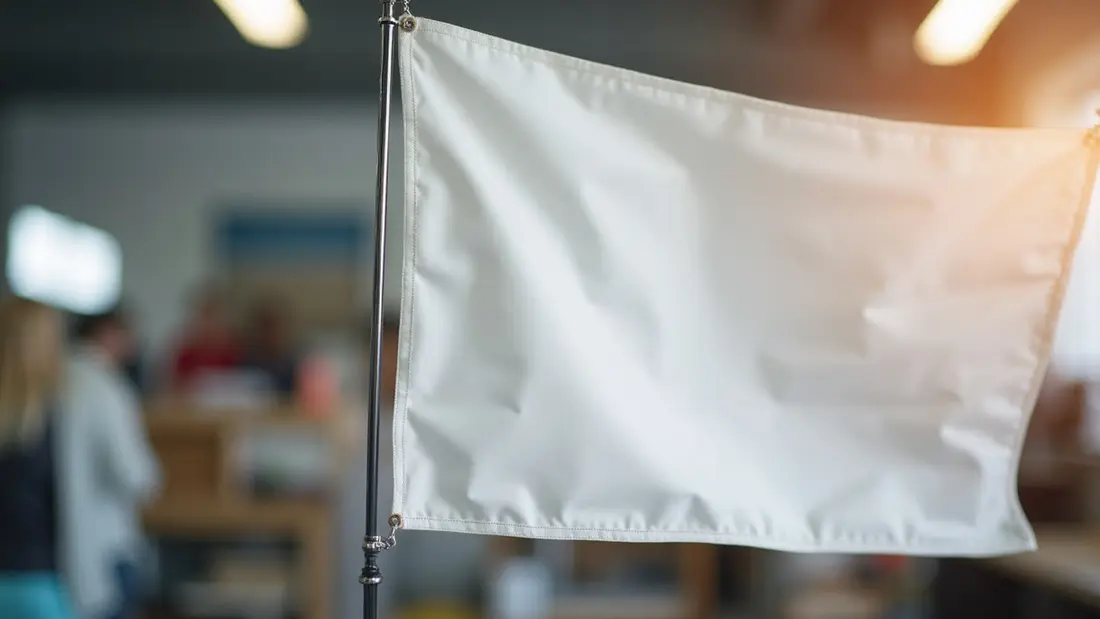
A flag is the one printed thing you own that is never still. Every other sign we make sits flat and gets judged flat — a banner on a fence, a panel on a wall, a stand behind a booth. A flag spends its life folding, twisting, snapping and hanging limp, and it is read in all four of those states. That single fact drives almost every decision on the order: the fabric, whether the back is printed, how the artwork is laid out, and how long the thing survives on a pole facing the 170. This is what we walk customers through before a flag goes on press.
What people mean when they say "custom flag"
Three different products hide behind the phrase. The first is a traditional pole flag — a rectangular flag with a sewn header and grommets, or a pole sleeve, that flies from a horizontal or vertical pole. That is what most businesses, schools, HOAs and event organizers are picturing. The second is a feather or teardrop flag: a sleeve of printed fabric stretched over a flexible fiberglass pole, staked into the ground or bolted to a base, which stays readable even in dead air because the pole holds it open. The third is not a flag at all — it is a fabric backdrop or a booth graphic that someone has been calling a flag because it is printed on cloth.
Our custom pole flag starts at $97.50 and covers the first category. If your plan is an indoor display or a photo wall, skip to the last section — the material is similar, the engineering is completely different, and buying the wrong one is an expensive detour.
Fabric, and why flags are knit polyester
Flags are printed on knit polyester, typically in the 110–200 gsm range, using dye sublimation: the ink turns to gas under heat and bonds into the fiber rather than sitting on top of it. That is why a properly made flag does not crack along a fold and does not go chalky the way solvent ink on vinyl eventually does. The dye is inside the yarn.
Weight is a genuine trade-off, not an upsell. Lighter knit flies in less wind, drapes better and reads as a flag even on a calm morning. Heavier knit holds color denser, resists tearing at the fly end, and lasts longer — but on a still day it hangs like a towel. In the Valley we generally lean lighter for street-level marketing flags that need to move to be noticed, and heavier for permanent installations at a building where the flag is up year-round and nobody is going to swap it.
Nothing printed survives Southern California sun indefinitely. Expect meaningful fade on a flag in constant direct exposure inside a year, faster on saturated reds and oranges, slower on dark blues and blacks. A flag that flies only for events and lives in a bag between them will look new for years. Plan replacements as a line item, not as a failure.
Single-reverse, double-sided, and the mirror-image problem
This is where most flag orders go wrong. A standard single-reverse flag is printed once, and the dye penetrates the knit enough that the image is visible from the back — mirrored. Text reads correctly on one side and backwards on the other, at roughly 80–90% of the front's color strength. For a logo-driven flag, or anything symmetrical, that is completely acceptable and it is what the base price assumes.
A true double-sided flag is two printed panels with an opaque blockout liner sewn between them, so both faces read correctly and neither shows through the other. It costs more, weighs more, and needs more wind to fly properly because you have tripled the material. Order it when the flag hangs where people approach from both directions — a corner lot, a two-way street, a plaza entrance — and when the message is words rather than a mark.
The middle option nobody asks for but often should: design a single-reverse flag that works mirrored. A wordmark on the front and a clean icon or a simple pattern reading through the back is the cheapest way to look intentional from both sides.
Wind is the specification, not the weather
Flags fail at the fly end — the free edge farthest from the pole — because that is where the fabric whips fastest. Everything about durable flag construction is a response to that: double or quadruple stitching on the fly hem, reinforced corners, and a header strong enough that the load transfers to the pole instead of tearing out a grommet.
Size multiplies the problem. A 3×5 flag on a residential-scale pole is forgiving. A 5×8 on the same pole in a Santa Ana condition is a sail putting real force on the hardware, and it is the pole or the mount that gives first. If a flag is going up on a building rather than a lawn, the mounting bracket and the wall anchors matter more than the flag does — that is structural work, and it belongs in a conversation about signage and front signs rather than a print order.
Feather flags have their own failure mode: the fiberglass pole sections and the ground stake. On soft irrigated turf a spike stake is fine. On the compacted decomposed granite and asphalt-edged parkways that a lot of Los Angeles frontage actually is, use a cross base with a water bag and accept that the flag will need to come inside overnight in a windy week.
Size, and how far a flag reads
Three by five feet is the default for a residential or single-storefront pole and reads clearly from across a two-lane street. Four by six suits a commercial building with a 20–25 foot pole. Five by eight and up belongs on a tall pole at a dealership, a campus or a large lot, where the flag is being read from a moving car at distance.
The legibility rule from signage applies, with a discount: about one inch of capital letter height per ten feet of viewing distance, then assume that at any given moment a third of your artwork is folded out of view. That means one idea per flag. A name, or a mark, or a single word — not a name plus a tagline plus a phone number. The phone number never gets read on a flag. Put it on something that stays flat.
Files and layout
Send vector artwork — PDF, AI, EPS or SVG — built at final size with fonts converted to outlines. Raster files should be at least 100 dpi at final size; a flag is never inspected from three feet away, so massive resolution buys you nothing. Specify color in CMYK or by Pantone reference. Dye sublimation on polyester renders saturated colors beautifully and struggles with the same things every process struggles with: near-neutral greys shifting, and metallics, which simply do not exist in print.
Keep critical elements away from the header. The pole sleeve or grommet edge consumes two to four inches depending on construction, and that strip is either hidden or distorted. Center the mark toward the fly side, not the middle, because the pole side is the part that stays hidden in a fold. This is standard digital printing file prep, with the one flag-specific twist that the geometry is never flat.
When a flag is the wrong tool
Indoors, a flag is dead weight — there is no wind, so it hangs. If the goal is a branded surface behind a booth, a stage or a step-and-repeat, a tensioned fabric system does the job the flag cannot. Our 3FT SEG fabric stand from $195 uses a silicone edge graphic pulled drum-tight into an aluminum frame, so the print stays flat and the graphic swaps out without replacing the hardware. For a wider photo or media wall, a backdrop banner from $189.99 covers the full-height format.
And if what you actually need is a portable message that one person can carry, set up in thirty seconds and roll away, a flag is the hard way to do it. A black stand retractable banner from $62.50 is cheaper, self-supporting, and readable from the moment it is up. We say this to a few customers a month: the flag is the more romantic object, the retractable is the one that gets used every weekend.
The honest split — outdoor, motion, distance, atmosphere: flag. Indoor, flat, detailed, close-read: fabric stand, backdrop or retractable.
Angels Print prints custom flags, fabric displays, backdrops and retractable banners at our shop at 8511 Lankershim Blvd in Sun Valley, for businesses, schools, event producers and property managers across the San Fernando Valley and greater Los Angeles. If your artwork is ready, configure size, finish and quantity and order online. If you are still deciding between single-reverse and double-sided, between a pole flag and a feather flag, or whether the wall you have in mind can carry the bracket, call us at (818) 806-9006 or come by the shop — we will put the fabric in your hands and show you what it looks like when it moves.