

August 23, 2026
Custom Shopping Bags in Los Angeles: Sizes, Handles, Paper Weight and What a Run of 50 Really Buys
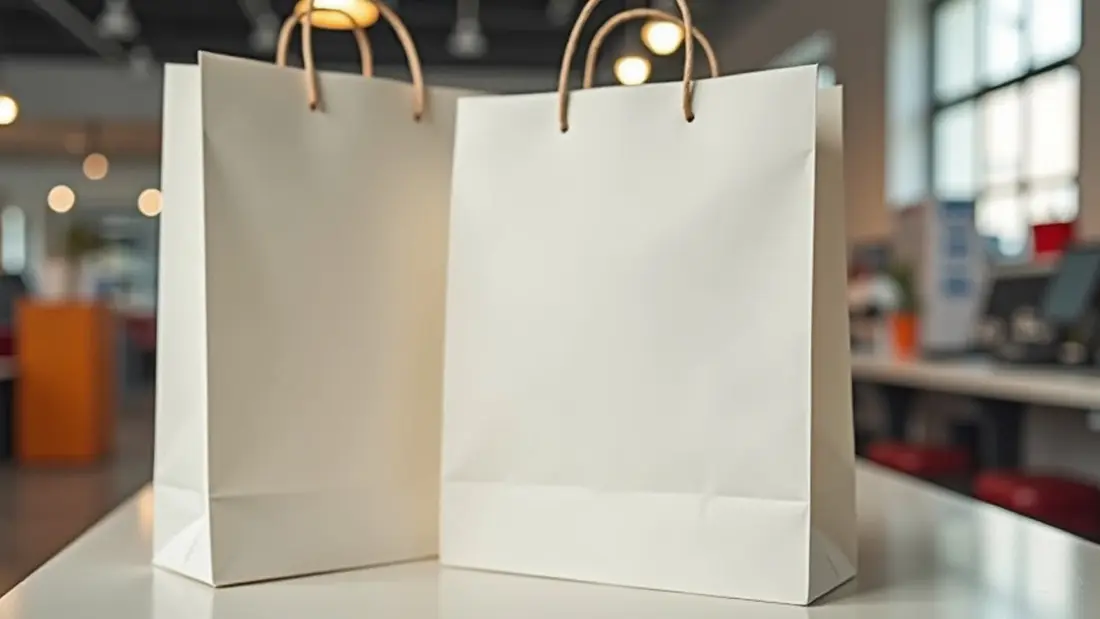
Almost nobody calls us about bags until they already need them. A boutique on Magnolia opens in three weeks. A skincare line got into a pop-up on Melrose and the samples are going out in whatever was in the back room. A restaurant switched to takeout-heavy service and realized the plain kraft bag walking out the door twelve times an hour is the most-seen piece of print they own and it has nobody's name on it. Bags are the last thing ordered and the first thing customers carry down a sidewalk, which is a bad combination. Here is how we spec them so the first run is the right run.
Start with what goes in the bag, not with the bag
The most common mistake is picking a size off a chart. Put the actual product on a table — the boxed candle, the folded hoodie with tissue, the two clamshells and a drink — and measure the footprint. That footprint plus about an inch of slack is your bag base. Then the height: the bag should stand roughly two to three inches taller than the tallest thing in it, because a bag packed flush to the rim looks stuffed and tears at the handle when someone lifts it.
Three rough families cover most of Los Angeles retail. A small bag around 8×5×10 handles jewelry, cosmetics, a single garment, a pastry box. A mid bag around 10×5×13 is the everyday apparel and gift size and the one most people should order if they are only ordering one size. A wide 16×6×12 is for food service and anything that goes in flat — bakery boxes, framed prints, records.
The third number is the gusset, the side depth, and it is the one people forget. A five-inch gusset makes a bag that stands open on a counter while a clerk fills it. A two-inch gusset makes an envelope with handles. If your staff will be packing bags one-handed during a rush, buy the depth.
Handles decide how the bag feels before anyone reads it
Twisted paper handles are the default and there is nothing wrong with them: they are strong for their weight, they cost the least, and they are what a customer expects from a retail bag. Flat paper handles look cleaner on a tall narrow bag and are noticeably less comfortable when the bag is heavy — fine for a boutique, wrong for six pounds of takeout.
Ribbon and cotton-cord handles are the upgrade, and they change the read of the bag more than any print decision you will make. They also change the failure point. A ribbon handle is stronger than the paper it is knotted through, so on a heavy bag with a light stock the handle stays intact and pulls a hole straight out of the panel. If you want ribbon, go up in paper weight and ask for reinforced handle patches.
Die-cut handles — the punched-out slot, no attached handle at all — are the cheapest and the least forgiving. They work on a flat, light bag carrying a lookbook or a single shirt. They do not work on anything with weight, and they do not work if the bag will be carried for more than a few blocks.
Paper weight, and where bags actually fail
Bags fail in three places, in this order: the handle attachment, the bottom fold, and the front panel where a corner of the product pushes through. Heavier stock fixes all three. Lighter stock is cheaper and looks cheaper — a thin bag creases the moment it is held, and once a printed logo has a crease through it, the bag reads as disposable no matter what you spent on the artwork.
A useful rule: if the contents weigh under two pounds and the bag is decorative, lighter stock is fine. Over two pounds, or anything with hard corners, go heavier and ask for a reinforced bottom insert. Food service is its own case — grease and condensation soften paper from the inside, and a laminated or coated finish is not optional there, it is structural.
Finish is the last variable. Matte lamination is the current retail look, hides fingerprints, and scuffs less than people expect. Gloss reads brighter and is better for food and for artwork with photography in it. Uncoated kraft costs the least, takes one or two colors beautifully, and cannot hold a photographic image — if your brand is a wordmark and a shape, kraft is often the best-looking option on the list and the cheapest.
Our custom shopping bags start at $230 for a run of 50, which is $4.60 each. That per-piece number is where most of the decision-making pressure lands, so it is worth understanding what drives it: size, stock weight, handle type and number of print colors, roughly in that order of impact.
Paper is the default at checkout now, and that is worth planning around
California retail has been moving away from film plastic carryout bags for years, and as of January 2026 the state's rules tightened further toward paper-only at the register, with recycled-content and labeling requirements attached to the paper bags that remain. Local jurisdictions in Los Angeles County layer their own ordinances on top. Check the current requirement for your category before you print — the specification you need to confirm is recycled content and the printed disclosure, and it is far cheaper to build that into the artwork now than to reprint a run because a line of required text is missing.
The practical effect for a small brand is good news. Everyone at checkout is handing out paper now, which means the bag stopped being a commodity and started being the thing that distinguishes one counter from another.
Colors, coverage and where the logo goes
Two decisions control the print cost more than anything else: how many colors, and how much of the bag they cover. A one- or two-color mark on kraft is the cheapest good-looking bag in existence. Full-bleed color across both faces is the most expensive, and on a bag it is often the worse choice — a solid flood of dark ink shows every crease and every scuff from the delivery box onward.
Center the mark on the front panel and leave the bottom third empty. That is where the bag folds, where hands go, and where the contents push out. Gusset printing — a small repeat of the logo on the side panel — is the detail that reads well when bags are lined up on a shelf and costs very little to add. If you want the bag to carry information as well as identity, the back panel is the place: address, hours, one social handle. Not all three plus a QR code plus a slogan.
Colors go in CMYK or as Pantone references. Ink on uncoated kraft dries darker and duller than the same ink on a coated white sheet, so a brand green matched on a screen will land somewhere else on brown paper. Tell us the stock and the Pantone together and we will tell you what it will actually do. Broader questions about how a piece prints across stocks are the ordinary work of digital printing, and the same logic applies whether the substrate is a bag or a brochure.
Why 50 is the shape of the price, and the cheaper way in
Setup dominates a bag run. The file check, the plate or press setup, the print pass and the make-ready happen once whether you order fifty bags or five hundred, so the per-piece price falls steeply as quantity rises and rises steeply if you split one order into two. If you know you will need bags again in four months, order them now.
But if the budget is not there yet, there is a genuinely good interim answer, and we say this even though it sells less: buy plain kraft bags and brand them with stickers. Die cut stickers start at $92.25 for 100 — 92 cents each — cut to the outline of your mark, and applied to the front panel of a blank bag they do most of the job. Individual stickers start at $58.14 for 100, or 58 cents each, if a simple shape works for you. It is more labor at the counter and it is not as good as a printed bag, but it is under a hundred dollars and it can be in a customer's hand this month.
Stickers earn their place even after you have printed bags. They seal tissue paper, they close a takeout bag, they turn a shipping box into branded packaging, and customers keep them. Custom sticker packs start at $170.13 for 25 packs — $6.81 per pack — and a pack dropped into a bag at checkout is the one piece of print a customer might photograph. Everything about materials, adhesives and outdoor durability sits under sticker and label printing.
Files, and the two things that delay a bag run
Send vector artwork — PDF, AI, EPS or SVG — with text converted to outlines. If your logo only exists as a JPEG pulled from a website, say so early; a bag panel is large and a low-resolution mark that looks acceptable on a business card will be visibly soft at 10 inches wide. Rebuilding a mark as vector is routine, but it takes time you would rather spend deciding on handles.
The two things that hold up bag jobs are dielines and text placement. A bag is a flat sheet that gets folded, so artwork has to be laid out against the specific dieline for the size you chose — a design centered on a rectangle will not be centered on the finished bag once the gusset folds take their share. Ask us for the dieline before you design, not after. And keep anything you need read at least half an inch inside the fold lines, because a phone number that sits on the crease of a gusset is a phone number nobody reads.
Angels Print prints custom shopping bags, stickers, labels and packaging at our shop at 8511 Lankershim Blvd in Sun Valley, for boutiques, restaurants, salons, pop-ups and event teams across the San Fernando Valley and greater Los Angeles. If your artwork and dimensions are ready, configure size, stock, handle and quantity and order online. If you are still deciding between a printed run and blank bags with stickers, or you want to feel the difference between a light stock and a heavy one before committing, call us at (818) 806-9006 or come by the shop and we will put both in your hands.