

August 26, 2026
Feather Flags in Los Angeles: Sizes, Bases, Wind and What Actually Survives a Summer Outside
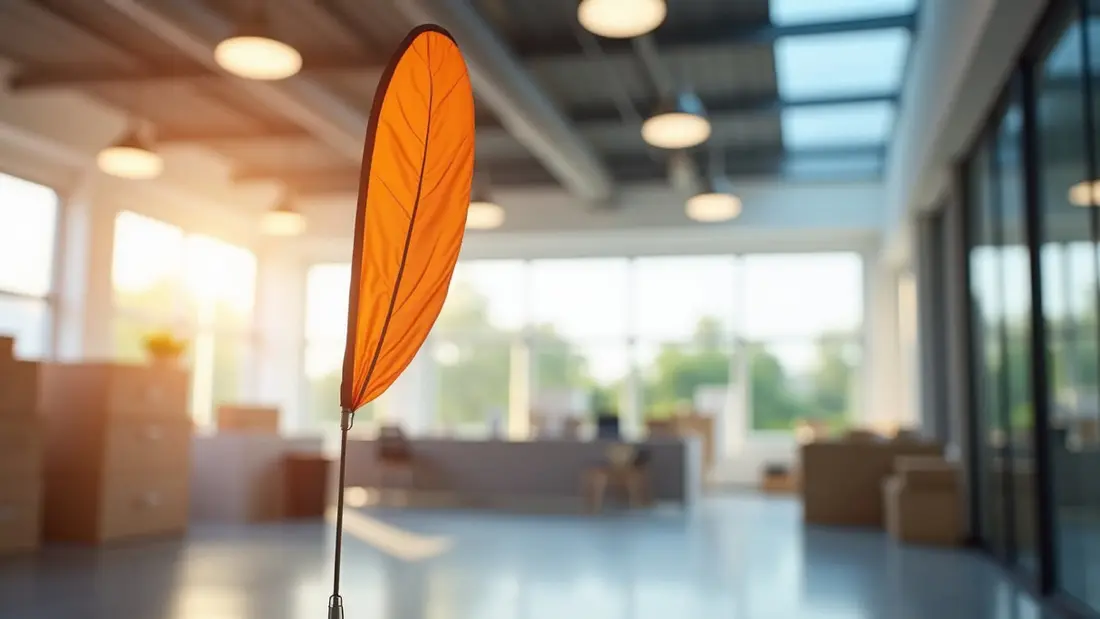
A feather flag is the sign people buy when nobody can find their business. The tenant at the back of a strip mall, the tax office two doors down from a nail salon, the dealership with a weekend event, the pop-up in a parking lot on Sherman Way. It works because it moves. A static sign competes with every other static sign on the block; a flag catching the wind is the only thing on that frontage doing something, and the eye goes to it at 35 mph whether the driver wants it to or not.
That is the whole appeal, and it is real. What people underestimate is that the printed fabric is the simple half of the product. The hardware, the mounting surface and the wind at your specific address decide whether the flag is still standing in October. We sell more replacement bases than replacement flags, which tells you where the failures actually happen.
What you are buying
A feather flag is three things sold as one: a printed polyester banner, a sectional pole, and a base. Our feather flags start at $172 for the complete kit, and the price moves with size and with whether you want one side or two.
The banner is knit polyester, printed by dye sublimation — the ink turns to gas under heat and bonds into the fiber rather than sitting on top of it. That matters outdoors. There is no ink layer to crack when the fabric snaps in the wind, and there is no coating to flake. The fabric stays soft, which is also why it flies instead of hanging like a vinyl banner would.
The pole is usually aluminum for the lower sections and fiberglass for the top, which is the part that has to bend. That flex is not a defect — a pole that bends is a pole that does not snap. The flag is sleeved onto it and tensioned with a cord at the bottom, so the fabric stays taut on the leading edge and free on the trailing edge.
Pick the size for the distance, not for the budget
Feather flags come in a range that runs from roughly 8 feet of total height up to about 17. The number to think about is not the flag, it is the sight line.
For a storefront where people are already on the sidewalk or already in the parking lot, the smaller sizes are fine — the flag is a marker, not a billboard, and it needs to say one word. For traffic on a four-lane road like Lankershim or Roscoe, go to the tall end. Ten feet of flag read from a car doing 40 mph with a driveway ninety feet ahead is barely two seconds of legibility, and half the flag's height is above the useful reading zone anyway.
Also check your overhead before you order the 17-footer. Awnings, gutters, low branches and the wires that cross most Valley parking lots are all in play. A flag that has to be tilted away from an obstruction is a flag that spends its life rubbing against something.
One side or two, and what "double sided" really means
A single-sided flag is one layer of fabric. The back is the same image reversed — readable, mirrored, and lighter in color because you are looking at it through the cloth. For a name or a logo people already know, that is often acceptable and it is the cheaper option.
A double-sided flag is two printed panels sewn together with an opaque blockout liner between them, so both sides read correctly and neither ghosts through. It costs more and it is noticeably heavier, which slows the flutter. If the flag sits perpendicular to the road so cars approach from both directions, double sided is worth it. If it stands flat against a wall or faces a single approach, it is money spent on a side nobody sees.
One thing to decide before you pay: a mirrored back is not a mistake, it is a physical property of a single layer of fabric. Tell us which one you want and we will set the file up accordingly.
Bases, and the mistake almost everyone makes
There are four common bases and they are not interchangeable.
A ground spike screws or drives into dirt or grass. It is the strongest option by a wide margin and it costs the least. If you have a planter strip, a lawn or an unpaved edge, use it and stop reading this section.
A cross base is a flat X of steel that sits on pavement. On its own it is not enough for anything over about ten feet in real wind — it needs the weight ring or plate that goes over the center. Buying the cross base and skipping the weight is the single most common reason a flag ends up lying in a parking space.
A water bag or sand bag ring is the portable answer: empty it weighs nothing, filled it holds the flag down. Water is convenient; sand is heavier per liter and does not evaporate or leak into the trunk. For an event you are tearing down the same day, water. For something semi-permanent, sand.
A tire base is a flat steel tongue you park a car on. It is the most secure pavement option there is, and it is the right call for a dealership or a lot where the flag stands next to parked vehicles all week.
Wind is the whole problem
Feather flags are built to flex, and up to a point wind is what makes them work. Past that point it destroys them in three specific ways: the fiberglass top section snaps, the sleeve tears at the top corner where the fabric loads hardest, or the base tips and the pole hits the ground.
Two Los Angeles-specific patterns to plan for. The first is the ordinary afternoon sea breeze that builds through the Valley from mid-morning, which is steady and survivable. The second is Santa Ana conditions in fall and winter — dry, gusting, and coming from the opposite direction to everything the flag has been living in. That is when flags go down. If a wind advisory is up, take the flag off the pole. It takes two minutes, it costs nothing, and it is cheaper than a new kit.
Corner buildings and gaps between two structures are worse than open lots, because the gap accelerates the flow. If your only spot is a wind tunnel between buildings, size down and weight up.
Artwork that still reads at 40 mph
Send vector art or a high-resolution file built at final size, with fonts outlined. Then cut what you wrote in half.
The usable canvas on a feather flag is a tall, narrow strip, and about the top third is what people actually see over parked cars. Put the one thing that matters there — OPEN, TAX, TIRES, GRAND OPENING, the logo. Phone numbers and addresses at the bottom of a flag are decoration; nobody is reading a ten-digit number off something that is moving.
Keep everything critical two to three inches clear of the pole edge, because that margin disappears into the sleeve. Avoid thin outlined type and avoid horizontal text set small — the shape wants big, vertical-friendly words. High contrast beats clever: dark type on a light field or the reverse, and no photographic backgrounds behind text.
When a feather flag is the wrong product
Indoors, a feather flag is usually a mistake. There is no wind, so it hangs limp and reads as a sagging vertical banner, and the base is a trip hazard in a booth aisle.
For a trade show or a lobby, the right answers are different products. A 3FT SEG fabric stand from $195 uses a silicone edge graphic pulled taut into an aluminum frame — flat, wrinkle-free, and the graphic is a washable printed panel you can swap without buying a new frame. A backdrop banner from $189.99 is the step-and-repeat wall behind the interview or the photo. And for the cheapest possible piece of portable signage that stands on its own indoors, a black stand retractable banner from $62.50 rolls into its own base and sets up in about fifteen seconds.
There is also a regulatory reason to check before you plant anything. Cities across Los Angeles County treat portable and freestanding signs in the public right-of-way very differently from signs on private property, and some restrict temporary banners and flags on private frontage too, by count or by duration. The sidewalk in front of your unit is generally not yours. If a flag is meant to live outside permanently, ask your city what is allowed, and if the answer is no, that is the point where a permanent mounted sign under signage and front signs becomes the actual solution rather than the expensive one.
Getting more than one season out of it
Take the flag down when it is not working for you. A flag flying twenty-four hours a day in full sun is being consumed by UV and abrasion the whole time, including the ten hours nobody is driving past. Shops that pull the flag at close routinely get years out of one; shops that leave it up get months.
Wash it when it gets grimy — cold water, mild soap, air dry, no bleach and no dryer heat. Polyester takes that fine. Check the sleeve seam at the top corner every few weeks; a small tear caught early is a repair, and a large one is a new flag. And store the pole in its sections rather than leaving it assembled in a hot truck bed, which is how fiberglass gets its permanent bend.
Buy a spare flag rather than a spare kit if you are running a location full time. The hardware outlives the fabric by a long way, and swapping just the banner is the cheap half of the purchase. It also lets you run a seasonal message without retiring the pole.
Angels Print prints feather flags, fabric displays, backdrops and retractable banners at our shop at 8511 Lankershim Blvd in Sun Valley, along with the rest of our digital printing work, for businesses across the San Fernando Valley and greater Los Angeles. If your artwork is ready, pick your size, choose single or double sided and order online. If you are not sure which base your pavement needs, how tall the flag has to be for the road out front, or whether your logo survives being set on a strip that narrow, call us at (818) 806-9006 or come by the shop with a photo of the spot and we will spec it with you before anything gets printed.