

September 2, 2026
Round Business Cards in Los Angeles: What the Circle Costs, What It Buys, and How to Set Up the File
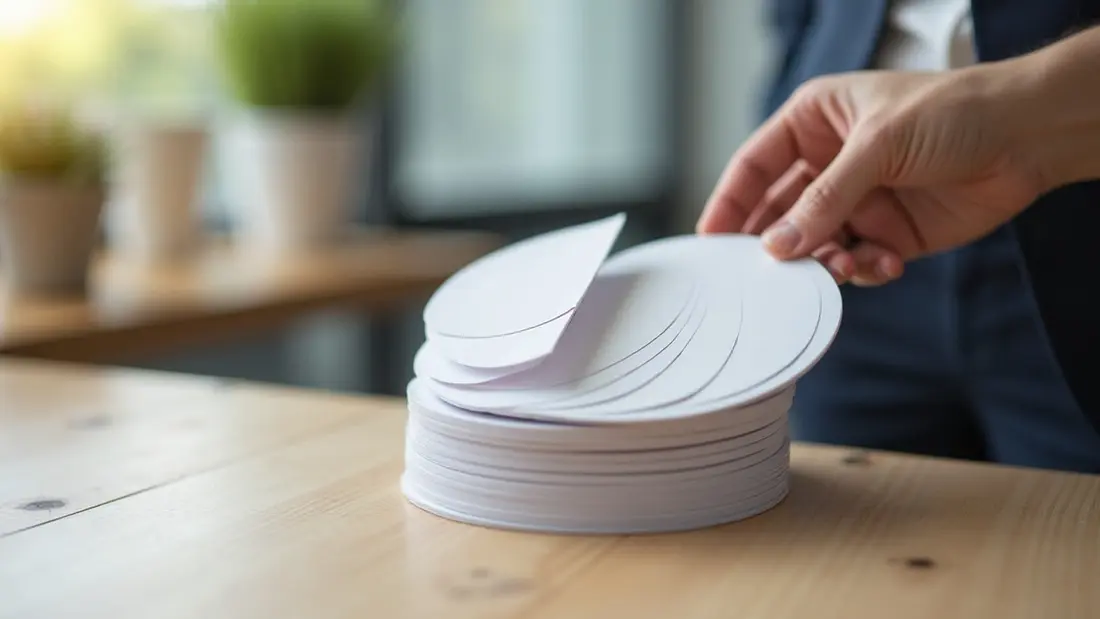
A round business card is the only card in the stack that does not look like a card. That is the entire pitch, and it is a real one: in a pile of forty rectangles collected at a mixer, the circle is the one that gets picked up and turned over. We cut these at the shop on Lankershim for salons, coffee roasters, tattoo artists, DJs, bakeries, wellness practices and a lot of one-person brands across the San Fernando Valley and greater Los Angeles. They work. They also have three specific downsides that nobody mentions until the box is open, and all three are decisions you make before the file goes to press, not after.
What "round" actually means on the cutting table
A rectangular card is trimmed. Sheets go through a guillotine, straight cuts, several cards deep, fast. A round card is not trimmed — it is punched with a die, the way a cookie cutter works, and the die is a physical object that has to be pressed through the stock. That is the whole reason for the price difference, and it is also the reason a round card behaves differently in every step downstream.
Two things follow from it. First, the cut edge on a circle is continuous, so any misregistration between your artwork and the die shows up as a crescent — a border that is 2 mm on one side and 4 mm on the other reads as sloppy in a way that the same drift on a rectangle never does. Second, there is no "straighten it up later." A rectangle can be recut a hair. A circle that landed off-centre is scrap.
Our round business cards start at $54.82, and the default run in the configurator is 50 pieces, which works out to $1.10 each. Size, stock and finish are chosen in the configurator, and the price moves with them.
Price: what the circle actually costs you
Set the two side by side at the same run of 50. Classic business cards start at $25.70 — $0.51 each. Round starts at $54.82 — $1.10 each. So the shape roughly doubles the per-card cost at the small end, and it is not a markup on prettiness; it is the die and the slower press-to-finished path.
Whether that matters depends entirely on how you hand cards out. If you are a contractor who leaves a card at every door on a street, doubling the unit cost of something you distribute by the hundred is a bad trade — print rectangles and spend the difference on more of them. If you are a stylist who gives out maybe fifteen cards a week, each one handed over with eye contact at the end of an appointment, the difference between fifty cents and a dollar ten is thirty dollars a year and it buys you the card people photograph. Be honest about which of those two businesses you are running.
There is also a middle path a lot of people miss: order round cards for the situations where the card is the introduction, and a cheap box of rectangles for the situations where the card is just a phone number. Nothing says you get one design.
The wallet problem, and who should ignore it
A circle does not sit in a card slot. It slides out of the pocket of a bifold, it will not stack neatly with the rectangles already in there, and a certain kind of person will be quietly annoyed by it. If your card's job is to live in a purchasing manager's wallet for eleven months until they need a quote, the round card is working against you.
But most cards do not live in wallets anymore. They get photographed and thrown away, or stuck to a fridge, or dropped in a bowl by the register, or handed straight to a partner. In all of those, the shape that does not stack is the shape that does not disappear. Pinned to a corkboard among rectangles, the circle is what the eye lands on. Decide which life your card is going to have before you decide its shape.
Designing for a shape with no corners
The hardest habit to break is designing a rectangle and then cropping it. A circle has no top-left, so a logo parked where the top-left would be looks like a mistake. Round layouts want radial or centred thinking: mark the centre, work outward, and let the shape do the framing.
Practical rules we apply to almost every round file that comes in:
Keep everything that matters well inside the edge. Your safe zone on a circle should be more generous than you are used to — the eye reads a curved edge crowding text as an error even when the cut was perfect. Give text a comfortable margin all round and resist the urge to fill the disc.
Avoid thin concentric borders. A ring of hairline rule set a few millimetres in from the cut is the single most punishing design choice on a die-cut circle, because it turns any drift into an obvious wedge. If you want a border, make it thick enough that a small shift is invisible, or bleed the colour off the edge entirely and skip the ring.
Set type on a horizontal baseline unless you have a reason not to. Text curved to follow the edge looks great on a coaster and terrible on something read at arm's length in a bar.
Use the back. A circle has less area than the rectangle you are used to, so trying to fit name, title, phone, email, address, website and two social handles onto one face will produce something nobody can read. Front: who you are. Back: how to reach you. That is usually the whole solution.
Stock, thickness and why a thin round card feels wrong
On a rectangle, thin stock reads as economical. On a circle, thin stock reads as a token, a raffle ticket, something punched out of a sheet — because that is exactly what it is. The shape already signals "object," and the hand expects an object to have some substance. A round card on light stock is the one variation of this product we see people regret.
Go heavier than you would for a rectangle, and treat that as part of the cost of the shape rather than an upgrade. A matte or soft-touch finish also does more work on a circle than on a rectangle, because there is more edge per square inch and the edge is what fingers find first. The stock and finish options live in the configurator, and if you want to feel the difference before committing, come by the shop and handle them — screens are useless for weight.
Files: how to send us a circle
Send vector artwork with fonts outlined, built in CMYK. Bleed matters more here, not less: extend any background colour or image well past the cut line all the way around, because a die that lands a fraction off on a circle will expose white on an arc, and an arc of white is much more visible than a sliver on one straight edge.
Do not draw the cut line as a black stroke in your artwork — tell us the finished diameter and we will handle the die. If your design depends on something aligning exactly with the edge, say so when you send the file, and expect us to talk you out of it. And if the only version of your logo is a small PNG pulled off Instagram, tell us up front; rebuilding it is a much better afternoon than discovering the softness after 250 cards are punched.
Colour: a rich background on a screen and a rich background under shop light are not the same thing, and a full-bleed dark circle shows handling marks that a light one hides. If a brand colour has to match something physical you already own, bring the physical thing in.
When a different shape is the better answer
Round is one option among several, and sometimes it is not the one you actually want. If the appeal for you is "not a rectangle" rather than "a circle specifically," die cut business cards start at $129.14 with a default run of 100 pieces — $1.29 each — and let the outline become the thing itself: a leaf, a bottle, a key, the silhouette of whatever you sell. That is a stronger move than a circle when your product has a recognisable shape, and at 100 pieces the per-card cost is close.
If the appeal is "people keep this," clear plastic business cards start at $92.60 — 50 pieces at $1.85 each — and do a different job: transparency, weight and a surface that does not crease or absorb a coffee ring. Plastic survives a glovebox and a toolbox in a way that any paper card does not.
And if you are working out a whole card programme rather than one order — a round card for events, a rectangle for volume, matching stock across both — that is our business card printing work, and the short-run colour behind all of it is digital printing, which is why a run of 50 is a normal order here rather than a favour.
Angels Print cuts round business cards, die-cut shapes, clear plastic and classic rectangles at 8511 Lankershim Blvd in Sun Valley, for businesses across the San Fernando Valley and greater Los Angeles. If your artwork is ready and you know the diameter you want, pick your stock and quantity and order online. If you are still deciding between a circle and a shaped die, or you want to hold the stocks before you commit to 250 of them, call us at (818) 806-9006 or bring your file to the shop and we will work it out before anything gets punched.