

September 4, 2026
Updated
Sticker Sheets in Los Angeles: Kiss Cuts, Sheet Layout and the Cheapest Sticker You Will Ever Print
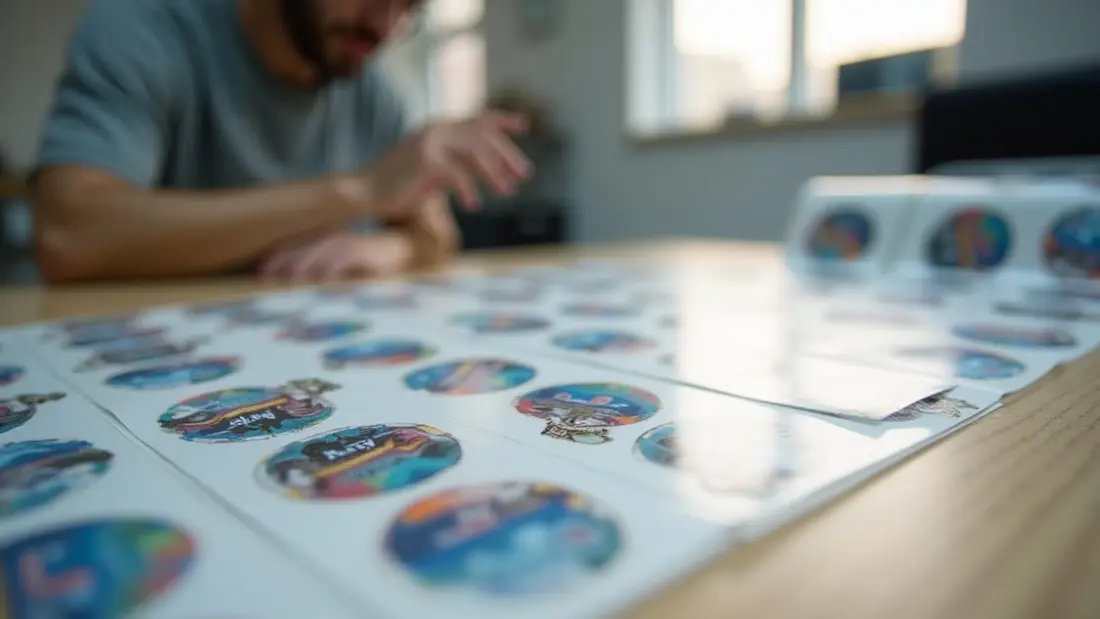
A sticker sheet is the format people ask us for last and should have asked for first. Artists at the Melrose and DTLA markets, coffee shops on Ventura, tattoo studios, bands with a merch table, Etsy sellers packing orders out of a Valley apartment — they all come in wanting die-cut singles, and about half of them walk out with sheets instead, because a sheet does the same job for a few cents a sticker and fits in a mailing envelope. We print these at the shop on Lankershim in Sun Valley, and what follows is what we actually tell people at the counter.
Kiss cut, die cut, and why the difference decides your price
A die cut goes all the way through paper and backing. You get a loose sticker with a shaped edge, and every unit is handled, counted and packed on its own. A kiss cut goes through the face material and stops at the liner, so the backing stays whole. That is the entire trick of a sticker sheet: many shapes cut on one rectangle of paper, sold and shipped as one object.
The price follows from that. Our sticker sheets start at $39.15, and the default run of 100 sheets works out to $0.39 per sheet. If your layout fits a dozen shapes on that sheet, you are printing twelve hundred stickers for under forty dollars — roughly three cents each. Compare that to die cut stickers, which start at $92.25, or $0.92 each at the default run of 100. That is not a markup we invented; a die-cut single is a cut, weeded, individually handled piece, and a sheet is one piece with cuts drawn on it.
So the honest rule is: if the sticker has to be handed out one at a time to a stranger — a hand-out at a trade show, a seal on a box, a logo for a laptop — you want a cut single, such as our individual custom stickers. If the stickers travel together as a set, go in a package, get sold as one item or get peeled off over time by the same person, you want a sheet. Kiss Cut Sticker Sheets put several designs on one backing, in White Matte Vinyl or White BOPP.
Laying out the sheet is the whole job
Everything that goes wrong with sticker sheets goes wrong in the layout, and almost none of it is visible on screen.
Leave a gutter. Shapes that touch each other leave the customer nothing to get a fingernail under. Keep an eighth of an inch of clear liner between neighbours, more if the shapes are small and fiddly, and keep a real margin around the outside of the sheet so the cut path never runs off the trimmed edge.
Bleed past the cut, or give the shape a border. The cut and the print are two separate operations, and they can drift by a hair. If your art stops exactly on the cut line, that hair shows up as a white sliver on one side. Either run the colour a couple of millimetres past the cut path, or draw a deliberate white keyline around each shape so a small shift lands inside the border and nobody can see it.
Draw the cut path as a path. Send us the cut line as a real vector path on its own layer, named so it is obvious. A dotted line drawn in Photoshop is a picture of a cut line, not a cut line, and we will have to redraw it — which means guessing what you meant on every corner.
Respect the small end. Shapes below about half an inch are hard to peel and easy to lift when the sheet flexes in transit. If the sheet is mostly tiny pieces, keep the corners rounded; sharp inside corners on small shapes are where a sticker starts curling before it is ever used.
Mix sizes on purpose. The best-selling sheets we print are not eight copies of one logo. They are one hero shape big enough to go on a water bottle, three or four mid-size ones, and a scatter of small marks filling the gaps. It reads as a set, and it uses the paper you already paid for.
Material and finish, decided by where the sticker ends up
Paper stock is cheaper and takes a pen, which matters if the sheet doubles as labels somebody writes on. It does not survive water. If a single sticker on your sheet is going on a laptop, a bottle, a car window, a helmet or a cooler, print the whole sheet on vinyl — one sheet, one material, and the weakest use case sets the spec.
Gloss makes colour look saturated and resists scuffs. Matte kills glare and photographs far better, which is the reason most sellers pick it: your sheet lives on a product listing before it lives on a laptop, and gloss shows every reflection of the room you shot it in. Matte with one gloss-varnished element is the trick when you want a logo to pop off an otherwise flat sheet — ask us about it rather than trying to build it into the artwork yourself.
Anything going outdoors, on a car window or into a Valley summer wants a laminate over the top. Unprotected ink in direct sun loses reds and deep blues first, and the sticker goes patchy long before the adhesive gives up.
Sheets, packs and singles are three different products
Do not think of these as tiers. They are answers to different questions.
Sheets are the everyday format: one flat item, easy to price, easy to ship, easy to include free with an order.
Packs are the retail format. Our custom sticker packs start at $170.13, with a default run of 25 at $6.81 each. That number looks steep beside a $0.39 sheet until you notice it is a finished, sellable object with more than one printed piece inside it — the thing you put on a market table with a price tag on it, not the thing you slip into an envelope.
Singles are for handing out and for anything that needs a shaped outer edge in the real world — a seal, a decal, a logo cut to its own silhouette.
Most shops we work with end up printing two of the three: a cheap sheet as a free add-in, and either packs or singles as the thing they actually sell.
The packaging question, since sheets are usually an add-in
Sheet stickers are the classic in-the-box extra, and the box matters. If you sell in person as well as online, custom shopping bags start at $230 for a default run of 50, or $4.60 a bag — worth doing the arithmetic on before you commit, because a printed bag walking down Ventura Boulevard is doing the same job as the sticker, for a customer who already bought.
Print the bag and the sheets from the same artwork in the same pass and the colours line up. Print them six months apart from two different files and they will not, and the person who notices is the one holding both.
Files, colour and what to send
Vector art, fonts outlined, cut path on its own named layer, built at final size. Build in CMYK. Neon greens, hot pinks and electric blues that glow on a phone screen are outside what four-colour process can hit on paper — they will print, but duller than your monitor promised. If a brand colour is non-negotiable, bring the physical thing in and let us look at it against a printed sample rather than matching to a screenshot.
Tell us the finished sheet size you want, or tell us the shapes and let us fit them. Sheet work sits under our sticker and label printing service, and the presswork behind it is ordinary digital printing — which is why short runs are viable at all. There is no plate to pay for, so a hundred sheets is a real order and not a favour.
Angels Print prints sticker sheets, die-cut singles, sticker packs and printed bags at 8511 Lankershim Blvd in Sun Valley, for artists, shops and small brands across the San Fernando Valley and greater Los Angeles. If your layout is finished and your cut path is drawn, pick your size and options and order online. If you are still deciding between a sheet and singles, or you want us to fit your shapes onto the sheet properly before anything is cut, call (818) 806-9006 or bring the artwork to the shop and we will lay it out with you first.